
Why the “Man Flu” Is a Desperate Cry for a Break
If you share a living space with a man, you know the ritual. It is as predictable as the tides, though significantly less majestic.
It begins with a subtle clearing of the throat, perhaps a slightly heavier sigh than usual while watching the evening news. A shadow passes over his face, a look of profound, existential concern. Within four hours, the transformation is complete. The highly functional adult male—who yesterday may have deadlifted twice his body weight, navigated complex corporate mergers, or fixed a leaking transmission on the side of the highway—has been reduced to a whimpering burrito buried beneath a duvet on the couch.
He is dying. He is sure of it. He needs soup, he needs the thermostat adjusted by exactly one and a half degrees, and he needs you to witness his suffering.
This cultural phenomenon, affectionately and derogatorily known as the “Man Flu,” is often treated as a punchline. It is the go-to example of male melodrama and a supposedly lower pain threshold. We roll our eyes, pass the extra-strength ibuprofen, and wonder how the species ever survived if the hunters dissolved into puddles of misery at the first sign of a runny nose.
But what if we have been reading the situation entirely wrong?
There is a compelling hypothesis floating around, one that sits at the fascinating intersection of sociology, evolutionary psychology, and hard-nosed immunology. It suggests that the “performance” of the man flu isn’t just about being wimpy. It is a subconscious, desperate attempt to secure a temporary “hall pass” from the exhausting, relentless burden of performing traditional masculinity. Furthermore, nature may have actually conspired against him, handing him an immune system that prioritizes brawn over biology.
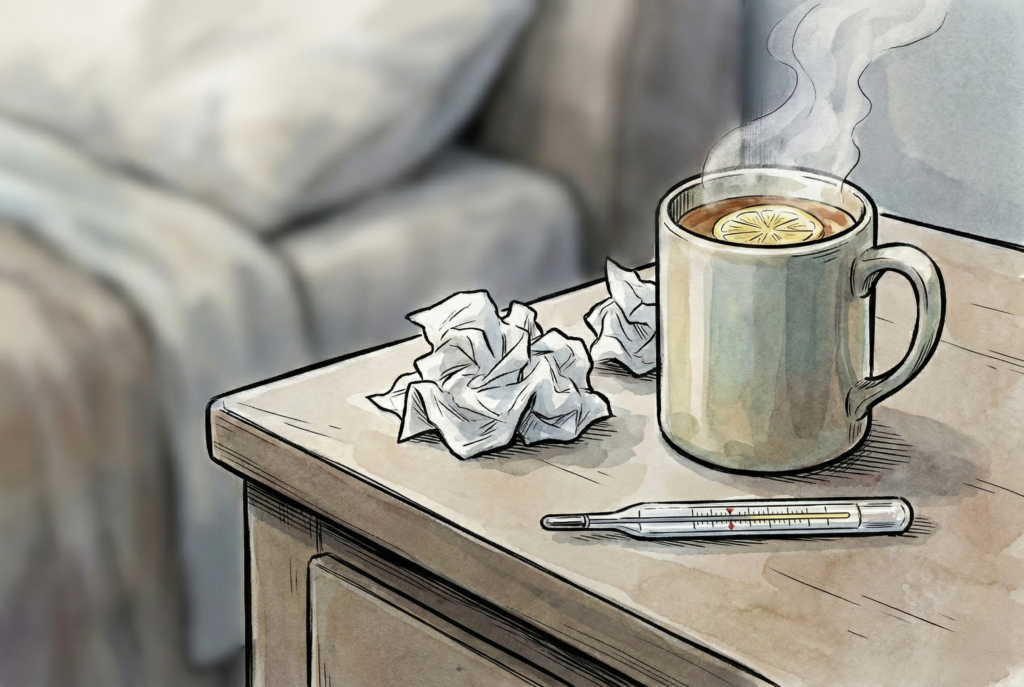
To understand the man flu, we must look beyond the pile of used tissues. We have to look at the heavy armor men wear every day, and what happens when they finally find an excuse to take it off.
The Heavy Armor of Everyday Life
To understand the psychology of the man flu, we first have to understand the baseline state of traditional masculinity. While gender norms are thankfully loosening in the modern era, the prevailing cultural script for “being a man” still leans heavily on stoicism, self-reliance, and emotional invulnerability. From the rough-and-tumble of the playground to the high-stakes environment of the boardroom, the message is consistent: Rub some dirt on it. Boys don’t cry. Toughen up. Be the rock.
This isn’t just outdated advice from a bygone era; it is a psychological load-bearing wall. Many men move through the world wearing invisible emotional armor. They are socialized to repress vulnerability, to view sadness as a malfunction, and to internalize stress rather than express it. They are the providers, the protectors, the ones who must remain calm when the house is on fire.
Maintaining this pose of invincibility is exhausting. It requires a constant, low-level burn of psychological energy to suppress the very human need to feel overwhelmed, scared, or just plain tired. It is a performance that never really ends. He cannot simply announce at the dinner table that he feels fragile today, because fragility is the antithesis of the role he has been cast in.
Until, that is, a rhinovirus shows up.
The “Sick Role” Loophole
In the mid-20th century, the sociologist Talcott Parsons developed a concept that he called the “Sick Role.” It is a brilliant framework for understanding how society deals with illness, and it is the key to unlocking the mystery of the man flu.
Parsons argued that being sick is a form of sanctioned social deviance. When you are genuinely ill, society agrees to grant you a temporary exemption from your normal responsibilities. It is a social contract. If you are sick, you are granted two specific rights. First, you are exempt from your normal duties—you don’t have to go to work, you don’t have to mow the lawn, and crucially, you don’t have to “be a man.” Second, and perhaps more importantly, you are not held responsible for your state. It is not your fault you caught the flu; you are a victim of biology.
For the armor-wearing male, the Sick Role is the ultimate loophole. It is perhaps the only culturally validated scenario where he is allowed to completely drop the act.
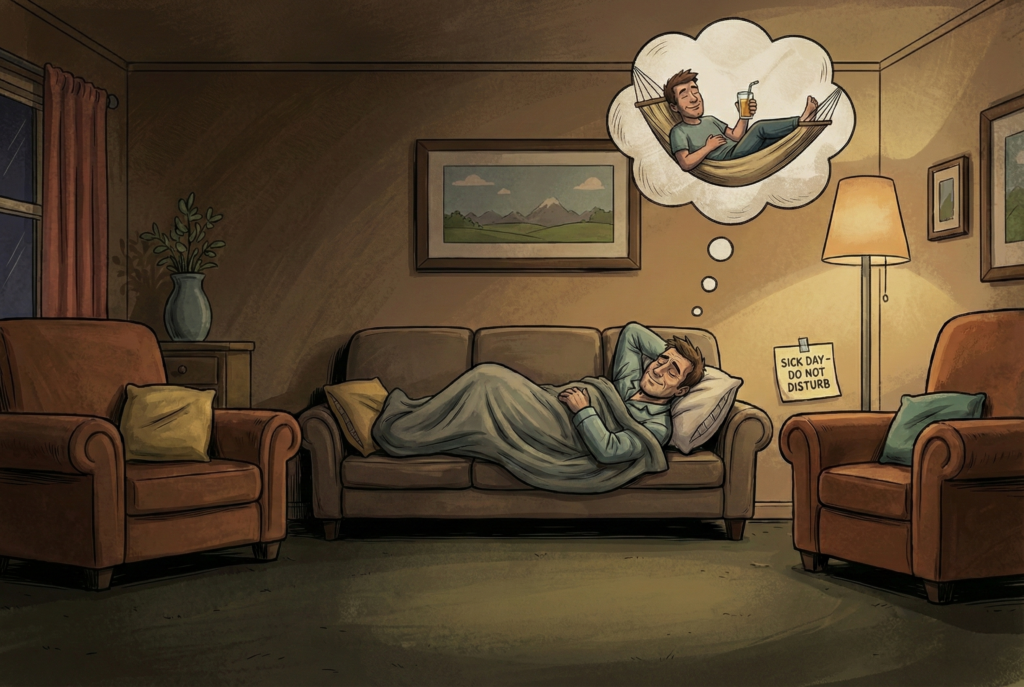
Consider the alternative. If a man says, “I had a really hard day emotionally at work, can I lay on the couch while you bring me tea?” he risks violating the code of toughness. He risks being judged by his peers, his partner, or even his own internalized critic as being weak or needy. But if a man says, “My throat feels like it is filled with broken glass and my body aches because a pathogen has invaded my system,” the judgment vanishes.
Biology has handed him an unimpeachable excuse.
This dynamic leads to the subconscious amplification of symptoms. If a mild sniffle doesn’t quite justify taking the day off from being “The Rock,” then the sniffle must be framed as the Black Death. The severity of the illness must match the severity of his need for a break. He isn’t necessarily lying; his brain is simply seizing the opportunity to offload the burden of stoicism, and it needs to make sure the excuse sticks. The louder the moan, the more legitimate the rest.
The Trojan Horse of Intimacy
There is another layer to this, one that is somewhat deeper and sadder. It is about the way men receive care.
In many cultures, there is a “compassion deficit” for adult men. While women often receive nurturing, physical touch, and emotional check-ins from friends and family as a matter of course, men’s social interactions are often shoulder-to-shoulder—doing an activity together—rather than face-to-face sharing of feelings. Men can become starved for non-sexual, nurturing touch. They crave the feeling of being cared for, the simple intimacy of having a forehead checked for fever, having a blanket tucked in, or being asked tenderly how they are feeling.
Because asking for this kind of nurturing directly feels forbidden by the rules of masculinity, illness becomes a “Trojan Horse” for intimacy. The man flu allows a man to solicit caretaking behaviors without having to admit emotional neediness. When he moans on the couch, he is essentially saying, “Please take care of me.” But because the request is wrapped in the guise of a physical ailment, it bypasses his own internal censors and society’s external judgments. It is a safe way to be held when you aren’t supposed to need holding.
The Plot Twist: The Science Says It Actually Does Hurt More
Up to this point, we have focused on the psychosocial drivers—the “why they might exaggerate it” aspect. It is a compelling narrative, painting the man flu as a psychodrama. But to be fair, and to maintain our commitment to scientific rigor, we have to admit a crucial piece of the puzzle that often gets overlooked: they might not actually be exaggerating that much.
In 2017, Dr. Kyle Sue, a clinical assistant professor at Memorial University of Newfoundland, published a review in The BMJ (British Medical Journal) literally titled “The Science Behind ‘Man Flu’.” His investigation moved the conversation from the living room to the laboratory, and his conclusion was vindicating for men everywhere. The concept isn’t just a myth; it is an evolutionary trade-off.
It comes down to the stark, hormonal differences in how male and female bodies manage immune responses.
First, we must look at the “Estrogen Advantage.” It turns out that estrogen is essentially an immune system supercharger. Research has shown that estrogen receptors are found on the surface of many immune cells, specifically T-cells, B-cells, and macrophages. When estrogen binds to these cells, it effectively gives them a pep talk, instructing them to work harder and faster. A study from Johns Hopkins University provided a striking visual of this mechanism: they found that estrogen compounds can directly hinder the replication of the influenza A virus in nasal cells. It acts as a biological blockade. Because women generally have more estrogen, they tend to carry a lower viral load during an infection. Less virus replicating in your body means fewer symptoms, less tissue damage, and a faster recovery time.
Then, there is the “Testosterone Tax.” Testosterone appears to be the culprit behind the misery. While it is great for building muscle density and secondary sexual characteristics, it comes with a heavy subscription fee: immunosuppression.
There is a biological theory known as the “Immunocompetence Handicap Hypothesis.” It suggests that testosterone dampens the immune system to allow the body to focus energy on other things, like mating efforts and aggression—traits that were historically useful for hunter-gatherer roles but are less helpful when you are fighting a respiratory virus in the suburbs.
We can see this tax being levied in a landmark study from Stanford University, which analyzed the immune response to the flu vaccine in men and women. The researchers found that men with higher circulating levels of testosterone had a significantly weaker antibody response to the vaccine. The testosterone seemed to interact with a specific set of genes involved in immune regulation, effectively telling them to “chill out” precisely when they should have been ramping up defenses.
So, when a man claims he is “dying,” his body is genuinely struggling to mount the same defense that a female body might mobilize with ease. He has a higher viral load and a weaker antibody response. Furthermore, studies in mice have suggested that males may have more temperature receptors in the preoptic nucleus of the hypothalamus—the part of the brain that regulates fever. This means that for the same viral load, a male might genuinely experience the symptoms of fever and body aches more acutely than a female.
The Synthesis: The Perfect Storm of Sniffles
So, is the “Man Flu” real biology, or is it a psychological performance to escape the pressures of masculinity?
The answer, like most things in human behavior, is not binary. It is a feedback loop.
It likely begins with biology. The man catches a virus. Due to his testosterone-dampened immune system and lack of estrogenic protection, the virus hits him slightly harder and faster than it might hit his female counterpart. He feels genuinely terrible.
Then, the psychological gateway opens. His brain recognizes the onset of illness. Subconsciously, it registers this as an opportunity to enter Parsons’ “Sick Role.” He realizes that the armor can finally come off.
This triggers the amplification effect. The genuine physical discomfort is compounded by the intense, subconscious relief of finally being allowed to rest and be cared for. He leans into the symptoms. He moans a little louder. He ensures the “hall pass” is validated by everyone in the vicinity because he needs to ensure the break lasts as long as possible.
The man flu is real, but not just because of the virus. It is real because the burden of toughness is heavy, and sometimes, you just need an excuse to put it down.
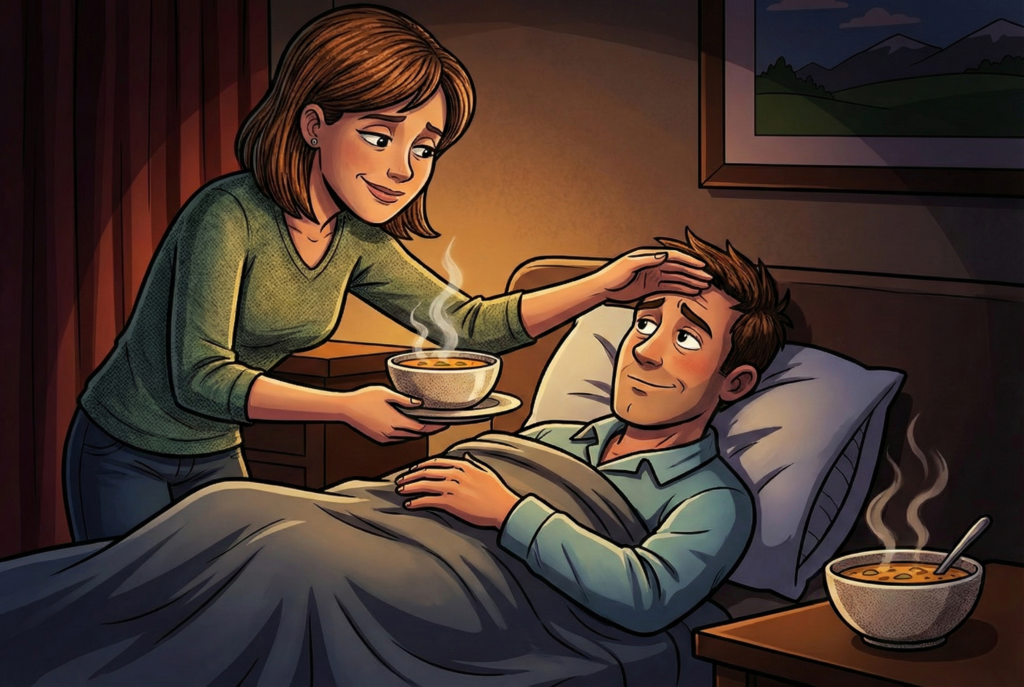
So, the next time the man in your life transforms into a sickly couch-burrito over a common cold, by all means, roll your eyes slightly. But then, perhaps bring him some soup. You aren’t just treating a rhinovirus; you are providing a rare moment of sanctuary for someone who thinks they always have to be strong. And besides, his T-cells are genuinely slacking off, so he probably really does need the help.

