
On Languishing and the Long Road Back to Joy
There is a specific, quiet kind of grief that arrives not with a bang, but with a fading. Through the tail end of my 40s, I felt very much like I was languishing—struggling for a sense of purpose that had once been as natural as breathing. For decades, my life had been anchored by a singular, consuming passion: the sport of Ultimate Frisbee. It wasn’t just a game; it was my identity, my social ecosystem, and my primary source of vitality. But as I moved through middle age, a combination of injury and health complications took that from me.
When I stepped off the field for the last time, I realized I hadn’t just lost a sport. I had lost the community that came with it. In my years of devotion to that one world, I had inadvertently let other friendships and hobbies wither on the vine. Suddenly, in my mid-40s, I found myself in a position that is statistically common for aging men but felt uniquely isolating: my community was dwindling, and my passions were non-existent. I had achieved the career goals I’d set out to reach, but no new milestones appeared on the horizon. Life felt heavy, flat, and fundamentally “stuck.”
Defining the Gray Zone
Sociologist Corey Keyes coined the term “languishing” to describe this exact state. It is the neglected middle child of mental health. It isn’t the presence of mental illness—you aren’t necessarily depressed or in a state of crisis—but it is the absence of mental wellness. It is the “blah” you feel when you look at your calendar and see nothing that sparks excitement. If flourishing is the peak of the mountain and depression is the valley, languishing is the vast, foggy plateau in between.
For me, it manifested as a gradual creep. I was going through the motions of a C-suite career, managing a technology group, and maintaining a home, yet I felt a profound lack of drive. The things that used to excite me felt like chores. I felt tired and lonely, a sentiment amplified by the “loneliness epidemic” that often hits men as they transition out of organized sports or high-intensity career building and into the more solitary years of middle age.
The Science of the Mid-Life Dip
If you find yourself feeling this way in your 40s, it is vital to understand that you are not an anomaly. You are, in fact, remarkably normal. Social scientists often refer to the “U-shaped happiness curve.” Across dozens of cultures, self-reported well-being tends to start high in youth, bottom out in the 40s or early 50s, and then rise again in later life.
There are several psychological theories that explain why this dip occurs. Erik Erikson, the developmental psychologist, identified the stage of mid-adulthood (ages 40 to 65) as the conflict between Generativity and Stagnation. Generativity is the urge to create or nurture things that will outlast us—to leave a legacy. Stagnation, on the other hand, is the feeling of being disconnected or uninvolved with society. When we reach the C-suite or the top of our respective mountains, we often experience a “plateau effect.” The “what’s next?” becomes a daunting question when the answer involves either staying put or taking risks that threaten the stability we’ve worked so hard to build.
Furthermore, the 40s are often the “sandwich years.” We find ourselves caring for aging parents while grappling with our own physical decline. In my case, having no children meant that the traditional path of generativity—passing things down to the next generation—required a more conscious, creative effort to define.
Navigating the Fog: Strategies for Recovery
Languishing is not a permanent state, but it does require intentionality to break. The transition from languishing to flourishing often begins with small, evidence-based shifts in behavior and mindset.
One of the most effective ways to combat the “flatness” is the concept of Flow. Flow, a term popularized by Mihaly Csikszentmihalyi, is the state of being so immersed in an activity that time seems to disappear. When we languish, we are rarely in flow; we are distracted, fragmented, and bored. Finding a “just-manageable challenge”—something that isn’t so hard it’s frustrating, but isn’t so easy it’s dull—can act as a bridge back to engagement.
Equally important is the rebuilding of social capital. For those of us who lost our communities to time or injury, the goal shouldn’t be to replicate the large-scale social circles of our youth, but to foster “high-quality connections.” This might mean moving away from large group settings and toward intentional one-on-one interactions. Research suggests that even small, positive social exchanges can release oxytocin and lower cortisol, helping to thin the fog of languishing.
Knowing When to Seek Help
While languishing is a distinct state from depression, the line between them can be porous. If the “heavy” feeling begins to interfere with your ability to function—if sleep, appetite, or the ability to care for yourself are compromised—it is time to seek professional support.
Seeking therapy or counseling is not an admission of failure; it is a strategic move for your long-term health. In my own journey, I initially resisted help, but I have come to see that talking to a professional provides a neutral ground to deconstruct the “stagnation” Erikson described. There is a profound strength in saying, “I am not in crisis, but I deserve to feel better than this.” Destigmatizing mental health support in mid-life is essential, especially for men who have been conditioned to believe that “feeling flat” is just the price of aging. It isn’t.
The Rediscovery of Joy
So, how do we find the light again? It begins by redefining joy. We often mistake joy for “happiness,” but happiness is often tied to external circumstances. Joy is an internal orientation. It is the quiet excitement that comes from connection, creation, or observation.
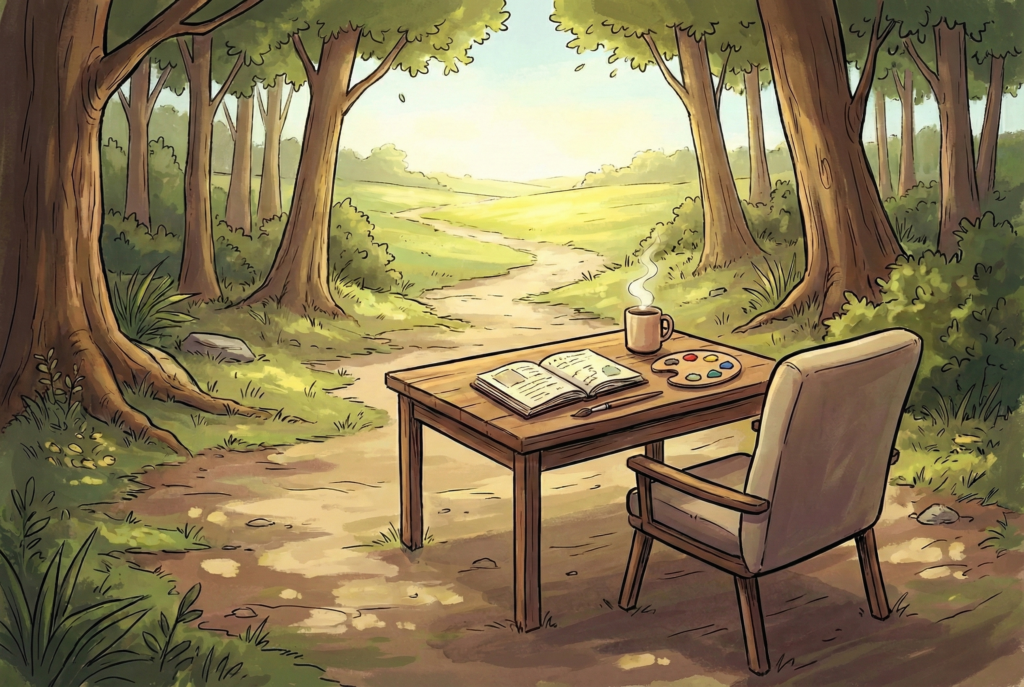
To rediscover joy, one must often look backward to look forward. Think about the things you loved before the world told you what you “should” love. For me, that meant returning to the tactile and the creative. I have begun to embrace writing and painting—activities that allow for a different kind of “flow” than the physical intensity of Ultimate. I have started spending more time in nature, moving through the woods of Mono not for the sake of competition, but for the sake of presence.
I am currently in this stage of the journey: the rediscovery. It is a slower process than the fast-paced victories of my younger years, but it is deeper. It is about trade-offs—trading the adrenaline of the field for the steady hum of a paintbrush or the clarity of a well-turned phrase.
A Final Note of Hope
If you are currently in the gray zone, know that the U-curve eventually turns upward. The heaviness you feel today is often the weight of a life that is being reconfigured. You are not “done”; you are in a chrysalis phase.
The goal isn’t to get back to who you were in your 20s. That person is gone, and that’s okay. The goal is to meet the person you are becoming. There is a quiet, resilient excitement waiting for you on the other side of this plateau. It starts with a single step: a single conversation, a single page written, or a single moment of noticing the light through the trees. You are still here, and there is still so much to create.

