
I’ve been fortunate enough to wander through the quiet, sun-dappled galleries of the Smithsonian, the gilded halls of the Hermitage, and the vast, echoing spaces of the British Museum. Whether it was in a small chapel in Portugal or a bustling wing of the Louvre, these spaces have consistently been my sanctuary. I love museums; they are the closest thing we have to a time machine, offering a visceral connection to human history that no photograph or textbook could ever hope to mimic. These visits have made me a better, more empathetic person, granting me a respect for global cultures I might never have encountered otherwise.
But as I’ve stood before wonders like the Rosetta Stone or the Benin Bronzes, my awe has increasingly been shadowed by a persistent, nagging question of privilege. I am a Canadian traveler enjoying the convenience of a one-stop shop for human history, but at what cost to the nations whose heritage has been transplanted to these Western vaults? I find myself torn. I believe that sharing and exposing different cultures is a vital human good, yet I recognize that we cannot continue to ignore the wars, pillaging, and colonial leverage that built these universal collections. To truly appreciate what we are looking at, we have to be willing to look at the ghosts in the gallery—the complex, often violent journeys these objects took to reach us.
Chapter 1: The Philosophy of Possession
For anyone who has stood beneath the glass pyramid of the Louvre or wandered the neoclassical halls of the British Museum, the sensation is unmistakable: it is a feeling of condensed time and space. I have felt this many times. In my travels across Italy, Portugal, Spain, and the United States—and within the halls of my home country, Canada—I have sought out museums as one might seek out shrines. There is a specific, quiet magic in seeing a 4,000-year-old artifact in person; it is a visceral connection that a photograph or a textbook can never replicate.
In these moments, I feel the weight of what I’ve learned. These institutions have made me a better person. They have granted me a deep respect for cultures I would likely never have encountered otherwise. From a purely educational standpoint, the Universal Museum is a miracle of convenience; it is not realistic for the average person to travel to fifty different nations to piece together the mosaic of human history. To see it all in one place is a privilege that fosters a unique, global empathy.
Yet, as I walk these galleries, that awe is increasingly shadowed by a nagging question of privilege. While I am being enriched by this proximity, is the source nation being left bereft? We find ourselves torn between two powerful, competing truths: Sharing and exposing cultures is essential to human progress, but so is the right of a culture to keep its own soul.
To understand how we reached this impasse, we must look at the two philosophical pillars that hold up the modern museum: Cultural Internationalism and Cultural Nationalism.
The Internationalist Ideal: The “Common Heritage of Mankind”
The defense of the large Western museum rests on the idea of Cultural Internationalism. This philosophy, championed by scholars like James Cuno, suggests that ancient artifacts do not belong to modern political states, but to the collective memory of humanity. This sentiment is echoed by modern political defenders of the model; as former UK Prime Minister Boris Johnson famously argued in defense of the British Museum, these institutions are ‘a unique resource for the world’ that ‘transcend national boundaries.’
The argument is that by housing an Egyptian statue in London or a Greek frieze in Berlin, we de-nationalize the object. It becomes part of a broader story. In this view, the museum is a “Lifeboat of Reason,” protecting history from the whims of local politics, war, or neglect. When I stand in the Smithsonian and see the sweep of human achievement, I am participating in this ideal—the belief that I am a citizen of a world that shares one long, complicated story.
The Nationalist Critique: The “Right of Soil”
On the other side of the marble wall is Cultural Nationalism. This view argues that an object’s meaning is inextricably tied to its provenance—the soil from which it sprang. When Napoleon took the Laocoön from Rome or the British took the Benin Bronzes from Nigeria, they didn’t just take art; they took the cultural patrimony of a people.
To the nationalist, the Universal Museum is merely a rebranding of the Imperial Museum. They argue that a culture cannot truly understand itself if its most sacred symbols are behind glass in a foreign capital thousands of miles away. The absence isn’t just aesthetic; it’s existential.
The Hidden Vaults and the Problem of Display
Perhaps the most jarring realization for the modern museum-goer is the scale of what is not seen. Most of the great museums only display about 1% to 5% of their total collections. The rest sits in dark, climate-controlled storage—warehouses of history that benefit no one.
This is where my own internal conflict finds a potential resolution. If the goal is truly universal education, why are these artifacts held so tightly by individual nations? If we have UNESCO World Heritage Sites—where the world agrees that a physical location like the Pyramids or the Rocky Mountains belongs to the global community—why can’t we have a similar designation for artifacts?
Imagine a future where the Universal Museum isn’t a fixed building in Paris or London, but a global circuit. A future where the wealth of history is shared through constant travel, ensuring that while an artifact is owned by the world, it spends significant time in the land that birthed it.
The Road Ahead
This essay is an attempt to reconcile these two halves of my experience: the grateful student and the uneasy guest. To do so, we must look back at how these collections were formed—not through the lens of modern ethics, but through the smoke of the wars that built them.
We begin with the man who invented the modern museum by turning the battlefield into a gallery: Napoleon Bonaparte.
Chapter 2: The Napoleonic Blueprint (The Louvre)
When I first walked through the Denon Wing of the Louvre, the sheer scale of the ambition took my breath away. It is a space designed to make the visitor feel small, an architectural manifestation of a universal vision. But as I moved from the towering Italian canvases to the Greek sculptures, I couldn’t help but think about the logistics of it all. How did one city come to hold the genius of so many others? The answer lies in the 1790s, with a young general named Napoleon Bonaparte who realized that to rule the world, he had to own its history.
Before Napoleon, museums were largely “Cabinets of Curiosities”—private, cluttered rooms where aristocrats showed off their wealth. Napoleon, a true child of the Enlightenment, had a different vision. He wanted to create the Musée Napoléon, a central repository for the cultural achievements of the human race. To Napoleon, France was the only nation enlightened enough to be the guardian of such treasures. As a Canadian visiting in the present time, I see the result of that conviction: a collection that feels like a map of a conquered Europe. It was a philosophy Napoleon summarized himself in a 1796 letter to the Directory: ‘All men of genius, all those who have attained a high rank in the republic of letters… are French, whatever be the country which has given them birth.’
The Industrialization of Looting
Napoleon did not just steal art; he industrialized the process. He understood that raw looting looked like thievery, so he sought to give it the veneer of legality and science. During his Italian campaigns, he didn’t just bring soldiers; he brought the Commission des Sciences et des Arts—a group of elite mathematicians, historians, and artists.
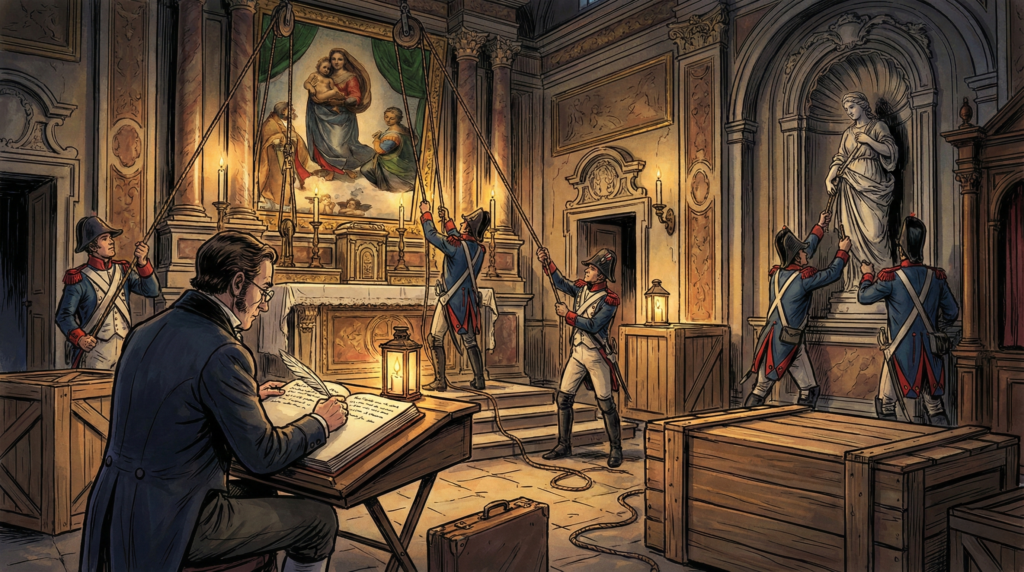
Their job was to identify the best of everything. While the soldiers secured the perimeter, the savants (as they were called) would enter churches and villas to catalog and crate masterpieces. I think back to my own travels in Italy—the quiet beauty of seeing an art exhibit in the Basilica Santa Maria della Salute in Venice or the Galleria dell’Accademia di Firenze in Florence—and I try to imagine a military truck pulling up to the door with a list of “required” items. It is a chilling image that complicates the beauty of the Louvre’s halls.
The Treaty of Tolentino: Plunder by Contract
To justify these seizures, Napoleon invented “Art Treaties.” The most famous of these was the Treaty of Tolentino (1797), signed by a desperate Pope Pius VI. Under the threat of total military destruction, the Pope was forced to gift one hundred paintings and statues to the French Republic.
This included the Apollo Belvedere and the Laocoön, works that had sat in the Vatican for centuries. By forcing the Pope to sign a contract, Napoleon could claim that the art wasn’t stolen—it was a legal reparation. This is a tactic we see throughout history: the victor using the law as a silencer for the cannon.
The Egyptian Expedition: The Birth of Egyptology
Perhaps the most audacious example of this scientific pillage was Napoleon’s 1798 campaign in Egypt. He brought 167 scholars with him. They mapped the pyramids, studied the flora, and—crucially—seized artifacts. The most famous spoil of this war was the Rosetta Stone.
While the British ultimately took the stone after defeating the French in 1801 (a spoil of a spoil—we’ll see this recurring theme again too), the French scholars produced the Description de l’Égypte, a massive multi-volume work that essentially birthed the modern field of Egyptology. Herein lies the “Lifeboat” paradox I struggle with: without Napoleon’s invasion and the subsequent removal of these items to European labs, would our understanding of ancient hieroglyphs have been delayed by centuries? Was the cost of the theft worth the gain in knowledge?
1815 and the First Great Restitution
When Napoleon was finally defeated at Waterloo in 1815, the “Great Restitution” began. The Duke of Wellington insisted that much of the art be returned to Italy and the Netherlands. It was a chaotic process—many pieces were too fragile to move, others were hidden by French curators, and some source countries simply didn’t have the funds to ship their heritage back home.
The Louvre we see today is a distilled version of Napoleon’s dream. It kept enough to remain the world’s premier museum, but the scars of its expansion remain visible to anyone who knows where to look.
Walking through those halls today, I am grateful for the universal access, but I am also aware that the museum’s foundations were laid in the mud of the battlefield. Napoleon proved that art is not just aesthetic; it is a form of currency, a symbol of dominance that is as powerful as any gold reserve.
Chapter 3: The Sun Never Sets on the Vitrine (The British Museum)
If the Louvre is a monument to the lightning-strike brilliance and ego of a single conqueror, the British Museum is something different: it is a slow-motion architectural ledger of an empire that once spanned a quarter of the globe. As a visitor from Canada, a nation born out of that same imperial expansion, I find the British Museum particularly resonant and particularly troubling. It feels like the family attic of the English-speaking world—full of treasures we inherited, but which we are increasingly realizing were never truly ours to keep.
Walking through the Great Court, you are surrounded by the physical evidence of the Empire. The British didn’t always see themselves as looters in the Napoleonic sense; they often viewed themselves as stewards, explorers, and saviors. They believed that by bringing the world’s heritage to London, they were placing it in a Universal sanctuary where it could be studied by the civilized world. But the gap between saving and seizing is often paper-thin.
The Elgin Marbles: A Study in Legal Erasure
The most famous—and arguably the most contentious—holdings in the museum are the Parthenon Sculptures, commonly known as the Elgin Marbles. In the early 19th century, Lord Elgin, the British Ambassador to the Ottoman Empire, removed about half of the surviving sculptures from the Parthenon in Athens.
Elgin’s defense, which the British Museum maintains to this day, was that he had a firman (an official decree) from the Ottoman authorities allowing him to remove them. He argued he was saving them from being ground into lime for mortar or damaged in the ongoing conflict between the Greeks and Turks.
However, for a Greek citizen—or for a traveler standing on the Acropolis looking at the empty, jagged scars where the friezes once sat—this isn’t saving. It is the removal of a nation’s heart. When I stood in the Parthenon gallery in London, the beauty of the marble was undeniable, but so was the clinical coldness of the display. The sculptures were designed to be seen under the harsh, brilliant sun of the Mediterranean, as part of a religious and civic structure. In London, they are specimens. This is the “Universalist” trade-off: we gain accessibility for the world, but we lose the soul of the site.
The 1897 Benin Expedition: The “Brutish” Museum
If the Elgin Marbles occupy a legal gray area, the Benin Bronzes are a matter of black-and-white military plunder. In 1897, a British punitive expedition was launched against the Kingdom of Benin (in modern-day Nigeria) after a British trade mission was attacked. The British military did not just retaliate; they dismantled the kingdom.
They looted thousands of intricately cast brass plaques and ivory carvings—works of art that shattered the then-prevalent European myth that Africa had no sophisticated history. These objects were sold off by the British Admiralty to pay for the costs of the war, ending up in museums across Europe and America.
When you see a Benin Bronze today, you aren’t looking at a discovery. You are looking at the spoils of a scorched-earth campaign. Geoffrey Robertson QC, a prominent human rights lawyer, famously stated: ‘The trustees of the British Museum have become the world’s largest receivers of stolen property, and the great majority of their loot is not even on public display.‘ Dan Hicks, a curator at the Pitt Rivers Museum, argues that the continued display of these items is a form of ongoing violence. It is a heavy thought to carry while wandering through a museum on a rainy afternoon: that the very floor you stand on was funded, in part, by the auctioning of a civilization’s sacred history.
The Rosetta Stone: The Spoils of the Spoils
The British Museum’s most famous resident, the Rosetta Stone, embodies the war and pillage theme perfectly. It was discovered by French soldiers during Napoleon’s Egyptian campaign. When the British defeated the French in Egypt in 1801, the stone was handed over to the British as a condition of the Treaty of Alexandria.
It is a spoil of a spoil. Egypt, the country that actually created the stone, was essentially a spectator in a game of imperial capture the flag. While I am profoundly grateful that the stone exists and was used to crack the code of hieroglyphs, I have to ask: does the fact that Britain won it from France give them a permanent right to keep it away from Cairo?
The “Universal” Justification
The British Museum’s defense is the Universalist argument: that if these objects were returned to their places of origin, the world would lose the ability to see the interconnectedness of human history. They argue that London is a neutral ground where an Egyptian statue can talk to a Roman bust.
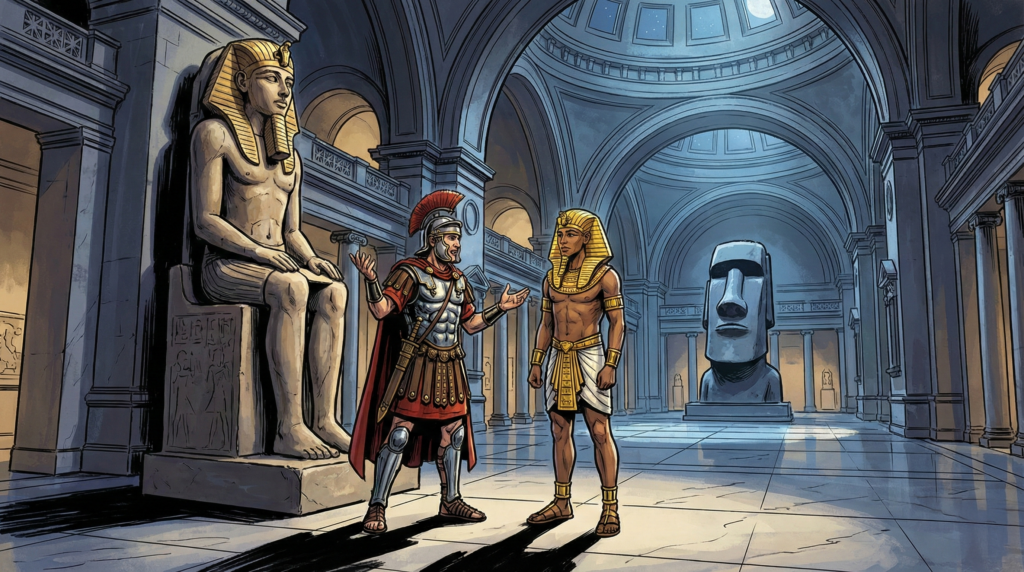
As someone who loves that dialogue between cultures, I see the value. But as a human being, I recognize the irony. We ask the nations that were pillaged to sacrifice their heritage so that we, the travelers of the West, can have the convenience of a one-stop shop for history.
Is the British Museum a gift to humanity, or a vault of the victors? Perhaps it is both. But as the 21st century progresses, the stewardship argument is beginning to feel more like an excuse for possession.
Chapter 4: The Esoteric Reich and the Soviet Retribution (The Hermitage)
If the Louvre is a monument to a single ego and the British Museum a ledger of empire, the State Hermitage Museum in St. Petersburg is a fortress of survival and retribution. My visit to the Hermitage was unlike any other museum experience. The Winter Palace itself is an artifact of staggering Romanov opulence, but as I walked through its three million items, I felt a different kind of tension. This is a collection that was nearly extinguished by one of history’s most hateful ideologies, only to be replenished by the spoils of that ideology’s defeat.
The story of the Hermitage’s pillage is not just about art; it is about the collision of two obsessive, totalizing regimes. To understand why the Hermitage holds what it does today, we have to look at the cultural war that happened alongside the literal one—a war fueled by Adolf Hitler’s obsession with the occult and the Soviet Union’s demand for a reparation in kind.
Hitler’s Ahnenerbe and the Hunt for “Power Relics”
Before the first shots of World War II were fired, the Nazis were already planning their own Universal Museum. Hitler envisioned a “Führermuseum” in his hometown of Linz, Austria—a facility that would house every masterpiece in Europe deemed Aryan-worthy.
However, Hitler’s interest went beyond aesthetics; it bordered on the esoteric. He established the Ahnenerbe, a pseudo-scientific research institute tasked with finding artifacts that proved Aryan superiority. They weren’t just looking for paintings; they were looking for “Relics of Power.” The prime example is the Heilige Lanze (the Hapsburg Spear), which Hitler seized from Vienna in 1838. Legend claimed that whoever possessed the spear that pierced Christ’s side would be invincible. To Hitler, museums weren’t just for education; they were armories of spiritual legitimacy.
During the invasion of the Soviet Union, the Nazis systematically looted or destroyed Russian cultural heritage. They didn’t just take art; they burned libraries and dismantled the famous Amber Room. When I stood in the Hermitage, I thought about the curators who lived through the 900-day Siege of Leningrad, sleeping in the basement to protect the crates. To them, these objects weren’t spoils—they were the only thing keeping the soul of their nation alive while they starved. I have seen the recreation of the Amber Room that was completed in 2003, but the original is lost to history. Is this a point in favour of the stewards?
Stalin’s “Trophy Brigades”
As the tide turned and the Red Army pushed into Germany, the Soviet Union retaliated with a level of organization that would have made Napoleon envious. They formed “Trophy Brigades”—specialized units of art historians and soldiers tasked with seizing German cultural property as compensation for the 27 million Soviet lives lost and the deliberate destruction of their own museums.
Millions of items were shipped east in “Trophy Trains.” For decades, the Soviet Union denied they had them. Masterpieces by Titian, Goya, and Renoir, as well as the legendary Priam’s Treasure (gold excavated from Troy), were hidden in secret vaults within the Hermitage and other facilities. They were “Trophy Art”—physical manifestations of a victory over a regime that tried to erase them from history.
The Moral Knot: Repatriation or Reparation?
In the 1990s, Russia finally admitted it held these treasures. This sparked an international firestorm. Germany wanted its heritage back. Russia’s response was blunt: No. The tension is often visible at the highest levels of diplomacy. During a 2013 spat with Angela Merkel, Vladimir Putin remarked: ‘We probably should not start a discussion now because people will appear on the Russian side who would evaluate the damage done to our art during World War II.‘
They argue that these objects are “Reparation in Kind.” Since the Nazis destroyed countless Russian artifacts that can never be replaced, the Russian government passed laws declaring these trophies to be federal property. As a visitor, this creates a profound moral knot. When I see an Impressionist painting in the Hermitage that was taken from a German bunker in 1945, am I looking at stolen art, or am I looking at a bill that was paid in blood?
The Human Toll of the Vault
What haunts me most about the Hermitage is the realization that pillage is often a cycle. The Nazis stole from Jewish families and European nations; the Soviets then stole from the Nazis. In the middle are the artifacts—silent witnesses to human cruelty and the desperate desire to own the spirit of the enemy.
The Hermitage reminds us that museums are often the final resting place of broken treaties and historical trauma. While I am grateful that the “Trophy Art” was preserved rather than destroyed, I recognize that its presence in St. Petersburg is a permanent scar of a war that humanity should never have fought. It is a museum of victory, but it is also a museum of deep, unresolved grief.
Chapter 5: The Lifeboat in the Strait (National Palace Museum, Taipei)
Of all the museums I have visited, I have yet to make it to the National Palace Museum (NPM) in Taipei. It may present the most challenging puzzle for my conscience. In the Louvre or the British Museum, the pillage narrative is clear: a stronger power took from a weaker or conquered one. But in Taipei, the story is internal—a family feud of civilizational proportions.
The Jadeite Cabbage—a small, intricately carved piece of Qing Dynasty jade that draws thousands of pilgrims daily—creates a strange sense of displacement. It is in Taiwan, yet it is the very soul of the Forbidden City in Beijing. This is a collection that wasn’t taken by a foreign invader, but by a retreating government fleeing its own people. It raises a question that haunts the modern era: Can you steal your own heritage if your goal is to save it from a fire you know is coming?
The 700,000 Crates: A Logistical Miracle
The story begins in 1948. As Mao Zedong’s Communist forces gained the upper hand in the Chinese Civil War, the Nationalist government (KMT) under Chiang Kai-shek faced a desperate choice. They were retreating to the island of Taiwan, and they were determined not to leave the ancestral heart of China behind.
What followed was one of the greatest logistical feats in cultural history. Curators and soldiers packed nearly 700,000 artifacts—paintings, calligraphy, jade, and bronze spanning 5,000 years of history—into thousands of wooden crates. They moved them by train, truck, and ship, often under bombardment, across the mainland and finally across the Taiwan Strait.
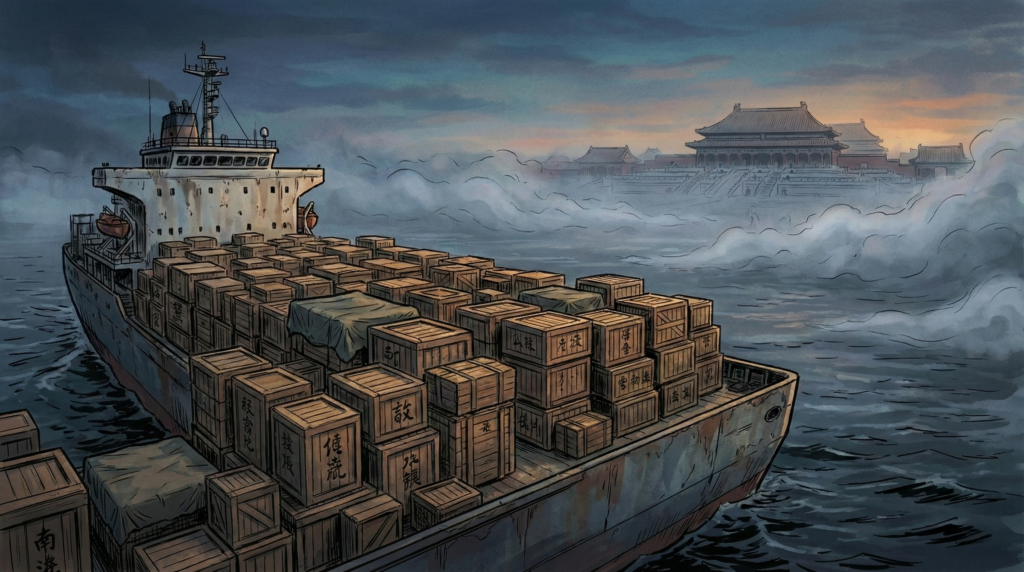
I think of my own home in Canada, and I try to imagine a scenario where we felt the need to pack the entire National Gallery into crates to move it to Newfoundland to keep it safe from a revolutionary fire. The scale of the desperation is hard to fathom.
The “Lifeboat” Justification: Salvation through Seizure
For decades, the KMT justified this taking as an act of Cultural Stewardship. They argued that they were the true guardians of Chinese culture and that the Communist Party was a cultural desert intent on destroying the past to build a Marxist future.
History, in many ways, vindicated their fear. During the Cultural Revolution (1966–1976), Mao’s Red Guards were unleashed with the mandate to destroy the Four Olds (Old Customs, Old Culture, Old Habits, and Old Ideas). Across mainland China, priceless artifacts were smashed, genealogies were burned as feudal remnants, and ancient temples were razed. While the treasures in Taipei sat in climate-controlled mountain vaults, their counterparts in Beijing were often being used as target practice or discarded as trash.
In this light, the NPM isn’t a museum of plunder; it is a civilizational lifeboat. If those 700,000 crates hadn’t crossed the strait, much of what they contained might now be dust. As a future traveler, I am grateful for the KMT’s foresight—I would like to see the pinnacle of Chinese artistry, and may only be able to because it was stolen from the path of destruction.
The “Stolen Soul” Argument
However, the People’s Republic of China (PRC) sees it very differently. To Beijing, the National Palace Museum is a monument to a great theft by a fleeing regime. They argue that a nation’s heritage belongs to the land and the people, not to a specific political party that happened to have the keys to the warehouse in 1948.
This creates a “Split Soul” for Chinese heritage. To see the best of China, you must go to Taiwan. To see the place where those objects were meant to live, you must go to Beijing. This separation is a form of cultural bereavement that persists to this day. It is a “Universal Museum” by accident—a collection that represents an entire civilization but is physically exiled from it.
The Dilemma of the Guest
Walking through the NPM, one would feel the privilege of the “Internationalist” most acutely. You would be seeing the best of the Forbidden City without the political constraints of the mainland. It would be convenient, educational, and breathtaking. But you should also feel the weight of the “Lifeboat” paradox.
If we accept that saving an object justifies taking it, we open a dangerous door. It is the same argument used by the British Museum for the Elgin Marbles. But who gets to decide when a culture is at risk? When does preservation become a pretext for possession?
The National Palace Museum teaches us that pillage isn’t always about greed; sometimes, it’s about a desperate, misguided love for a culture that is being torn apart. It is a museum of survival, but it is also a reminder that when a culture is fractured by war, the art is often the first thing to be sent into exile.
Chapter 6: The New Rome (The Pergamon and the Vatican)
In my travels through Europe, two cities stand out as the ultimate heirs to the Roman ideal of a global capital: Berlin and Vatican City. Both contain museums that do not just display art; they display architecture. Unlike the Louvre, which often feels like a gallery of captured moments, these institutions feel like captured places. Walking through them a person would experience a specific kind of vertigo—the realization that you are standing in a climate-controlled room in Europe, yet you are physically surrounded by the walls of ancient Babylon or the sacred relics of the Pacific Islands.
This is “Archaeological and Spiritual Imperialism.” It is the process of not just taking the genius of a people, but transplanting their very environment.
The Pergamon: The Altar on the Spree
Berlin’s Pergamon Museum is a marvel of Prussian ambition. In the late 19th and early 20th centuries, the German Empire was a rising power, eager to prove it was the “Third Rome” (a title now often associated with Moscow). They didn’t want statues for their mantels; they wanted the monuments of antiquity to serve as the literal walls of their capital.
Walking into the hall containing the Pergamon Altar, the effect is overwhelming. This is a massive 2nd-century BC Greek sacrificial altar. German archaeologists, with the permission of the Ottoman Empire, dismantled the entire structure in what is now Turkey and shipped it piece by piece to Berlin. The same was done with the Ishtar Gate of Babylon (a replica of which sits in the British Museum, though the original is at the Pergamon).
Standing before the glazed blue bricks of the Ishtar Gate, you can feel that familiar “Internationalist” awe. When I saw the replica, I was seeing the gates that Nebuchadnezzar once walked through. But the “Moralist” in me couldn’t ignore the displacement. This wasn’t a “discovery” of an abandoned site; it was a negotiation between empires. The Ottomans, in a state of decline, traded their history for German political and military favor. It was “Conquest by Contract.” Turkey and Iraq have both made claims for these structures, arguing that the “permission” given by an imperial power a century ago should not strip a modern nation of its architectural heritage.
The Vatican: The Spiritual Spoil
The Vatican Museums present an even more complex layer of acquisition. While the Vatican holds the “spoils” of the Renaissance—statues like the Laocoön that Napoleon once coveted—it also houses the Anima Mundi (Ethnological Museum).
This collection contains tens of thousands of indigenous artifacts from the Americas, Africa, and Oceania, many of which were sent to Rome by Catholic missionaries. For centuries, these were categorized as “gifts” to the Pope or “curiosities” of the mission field. However, the intricate masks and sacred carvings, beg the question: What does “gift” mean in the context of colonial conversion?
In many cases, these objects were surrendered by indigenous peoples as part of their conversion to Christianity—acts that were often performed under the heavy shadow of colonial rule. To the Vatican, these were symbols of the Church’s universal reach. To the descendant communities, they are often seen as spiritual spoils—the sacred items of their ancestors held by the very institution that helped dismantle their traditional way of life.
It is notable that Pope Francis has begun to acknowledge this, recently stating that restitution is necessary for objects taken during the colonial era. It marks a shift from the universal claim toward a human claim—an admission that the spiritual power of an object belongs to its people, not just its guardian. This is happening in my own country. In December 2025, 62 sacred and cultural objects from Inuit, First Nations and Métis communities that have been held in vaults thousands of kilometres away in the Vatican Museums were flown to Montreal, including a Inuvialuit kayak.
The Burden of Being the Center
Berlin and the Vatican were built to be centers of the world. Their museums were designed to prove that all roads led to them. As a Canadian visitor, I would benefit from this centralization—I can see the Ishtar Gate and the Sistine Chapel in a single European trip.
But the New Rome model is fragile. It relies on the idea that one place is safer or more important than another. As the world becomes more multipolar, the idea that a blue-brick gate from Iraq is better off in Berlin is becoming harder to defend. These museums taught me that power isn’t just about who wins the war; it’s about who gets to rebuild the world in their own image, using the stones of the vanquished.
Chapter 7: The Spoils of Capital (The Met and The Smithsonian)
As a North American, my visits to the great museums of the United States—the Metropolitan Museum of Art (The Met) in New York and the Smithsonian Institution in Washington, D.C.—the weight of power is no less present. In the U.S., the “Universal Museum” was built through a unique American alchemy: capital and conquest.
The Gilded Age: Looting by Checkbook
The Met is perhaps the world’s greatest monument to the power of the checkbook. During the Gilded Age of the late 19th and early 20th centuries, American industrial titans—J.P. Morgan, Rockefeller, Hearst—amassed fortunes that dwarfed the dwindling coffers of the European aristocracy. They didn’t need to invade Italy; they simply waited for the Italian dukes to go bankrupt and then bought their ancestral galleries.
This was a different kind of pillage—a market-driven transfer of heritage. While it lacks the violence of Napoleon, it shares the same result: the concentration of cultural wealth in the hands of the most economically dominant power. As I walked through the Met’s European Sculpture Court, I felt the Internationalist gratitude of seeing the Old World’s finest works a subway ride away from Central Park. But I also recognized that this was the result of an industrial war—a century of economic dominance that allowed America to vacuum up the history of other nations.
The Smithsonian and the “Scientific Spoils” of the Frontier
If the Met represents the spoils of capital, the Smithsonian represents the spoils of internal expansion. While the U.S. was not an overseas empire in the same sense as Britain, its westward expansion was a colonial project of its own. Much of the Smithsonian’s early anthropological and ethnographic collection was gathered during the Indian Wars.
Collectors and scientists followed the U.S. military into the American West. They treated indigenous cultures as vanishing races, a narrative used to justify the seizure of sacred objects, genealogies, and even human remains. This was “Scientific Colonialism”—the belief that these artifacts were better off in a museum drawer in D.C. than in the hands of the people who created them.
In my own country, Canada, we grapple with a similar history. The realization that our national collections were built on the disenfranchisement of Indigenous peoples is a painful, necessary reckoning. In the USA, this led to NAGPRA (Native American Graves Protection and Repatriation Act)—a legal mandate for the return of ancestors and sacred items. Canada’s path, however, has been less a single law and more a shifting ‘patchwork’ of policy. While we have passed the United Nations Declaration on the Rights of Indigenous Peoples (UNDRIP) into law, we still lack a dedicated federal Repatriation Act. Instead, the burden often falls on individual museums to navigate voluntary standards, such as those in the 2022 Moved to Action report. We are currently in a transition from a ‘gift-based’ model of cooperation to a ‘rights-based’ model of restitution—an admission that our greatness was built on a foundation of theft, and our future depends on the courage to let go.
The Temple of Dendur: The Diplomatic Spoil
The Met also houses one of the most remarkable examples of Diplomatic Spoils: the Temple of Dendur. This entire Egyptian temple was gifted to the United States in 1965 by the Egyptian government. It was a gesture of thanks for American help in saving ancient monuments from the rising waters of the Nile caused by the construction of the Aswan High Dam.
When I stood inside the Sackler Wing, watching the sun set over the temple’s sandstone through the Met’s massive glass walls, the Universalist in me was deeply moved. It is a masterpiece of preservation. But the Moralist asks: Is a gift given in a moment of crisis truly a gift? Egypt was facing the literal drowning of its history; they traded one temple to save many others. It is a sophisticated form of soft-power acquisition—the New World saving the Old World, and keeping a piece of it as a trophy of its benevolence.
The New World’s Dilemma
The American museums teach us that you don’t need a bayonet to acquire a world-class collection; you just need enough leverage—whether economic, scientific, or diplomatic. For a traveler, these institutions offer an unparalleled education. But they also force us to confront the fact that even in peaceful acquisitions, there is often an imbalance of power.
We are left with the same conflict I feel at every stop on this journey: I am a better person for having seen these things, but I must acknowledge that my enlightenment was bought with someone else’s loss.
Chapter 8: The Great Reckoning (Restitution and the Future)
Proponents of the status quo argue that museums provide a safe haven for objects that might be destroyed in conflict-prone regions. They cite the destruction of Palmyra by ISIS as a reason for centralized, Western stewardship.
As I look back on my journeys through the marble corridors of the world’s Universal Museums, I realize that we are living through a pivot point in human history. The spoils of war model, which has stood since the time of Napoleon, is cracking. We are entering the era of the great reckoning.
In my home in Canada, and during my travels abroad, the conversation has shifted. It is no longer enough to simply admire the beauty of a Benin Bronze or an Elgin Marble; we are now compelled to look at the ghost of the person who once owned it, and the void left in the culture that lost it. My own internal conflict—the Universalist who loves the access and the Moralist who mourns the theft—is mirrored in the global debate currently unfolding in boardrooms and government offices.
The Sarr-Savoy Report: A Seismic Shift
The landscape of the museum world changed forever when French President Emmanuel Macron stated in his landmark 2017 speech: “I cannot accept that a large part of cultural heritage from several African countries is in France.” In 2018, he then commissioned a report by academics Felwine Sarr and Bénédicte Savoy. Their conclusion was radical: they recommended that any objects taken without consent from African nations during the colonial era should be returned.
This was a direct challenge to the stewardship argument. Sarr and Savoy argued that a large part of the cultural heritage of an entire continent is currently being held hostage in Europe. Since that report, we have seen the first major trickles of restitution—France returning statues to Benin, and Germany returning Benin Bronzes to Nigeria. The Universal Museum is no longer an unquestionable fortress; it is now a negotiator.
Digital Restitution: A Virtual Solution?
As a technology-literate traveler, I find the prospect of Digital Restitution fascinating. We now have the ability to 3D-scan artifacts with sub-millimeter precision. Some museums are proposing that they return the physical soul of the object to its home country while keeping a high-fidelity digital twin or 3D-printed replica for the Universal audience.
While this solves the problem of accessibility, does it solve the problem of magic? As I mentioned at the start of this essay, there is a visceral power to being in the presence of the actual object—the very stone carved by an ancient hand. A 3D print, no matter how perfect, is a ghost. If the Universal Museum becomes a gallery of replicas, will it still have the power to make us better, more empathetic people? Personally – I think it might. Many of the dinosaur bones I’ve seen in museums are plaster cast copies of the actual bones stored in vaults – but the look on a child’s face when they see a dinosaur standing in front of them shows that the magic still exists.
The Vision: From Owners to Stewards
Perhaps the conclusion is not to empty the museums, but to change their DNA. The most compelling idea I’ve encountered—and one that eases my own torn conscience—is the transition from ownership to stewardship.

Imagine a future where the British Museum doesn’t own the Rosetta Stone, but acts as its custodian on a rotating basis. Imagine a world where the hidden 95% of museum collections are not sitting in dark basements, but are constantly on the move, traveling to the countries that birthed them and to new nations that have never seen them. The museum of the 21st century cannot be a cemetery of dead cultures; it must be a laboratory of living ones.
Final Thoughts: The Gift of the Guest
I will never stop visiting museums. They are the closest thing we have to a time machine, and they have given me a respect for the human spirit that I carry with me every day. But I no longer visit them as an uncritical guest.
The greatness of the Louvre, the Hermitage, and the Smithsonian was indeed built on the spoils of war and the leverage of capital. We cannot change that history, but we can change how we respond to it. The future of the museum must be one of Radical Transparency. Every display should tell two stories: the story of the object’s creation, and the story of its journey—including the violence or privilege that brought it to the gallery.
True Universality isn’t found in a building that holds everything; it is found in the willingness to share. By letting go of the need to possess history, these great institutions might finally become what they have always claimed to be: bridges to a shared, global understanding.
Recommended Reading
Cuno, James. Who Owns Antiquity? Museums and the Battle over Our Ancient Heritage. Princeton University Press.
If you value the ability to see the “story of humanity” in one place, this is your manifesto. Cuno, a former director of the Art Institute of Chicago, argues that artifacts belong to the world, not to modern nation-states. He makes the case that museums protect these treasures from the whims of local politics and nationalism.
Why read it: To understand the most sophisticated intellectual defense of the Louvre and the British Museum.
Hicks, Dan. The Brutish Museums: The Benin Bronzes, Colonial Violence and Cultural Restitution. Pluto Press.
Focusing on the 1897 sacking of Benin, Hicks—himself a curator—redefines the museum not as a place of education, but as a “weapon of war.” He argues that the continued display of looted items is an act of ongoing violence and that the only ethical path forward is a total return of colonial spoils.
Why read it: To challenge your perspective on “stewardship” and see the museum through the eyes of the cultures left bereft.
Nicholas, Lynn H. The Rape of Europa: The Fate of Europe’s Treasures in the Third Reich and the Second World War. Knopf.
This is the definitive history of the Nazi obsession with art and the subsequent Soviet “Trophy Brigades.” It explains how the map of European museums was redrawn by the most brutal conflict in history.
Why read it: To understand the “blood on the walls” of the Hermitage and the strategic value of art in total war.
Waxman, Sharon. Loot: The Heritage of Plunder and the Theft of the World’s Museum Treasures. Times Books.
A former New York Times reporter, travels from the Met and the Louvre to the source countries demanding their history back. Her writing mirrors the modern traveler’s experience—balancing the thrill of the gallery with the uncomfortable reality of its provenance.
Why read it: For a narrative-driven, journalistic look at the “tug-of-war” over the world’s most famous antiquities.

