
The Great Isolation: Six Months In
The rhythmic, visual loop of the ceiling fan was the first thing Dave noticed—the familiar vibration in the air was gone, but the sound inside his head had never been louder. He lay there, head pressed into the pillow, listening to the thumping of his carotid artery against the foam. It was a heavy, industrial sound, like a piston in a deep well.
For Dave, the world hadn’t turned off. It had simply changed channels. Having been born profoundly deaf, the Great Isolation as they called it—now entering its sixth month—had been an unexpected gift. Where others had plummeted into madness, terrified by the sudden loss of the world’s voice, Dave had found his own. He could hear the wet slide of his tongue against his teeth and the low-frequency hum of his nervous system. For the first time in fifty years, he wasn’t living in a void; he was living in a symphony of his own anatomy.
He sat up. The bedsheets didn’t rustle—or rather, they did, but the sound didn’t travel through the air to his ears. Instead, he felt the friction in his joints, a subtle grinding of bone and cartilage that he now recognized as the music of movement.
Below, on the street, the city had settled into a grim, visual ballet. It had been 180 days since the air had stopped carrying sound to human ears. The initial chaos—the screaming, the car horn protests, the frantic sirens—had long since faded. Most people had realized that screaming only deafened themselves with the roar of their own vocal cords. Now, they moved in a practiced, eerie stillness.
The Burden of the Witness
Three miles away, Sonia was huddled in the corner of a subway station. She wore heavy industrial earmuffs, but they were useless against the weight of the sound.
The world was not silent. To her, it was a mechanical graveyard. Because no one could hear the warning signs of friction or failure, the city was literally grinding itself to pieces. She heard the screech of metal on metal from a distant elevator with a dry bearing; she heard the hiss of a gas leak two blocks away that no one would ever find.
Sonia was the only receiver left that she knew of. In the first few months, she had tried to be a guardian.
Days after the whole world stopped listening, Sonia had stood outside a hospital window, paralyzed by the sound of a medical monitor. A rhythmic, piercing beep-beep-beep was echoing through the glass of the neonatal ward. Inside, a nurse was gently rocking a bassinet, her mouth moving as she sang a lullaby she could actually hear. But she couldn’t hear the monitor. She couldn’t hear the alarm telling her the infant’s oxygen had dropped. Sonia had hammered on the glass, screaming “Look at the red light! Listen to the beep!” but to the nurse, Sonia was just another frantic shape in the window, her voice just more background vibration in a world that had gone mute.
A few weeks after that, she was walking through the financial district. She had heard the structural moan of a construction crane. High above the street, a steel cable was fraying, the individual strands snapping with the sound of pistol shots—ping, ping, ping. A dozen people were walking directly underneath it. Sonia had tried to bar their way, spreading her arms to stop them, but they had simply pushed past her, muttering their own internal monologues. They couldn’t hear the metal screaming under the tension. When the cable finally gave way, the sound of the steel whip-cracking through the air was the loudest thing Sonia had ever heard, followed by a silence that wasn’t silent at all—just the sound of her own horrified gasping while the survivors kept walking, oblivious to the thud and trauma behind them.
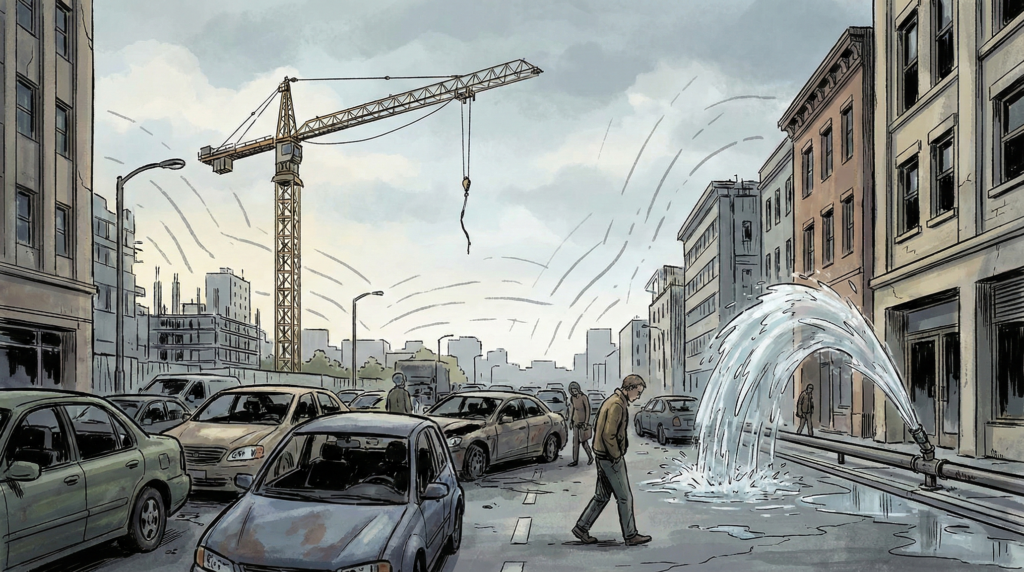
She was shaken from her memories by a stranger colliding with her. “I think I’m dying, I think I’m dying, I think I’m dying!” a businessman screamed into his dead cellphone as he brushed past her. “Don’t forget the 2% milk, the blue carton, not the red!” a woman shrieked at a pigeon.
Sonia looked at them and realized it had taken less than six months for the isolation to undo a world unprepared for the sound of its own voice.
She lived in a state of constant auditory trauma. The sound of the city’s mechanical failure was even worse than the people. Without the feedback loop of human hearing, machines were being run into the ground. Brakes squealed until they fused; fire alarms in distant buildings wailed for hours because no one bothered to reset them.
Sonia wore heavy industrial earmuffs, but the noise pierced through. It wasn’t just sound; it was the weight of a billion unreceived messages. She stumbled toward the park, seeking the open air, hoping the trees might swallow some of the din.
The Silent Concerto
The violin music was the only thing holding the park together. To the crowd, the girl was a statue in motion, her bow a silent blur of horsehair and wood. But to Sonia, she was playing Bach’s Chaconne with a ferocity that made the very air ache.
She pulled her earmuffs down around her neck. The roar of the city rushed in like a tidal wave—a thousand overlapping monologues—some whispered, some screamed. The distant crash of a fender-bender and the sigh of the wind—but through it all, the elegant clean notes of the violin.
It wasn’t perfect. Without the feedback of the air, the girl’s intonation was wandering; the notes were sharp and strained, a fraction of a semitone off. The violinist was pressing her jaw with bruising force into the chin-rest, desperate to feel the vibrations of the wood through her mandibles. She was trying to hear the Bach through her skull.
Sonia stood twenty feet away, her hands over her ears, trying to filter the beautiful, flawed notes from the ambient roar of a dying city.
Then she saw the man.
He was Dave. He was standing near the violinist, his expression one of profound, peaceful focus. He wasn’t muttering a grocery list. He wasn’t twitching. He stood with the grounded stillness of someone who had navigated silence his entire life. He was watching the girl’s fingers, his eyes tracking the geometry of the music with a steady, quiet reverence.
“You’re doing great,” Dave said.
His voice was a low, resonant baritone. Because he had been deaf his whole life, he didn’t know how to modulate for an audience, but he knew the feel of his own throat. To Sonia, it was the first human conversation she’d heard in weeks that wasn’t a panicked self-monologue.
She lunged toward him. Dave didn’t hear her boots on the gravel. He didn’t hear the rustle of her coat. When she grabbed his shoulder, he didn’t jump with the predatory fear of the newly deaf. He turned slowly, his eyes scanning her face with a calm, practiced habit of lip-reading.
“I can hear her!” Sonia screamed.
The sound tore through her own throat, but the air between them was a graveyard. Dave saw her mouth open—the wide, dark pit of her desperation—and he saw the tears, her face distorted by a sob.
He didn’t hear a word. The air remained a vacuum.
Dave looked at her, and for the first time in months, Sonia saw pity instead of panic. He raised a hand, gently miming the sign for peace.
“I can’t hear her either,” Dave said, his voice vibrating clearly in his own chest, “or you,” he continued sadly. “I’ve never been able to hear you. But I can feel that you’re sad.”
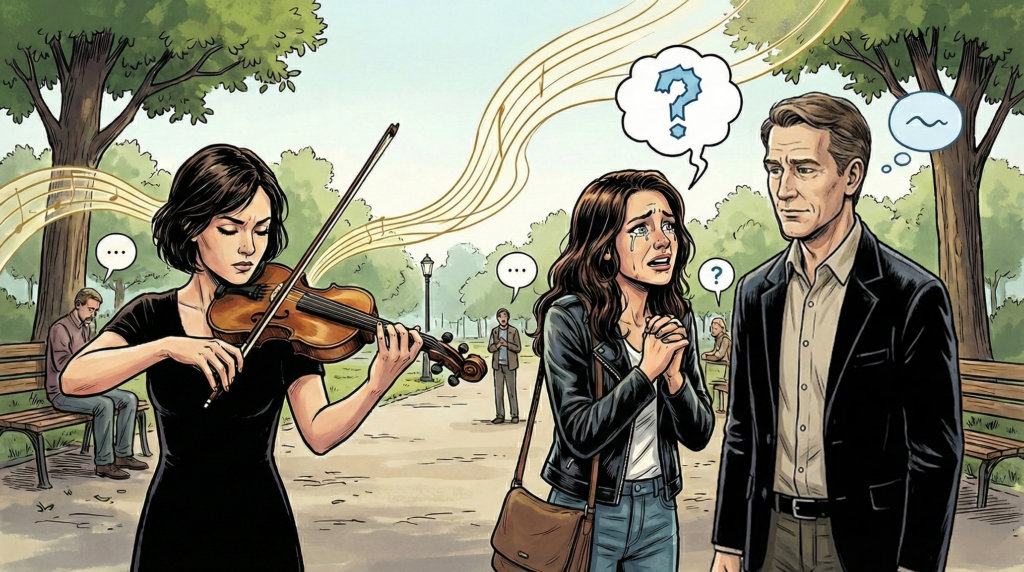
Behind them, the violinist reached the final, haunting chord. She pulled the bow across the strings one last time, a movement of pure, silent grace. Sonia heard the note linger in the air—a perfect, golden thread of sound. She turned back to the performer, and Dave’s gaze followed hers.
Dave watched the girl lower her violin. He didn’t hear the note. He didn’t hear the silence that followed. He simply nodded to the girl, a gesture of respect for a performance he had only imagined.
“Beautiful,” Dave whispered.
Sonia began to sob, the sound of her grief loud and ugly against the fading echo of the Bach. Dave watched her cry for a moment, then turned and walked away into the silent city, humming a tune that only he would ever hear.

