The Witness
The silence was absolute, a heavy blanket woven from the fabric of cosmic indifference. For centuries, the deep-space listening post, designated ‘Echo Point Alpha,’ had been a monument to persistent hope, a sentinel perched on the very edge of the Milky Way, straining its colossal array of sensors towards the void. Its purpose: to capture the faint whispers of other intelligent life, to confirm that humanity was not, in fact, alone. For 347 years, it had diligently recorded, analyzed, and categorized. And for 347 years, it had found nothing but the predictable hum of the universe.
Until now.
Dr. Aris Thorne, his face etched with a lifetime of late-night shifts and lukewarm synth-coffee, stared at the flickering holographic display. The data stream wasn’t new. It had been arriving, intermittently, for the past fifty years. A faint, complex signal emanating from the Andromeda galaxy, a spiral island of stars so distant that even light took millions of years to bridge the gap. Initially, it had been dismissed as an incredibly stable, repeating natural phenomenon. Pulsars could do strange things. But then, ten years ago, a junior xenolinguist, bored during a particularly quiet shift, had run a fractal analysis on the waveform. The patterns weren’t random. They weren’t natural. They were… structured.
“Sir?” Ensign Lia Vasquez, a fresh-faced graduate with an unsettlingly cheerful disposition, broke the spell. “The latest sequence has fully downloaded. It’s… different.”
Aris nodded, his gaze still fixed on the shimmering lines of data. Different was an understatement. For five decades, the Andromeda signal had been a rhythmic, mathematical progression, a cosmic Rosetta Stone of pure, abstract information. It was like receiving a textbook written in an alien language – complex, fascinating, but utterly impenetrable without a key. Today, however, the structure had shifted. The elegant mathematical sequence had given way to something chaotic, almost desperate.
“Play it,” Aris commanded, his voice raspy.
The air in the control room shimmered as the signal was translated into an auditory waveform. It was a cacophony, a jumble of frequencies that grated on the human ear, rising and falling in jarring crescendos and sudden, guttural drops. It sounded like a thousand dying stars screaming in unison, then abruptly collapsing into silence, only to resume the agony moments later.
Lia winced. “It’s… violent.”
“It’s a language,” Aris corrected, his eyes narrowed, searching for a pattern in the chaos. “Or what’s left of one. Run it through the predictive algorithms. Prioritize emotional markers.”
The supercomputer hummed, its massive processors churning through quadrillions of computations per second. The room was silent again, save for the soft thrum of the machinery. Aris felt a prickle of unease. They had spent decades trying to decode the elegant, structured messages, building complex models based on universal mathematical principles. Now, faced with this raw, unfiltered primal scream, their sophisticated tools felt crude and inadequate.
Minutes stretched into an eternity. Finally, the main console flashed green.
“Results, sir,” Lia announced, her voice subdued. “The primary emotional markers are… fear. Overwhelming fear. And… grief. Profound grief.”
Aris closed his eyes, a cold knot forming in his stomach. This wasn’t a greeting. This wasn’t a scientific exchange. This was a death rattle.
“Any discernible narrative structure?” he asked, his voice barely a whisper.
Lia scrolled through the readouts. “There are recurring motifs, fragmented images, if you will. A star, growing. A planet, fracturing. A… void. And a repeating phrase, translated loosely as… ‘We remember. Do you?’”
We remember. Do you?
The words echoed in Aris’s mind, heavy with the weight of unimaginable history. This wasn’t first contact. This was last contact. The final gasp of a civilization billions of years away, flung across the intergalactic expanse, reaching out into the darkness not for companionship, but for recognition. For someone, anyone, to bear witness to their passing.
“What’s our response protocol for this scenario?” Lia asked, her cheerfulness entirely gone, replaced by a tremor of awe and dread.
Aris ran a hand over his tired face. “There isn’t one. No one ever thought we’d receive a last contact. Only transmit one, perhaps.” He paused, considering the implications. To send back a message now would be like shouting into a hurricane, millions of years too late. Their own reply would arrive long after the source of the signal had vanished.
“What about the ‘We remember. Do you?’ phrase?” he mused aloud. “It suggests they knew, somehow, that their message was a testament, not a conversation. That they knew it would be heard by a future that couldn’t save them, but could, at least, acknowledge them.”
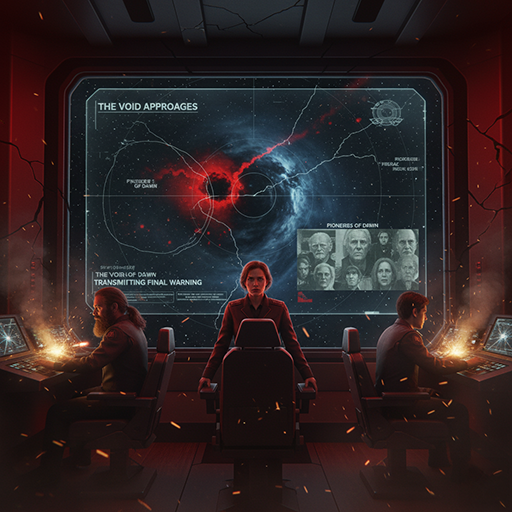
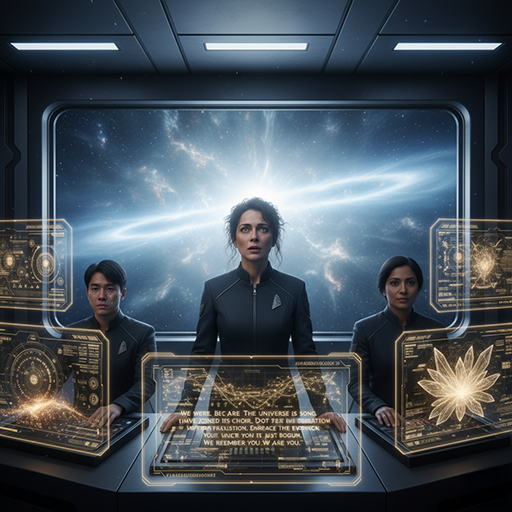
He stood up, walking over to the main viewscreen, which displayed a star chart of the Andromeda galaxy, a swirling vortex of light. Somewhere within that distant blaze, an entire civilization had lived, thrived, and was now, apparently, dying.
“We send a reply,” Aris declared, his voice firm, dispelling the lingering doubts in the room.
Lia’s eyes widened. “Sir? With respect, any message we send would take another two and a half million years to reach them. They’re already gone, or will be, long before then.”
“It’s not for them,” Aris explained, turning to face his crew. “It’s for us. And for whatever comes after us. We are the last witnesses to their last breath. We have a responsibility to acknowledge it.”
He pointed to the “We remember. Do you?” translation. “They asked if we remember. Our answer must be yes.”
The next few weeks were a whirlwind of activity. Every xenolinguist, every communication specialist, every philosopher on Echo Point Alpha was pulled into the monumental task. They weren’t trying to decode the entirety of the chaotic “last message.” They were trying to craft a response that resonated with its raw, emotional core. A message of understanding, of shared cosmic fate, and of enduring memory.
The final message was surprisingly simple. It began with the universal mathematical constants, the common language of the cosmos, to ensure it would be recognized as an intelligent signal. Then, it wove a tapestry of images and concepts. A depiction of a solitary human figure, gazing at the Andromeda galaxy. A representation of the vastness of time and space, and the fleeting beauty of life within it. And finally, the words, translated into every conceivable universal symbolic representation:
We remember. We bear witness to your journey. We grieve your passing. You are not forgotten. Your light shines on, within us.
The day they transmitted the response was overcast, even in the perpetual twilight of the deep-space station. The massive dish antenna, a silent titan against the backdrop of distant stars, hummed with a newfound purpose. Aris stood by the console, his hand hovering over the ‘send’ button. He looked at Lia, at the other crew members, their faces solemn, a shared understanding passing between them.
“This isn’t just a signal,” Aris said, his voice thick with emotion. “It’s a promise. A promise that even in the vast, cold silence of the universe, no light truly goes out without an echo.”
He pressed the button.
A surge of energy coursed through the station, a silent farewell to a distant, unknown friend. The signal, encoded with humanity’s empathy and acknowledgment, began its long, lonely journey across the intergalactic void, a two-and-a-half-million-year voyage to an empty destination. It was a message that would arrive long after the senders were gone, a whispered promise to dust and echoes.
As the transmission faded, the silence in the control room deepened. It was no longer the indifferent silence of the cosmos, but a silence imbued with memory, with loss, and with a profound, shared sense of something precious that had passed.
Aris looked up at the viewscreen, at the distant, shimmering spiral of Andromeda. He imagined the last moments of that unseen civilization, their final message a desperate plea for recognition. And he felt a strange sense of peace. They were gone, yes. But they were not forgotten. Humanity, the sole witness, would carry their memory forward.
In the vast, silent expanse of space, the concept of ‘last contact’ wasn’t an ending, but a continuation. A somber reminder that even in oblivion, there could be a final, poignant connection, a shared moment of cosmic remembrance. And in that moment, humanity wasn’t just alone; it was the keeper of a sacred trust, bearing the weight of a galactic memory, destined to carry the echo of a vanished light into the uncharted future.
The mission of Echo Point Alpha had changed. It was no longer just a listening post. It was a memorial. And Aris Thorne, a man who had dedicated his life to finding intelligent life, had, in its final moments, found something far more profound: a testament to its enduring spirit, even in the face of absolute extinction. The universe was still silent, but it was no longer empty. It was filled with echoes.
Science fiction is full of first contact stories, but is there such a thing as a last contact?
That was the question I explored.
It is the last time humanity, or any given intelligent species, makes contact with another intelligent species. It is the end of an era, the conclusion of a cosmic story, and the beginning of a profound loneliness.
Last contact is a one-way street. Unlike first contact, where there is a shared hope and curiosity about the future, last contact is the final message, the dying echo of a species that is either gone forever or so changed that they are no longer recognizable as the beings we once knew. It is the final transmission from a starship that will never return, the last intelligible signal from a planet that has been consumed by its dying sun, or the final communication from a species that has transcended its physical form and left the universe as we know it.
Last contact could be a message of despair, a warning to other species about a cosmic danger that is coming for them all. Or it could be a message of hope, a final gift of knowledge and wisdom from a species that has reached the end of its journey. It could be a simple “goodbye,” a final acknowledgment of a shared history and a shared fate.
Last contact is a concept that is both deeply sad and profoundly hopeful. It is a reminder that we are all alone in the universe, but it is also a reminder that we are not the first to travel this path. It is a concept that forces us to confront our own mortality and our own place in the cosmos. It is the end of a story, and the beginning of a new one, one where we are the sole authors of our own destiny.
This is one of three stories that explore the concept from three different perspectives; Witnessing, Warning, and Transcendence.