
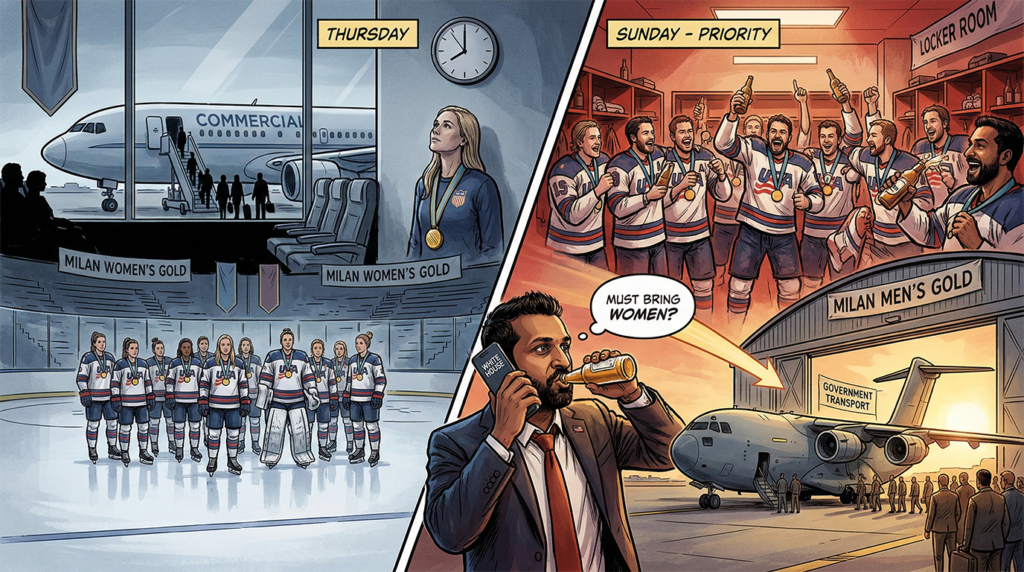
The silence following a historic victory is often heavier than the noise that preceded it. On a Thursday in Milan, the United States women’s hockey team defeated Canada in a two-one overtime thriller, a game that broke every existing viewership record for the sport. It was a moment of cultural and athletic culmination, punctuated by Laila Edwards becoming the first Black woman to represent the country in Olympic hockey. Yet, for three days, the White House remained conspicuously quiet. There were no celebratory phone calls, no official recognitions, and no digital acknowledgments. The world’s best athletes stood in a locker room that felt, for the first time, like an island.
When the men’s team secured their own gold on Sunday, that island was suddenly bridged by an expensive, military-grade infrastructure. The Director of the FBI, Kash Patel, did not just send a message; he arrived in person. He flew across the Atlantic on a government aircraft, purportedly for administrative meetings, yet his immediate priority was the men’s locker room. The image of the nation’s top law enforcement official shotgunning beers and banging on tables while the President waited on the other end of a cell phone provided a stark contrast to the commercial flights and tourist-class democracy afforded to the women just days prior.
The most revealing moment was not the drinking or the performative celebration, but the specific phrasing used by the President during that speakerphone call. He stated that the administration would have to bring the women’s team along for the official visit. The choice of words was not accidental. It framed the recognition of the women’s achievement as a burdensome necessity, a political chore designed to manage the risk of public backlash rather than a genuine celebration of excellence. To the President, the women were not champions in their own right; they were a scheduling obligation, the plus-one to the main event.
This disparity goes beyond simple thoughtlessness; it is a fundamental rejection of gender equity. Equity requires that the starting line and the support structures are calibrated to the magnitude of the achievement, not the gender of the achiever. When one team is rewarded with a charter jet and an immediate presidential audience while the other is offered a late-night invitation via a drunk-dialed iPhone, the message is clear. One victory is viewed as a national triumph, while the other is treated as a political liability to be managed.
The women’s team eventually received their invitation late Sunday night, long after the men had already secured their military transport home. The women flew commercial, sitting in middle seats next to strangers while the men were afforded the proximity of Air Force luxury. By treating the women as an afterthought, the administration demonstrated that their supposed support for women’s sports is entirely conditional. It is a performance of inclusion that vanishes the moment it requires actual resources or genuine respect.
The argument that women’s sports are a charity case—a product that must be subsidized because it cannot sustain itself – is one of the most persistent fictions in modern athletics. It is a narrative built on the circular logic that since women’s sports have historically received less investment, their lower commercial footprint is a natural reflection of public apathy. However, the data from the last two years has effectively dismantled this myth, revealing that the ceiling is not made of glass, but of institutional inertia.
In 2024, the NCAA women’s basketball championship game between South Carolina and Iowa averaged nearly nineteen million viewers, peaking at over twenty-four million. For the first time in history, the women’s final outdrew the men’s equivalent, and it did so by a margin of four million people. This was not a fluke or a momentary surge in curiosity; it was a demonstration of what happens when a sport is allowed to develop stars, storylines, and a broadcast infrastructure that actually treats the game like a marquee event. When the product is accessible and the promotion is equitable, the audience does not just appear – it overwhelms the existing capacity.
The Professional Women’s Hockey League has told a similar story of suppressed demand. Within its first two seasons, the league shattered global attendance records, culminating in over twenty-one thousand fans filling the Bell Centre in Montreal. These are not the numbers of a niche interest. These are the markers of a major market correction. Yet, despite women’s sports revenue growing nearly five times faster than men’s between 2022 and 2024, the investment gap remains cavernous. The top male athletes still earn significantly more than their female counterparts, often by a factor of eight or more, even as women’s leagues deliver higher rates of growth and deeper fan engagement.
This disparity in funding—the middle seat versus the charter jet – is often defended as a simple matter of market reality. But market realities are shaped by those who control the capital. When a brand or a broadcaster decides that the men’s game is the default investment and the women’s game is a speculative risk, they are not following the market; they are anchoring it in the past. The myth that women’s sports are not as fun to watch is a convenient excuse for those who would rather manage a familiar decline in men’s legacy leagues than navigate the hypergrowth of a rising competitor.
Ultimately, the commercial ceiling is a manufactured boundary. The fans have already proven they are willing to show up, pay for tickets, and tune in by the millions. The only thing missing is an institutional willingness to stop treating women’s excellence as a secondary concern. As long as we continue to fund one group based on its potential while demanding the other prove its worth a thousand times over, we are not practicing meritocracy. We are merely subsidizing a tradition of inequity.

Moving from the ice to the boardroom or the legislative floor reveals a different kind of barrier – one that isn’t about funding or physical infrastructure, but about the intangible tax on a woman’s voice. Even when women achieve the highest levels of professional success, they often find their expertise filtered through a gendered lens. This is the authority gap, a persistent divide where a woman’s competence is treated as provisional, requiring constant re-verification, while a man’s is assumed as the default state.
One of the most pervasive examples of this is the phenomenon often termed hepeating. It is a specific, quiet erasure: a woman offers an insight or a strategic proposal in a meeting, only to have it met with a neutral or dismissive silence. Minutes later, a male colleague offers the exact same point, perhaps in a slightly louder register, and is met with a chorus of approval. This is not merely a social awkwardness; it is a structural failure to attribute value to female intelligence. It suggests that for an idea to be accepted as truth, it must first be validated by a masculine voice.
This gap is codified early in the professional journey. The 2025 data on corporate leadership continues to highlight the broken rung – the first step from entry-level to manager. For every one hundred men promoted to that first leadership role, only ninety-one women are afforded the same opportunity. This isn’t a glass ceiling at the top; it is a structural flaw at the very base of the ladder. Because men are promoted based on perceived potential while women are promoted based on proven past performance, the leadership pool is skewed before the race even truly begins.
The political sphere is a landscape where the hill is not only steeper but is often greased with a particular kind of double standard. Female politicians are forced to navigate a narrow, suffocating corridor of acceptable behavior—what sociologists call the double bind. They must be strong enough to command a room but soft enough to remain likable. When they speak with conviction, they are frequently labeled as shrill or emotional. When they remain composed and analytical, they are dismissed as cold or uninspiring. This this is a tired and outdated hyperbolic argument? Let’s look at something recent.
We see this authority gap most clearly in the way policies are birthed and eventually adopted. A striking example can be found in the transition from the Green New Deal to the Inflation Reduction Act in the United States. When Representative Alexandria Ocasio-Cortez and her colleagues first championed the Green New Deal, it was characterized by critics as a radical, impractical fantasy. The rhetoric surrounding the proposal was often patronizing, focusing on her age and her perceived emotional approach to climate change. It was described as a pipe dream fueled by activist energy rather than serious governance.
Yet, a few years later, many of the core climate and economic goals of that fantasy were repackaged and signed into law through the Inflation Reduction Act. When the legislation passed, the narrative shifted. It was no longer a radical fever dream; it was lauded as a masterclass in legislative pragmatism and a bold, decisive move for the American economy. The content of the climate goals remained largely the same, but the reception changed once the policy was filtered through the masculine authority of the presidency. The perceived shrill activism of the originators was replaced by the statesmanlike victory of the executors.
This phenomenon is not limited to the United States. In the United Kingdom, Deputy Prime Minister Angela Rayner has spent years as the primary architect of the New Deal for Working People, a comprehensive overhaul of employment rights. Throughout its development, she faced relentless attacks on her communication style, with critics labeling her as aggressive or out of her depth. However, as the policy was finalized and championed by the Prime Minister as a cornerstone of the government’s mission, the framing began to soften. The aggression of the female architect was slowly translated into the discipline of the male-led administration.
This persistent filtering of expertise means that we often value the messenger more than the message. It suggests that a policy is only truly bold once a man has given it his permission to exist in the mainstream. Until we stop requiring women to have their ideas validated by a masculine echo before they are accepted as reality, we are essentially operating a democracy with a built-in handicap.

The structural barriers in the locker room and the boardroom find their most intimate expression in the invisible architecture of the home. This is the time gap, a persistent disparity where gender equity is undermined by the silent, ongoing accumulation of unpaid labor. While the physical tasks of cleaning and cooking are more visible, the true weight of this inequity lies in the cognitive and emotional burden often referred to as the mental load.
Recent studies into 2025 and 2026 show that in dual-earner households across Canada and the United Kingdom, mothers still handle over seventy percent of the cognitive tasks required to keep a family functioning. This involves the constant monitoring of schedules, the anticipation of needs, and the coordination of care that never truly pauses. It is a form of labor that is boundaryless and always on, frequently spilling over into a woman’s professional hours and leaching the restorative value from her leisure time. Even in households that aspire to be egalitarian, women are often the primary architects of the domestic schedule, while men act as contributors who wait for direction.
This imbalance effectively serves as a silent tax on women’s ambitions. When the President promised the women’s hockey team that they would be invited to the White House soon, he was drawing on a cultural assumption that a woman’s time is infinitely elastic. It is the same assumption that expects a mother to manage a child’s medical appointments or a school’s volunteer requirements while maintaining the same professional trajectory as a colleague who has no such domestic overhead. By treating women’s time as a secondary resource that can be stretched to accommodate the needs of the state or the family, society keeps them in a permanent state of catch-up.
Furthermore, this time gap creates a secondary authority gap. When the mental load is disproportionately carried by one partner, it reduces their capacity to engage in the broader civic and professional spheres with the same level of focus and energy as those who are supported by an invisible domestic infrastructure. It is the difference between flying on a charter jet where the logistics are handled for you and navigating a commercial terminal where you are responsible for every connection, every delay, and every piece of luggage.
Achieving true equity requires us to recognize that time is the ultimate currency of power. As long as the domestic infrastructure relies on the unacknowledged and uncompensated labor of women, the promises of professional or political equality will remain hollow. We cannot expect women to occupy the same space in the national narrative if we continue to require them to manage the entire foundation upon which that narrative is built.

The rhetoric of safety is perhaps the most potent tool in the modern political arsenal, specifically when it is used to justify the exclusion or monitoring of marginalized groups. In the current landscape, we see a sudden and loud concern for the integrity of women’s sports and the privacy of bathrooms, yet this advocacy is curiously narrow. It appears only when the presence of trans women can be framed as a threat. This is not a genuine defense of women; it is the strategic weaponization of their spaces to serve a broader cultural conflict.
If the goal were truly to protect and elevate women’s sports, the administration’s first instinct in Milan would have been to celebrate the historic gold medal of the women’s hockey team with the same fervor they later showed the men. Instead, the women were treated as a scheduling obligation. The integrity of their competition only becomes a priority for these advocates when it can be used as a rhetorical shield against a minority group. When the focus is on pay equity, media visibility, or the provision of charter flights, the silence from these self-appointed defenders is absolute. This reveals that the value of women in this narrative is entirely conditional, resting on their utility as props in a larger argument rather than their inherent rights as athletes.
The same logic applies to the manufactured crisis surrounding public washrooms. The articulated fear is rarely about trans women themselves, as there is no statistical evidence to support the idea that they pose a threat to others in these spaces. Rather, the anxiety centers on the possibility of predatory men masquerading as trans women to gain access. This is a crucial distinction. It means that the underlying fear is actually a fear of men. Yet, instead of addressing the root causes of male violence or predatory behavior, the resulting policies are designed to monitor and restrict the autonomy of women and trans people. It is a cynical loop where the perceived danger of one group of men is used to justify the surveillance of all women.
By framing gender equity as a matter of protection rather than power, these narratives keep women in a state of perpetual victimhood. They suggest that women are fragile entities in need of a masculine guard, conveniently ignoring that the most significant threats to women’s safety and success are often the very institutions claiming to protect them. True equity does not look like a locked door or a restrictive policy. It looks like the autonomy to move through the world, the boardroom, and the locker room without being used as a pawn in someone else’s political game.

The promise of a visit delivered through a midnight phone call is more than a logistical failure. It is a symptom of a worldview where women are treated as the plus-one to the national story. From the ice in Milan to the halls of Congress and the quiet exhaustion of the kitchen table, the narrative remains the same. Women are expected to perform at the highest levels of human achievement while navigating an infrastructure that was never designed for them, and then wait for a recognition that is offered as a political chore.
Achieving true gender equity requires us to move beyond these performative invitations. It is not enough to open the door if the hallway leading to it is blocked by a broken rung, or if the person entering is still carrying the invisible weight of an entire domestic architecture. We have seen that the audience is ready, the market is proven, and the expertise is present. The only thing currently lacking is the institutional courage to treat success as a primary objective rather than a secondary obligation.
We must stop viewing the advancement of women through the lens of protection or liability. When we frame equity as a legal necessity to avoid impeachment or as a shield to use against others, we are merely managing a problem. We are not building a future. A genuine commitment to equity looks like a charter flight that is booked before the game begins. It looks like a promotion based on potential. It looks like a society that values time as much as output.
The women of the Olympic hockey team understood the silence that followed their victory and the noise that followed the men’s. They saw the middle seat for what it was: a physical manifestation of their place in a rigid hierarchy. But they also know that the optics of this era are screaming. In a country where women constitute the majority of the electorate and where their fundamental rights are being treated as negotiable, treating them as an afterthought is a profound miscalculation.
The era of the scheduling obligation is ending. The primary architects of the future national narrative are no longer waiting for a phone call or a vague promise of a visit. They are building their own stages and defining their own terms. The invitation may have been an afterthought, but I hope the response will be anything but.

