
There is an uncomfortable truth that polite society prefers not to discuss at dinner parties: We, the world, need a military.
Since the conclusion of World War II, the United States has largely fulfilled that role for the Western world. Whether one views American hegemony with gratitude or disdain, the economic reality remains the same: the stability provided by American military strength allowed much of the world to avoid a “wartime economy.”
A wartime economy is a desperate engine. It devours resources that civil society relies upon—education, environmental protection, healthcare, and social welfare—and repurposes them for survival. By outsourcing the role of “global enforcer” to the United States, Europe and other allies were able to build robust social safety nets.
But every debt eventually comes due. We are now witnessing the cultural and political cost of that arrangement, both for the protector and the protected.
The Mathematics of Kindness and Scarcity
Do we actually need a military? The idealist says no. The idealist argues that humans are inherently kind. If you are a kind human, you do not steal. If you are a kind human, you share.
This is a beautiful sentiment, but it relies on a specific variable: Excess.
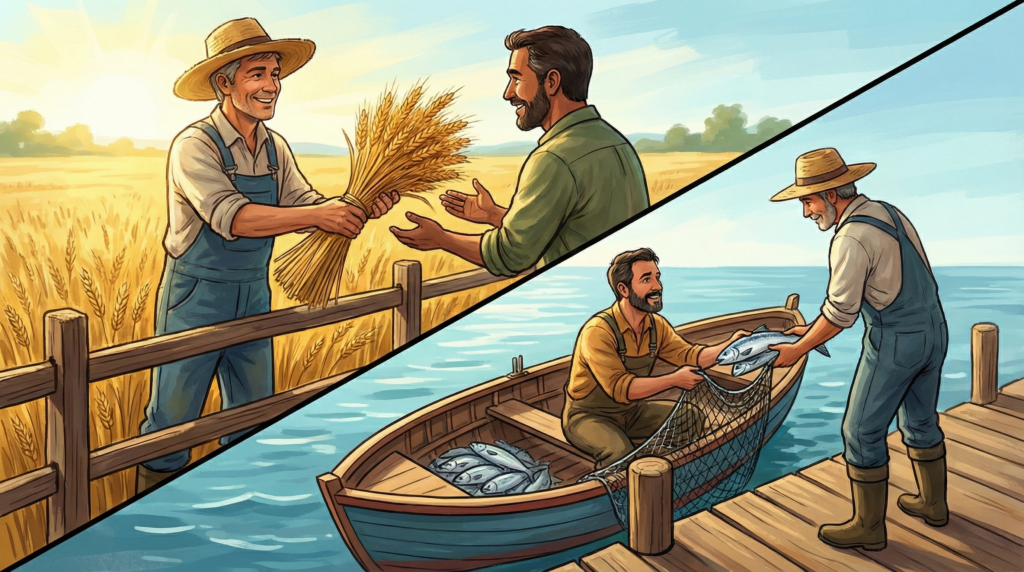
Sharing is easy when the silos are full. If my neighbor’s crop fails through bad luck, and mine thrives, I share my surplus. I remain fed; he does not starve. We are both “good.” But the equation changes when scarcity is introduced.
What if there isn’t enough to go around? What if the neighbor’s crop failed not through luck, but through neglect?
Now, the moral calculus shifts. You are no longer being asked to share your excess; you are being asked to share their pain. To help him, you must go hungry. This is the breaking point of natural altruism. When a neighbor is neglectful, and you refuse to starve alongside them, their survival instinct overrides their social contract. They will attempt to take what they need by force.
They militarize to survive. You militarize to defend. In a world of finite resources, the potential for violence is not an aberration; it is a constant.
The Hollow Leviathan
This brings us back to the geopolitical stage and an uncomfortable analysis of the American superpower. For decades, the Western world implicitly agreed to a division of labor: The United States would shoulder the burden of the “Watchman,” securing global trade routes and holding the line against rival superpowers.
Critics are right to point out that the United States did not step into this role purely out of altruism. The drive was not merely to protect, but to project. This impulse is woven into the American DNA, tracing back to the 19th-century doctrine of Manifest Destiny—the belief that American expansion was not just inevitable, but divinely ordained.
However, the “Guardian” nation paid a heavy tax in social capital. It is a profound irony that the man who best articulated this danger was himself a Five-Star General. Dwight D. Eisenhower assumed the Presidency with a terrifying awareness of what a permanent war economy would do to his nation. In his 1953 “Chance for Peace” speech, he warned:
“Every gun that is made, every warship launched, every rocket fired signifies, in the final sense, a theft from those who hunger and are not fed… This world in arms is not spending money alone. It is spending the sweat of its laborers, the genius of its scientists, the hopes of its children.”
We see the echoes of ancient Rome in America today. Rome aspired to be a center of Greek culture and philosophy, yet its survival required it to be a fortress of Spartan violence. Eventually, the “cultured core” could not hold against the weight of the legions, leading to the era of the “Barracks Emperors”—leaders chosen for force, not wisdom.
We outsourced the violence to the US, allowing them to become the “Barracks Emperor” of the West. We are now surprised that their internal culture reflects the harshness of the garrison rather than the enlightenment of the university.
The Technocratic Illusion (and the Divergent Problem)
Facing this dysfunction, it is tempting to look toward solutions found in speculative fiction. Why not govern by a council of competence—a stratification based on “skills” rather than polling numbers?
We imagine a global council divided not by nations, but by function: The Directorate of Science, The High Command of Military, The Department of Administration.
It sounds efficient. It sounds logical. But our literature warns us that this path leads to a different kind of rot. We see this in the “District” system of The Hunger Games, or even more clearly in the “Faction” system of the Divergent series, where society is split by primary virtue: Erudite for the smart, Dauntless for the brave, Abnegation for the selfless.
The flaw in these systems is that they assume a human being—or a nation—is a single ingredient. They create a “Caste of the Self-Aggrandizing,” where the Military faction becomes cruel because they are isolated from the softening influence of the selfless, and the Science faction becomes cold because they are isolated from the moral grounding of the brave.
A government built on rigid castes inevitably stagnates because it purges the very thing it needs to evolve: the cross-pollination of ideas.
The Pragmatism of Shared Pain
So, where does that leave us?
It brings us back to the individual. Nations, like people, should aim for self-sufficiency—but not to the extreme. We all have talents. As individuals, we excel in some areas and lag in others. Nations, often by the lottery of geography, will differ in the resources they have and the skills they foster.
The trick is not to isolate these differences, but to intermesh them.
We must move away from the model of “Outsourcing,” where we dump the ugly necessity of violence on one nation and the luxury of high-minded social welfare on another. We must move toward a model of shared burden.
This requires a system of “Fluid Guardianship.” We need the strength of the Military, the logic of Science, and the empathy of the Moral, but we cannot let them remain separate castes. The General must understand the cost of war by having spent time healing the sick. The Scientist must understand the consequence of invention by spending time in the trenches.
This comes with a trade-off. If we force a brilliant physicist to spend four years in civic service to “build character,” we deny the world four years of their physics. But in exchange, we gain a leadership class that actually understands the people it serves.
Ultimately, we must strive to ensure there is abundance all around. But for those moments when the crop fails—when scarcity rears its head—we must emphasize the value of shared pain. Not just as a moral virtue, but as a pragmatic insurance policy.

If we share the excess when we have it, and share the pain when we don’t, we reduce the desperation that drives a neighbor to steal. And in doing so, we might finally reduce the need for the very military we are so afraid to live without.

