
Donald Trump and the Return of the Repressed
To view Donald Trump’s capture of the American presidency in 2016, and his resurgent dominance in 2024, as a mere accident of history is to indulge in a comforting but dangerous delusion. It suggests that he is a glitch, a momentary static interference in an otherwise clear signal. But history does not make mistakes of this magnitude. In Newtonian physics, every action has an equal and opposite reaction; in the physics of a nation’s soul, the reaction is often delayed, accumulating pressure underground until it explodes.
Donald Trump is not an invader who breached the walls of the republic from without. He is the inevitable result of the republic’s own unresolved tensions. Carl Jung, the Swiss psychoanalyst, wrote of the “Shadow“—those dark, impulsive, irrational traits that we deny in ourselves and repress into the unconscious. He warned that the Shadow does not disappear when it is ignored; it grows denser, colder, and more autonomous, waiting for a moment to break through and seize control.
Trump is the American Shadow made flesh. He emerged from the basement of the American psyche, embodying the raw, unfiltered appetites that the nation has long practiced but politely denied: a ruthlessness disguised as enterprise, a tribalism disguised as patriotism, and a narcissism disguised as exceptionalism. He forces the United States to confront a version of itself stripped of the “Superego’s” social restraints. To look at him is not to look at an aberration; it is to look into a mirror that reflects the predatory nature of a civilization that has begun to devour itself.
The Orwellian Conquest of Reality
The United States was founded on a high-minded contradiction: the proclamation of universal liberty by men who owned other human beings. For centuries, the country managed this cognitive dissonance through a polite hypocrisy—the tribute that vice pays to virtue. We maintained the language of high ideals even while violating them. Trump’s innovation was to abandon the pretense entirely.
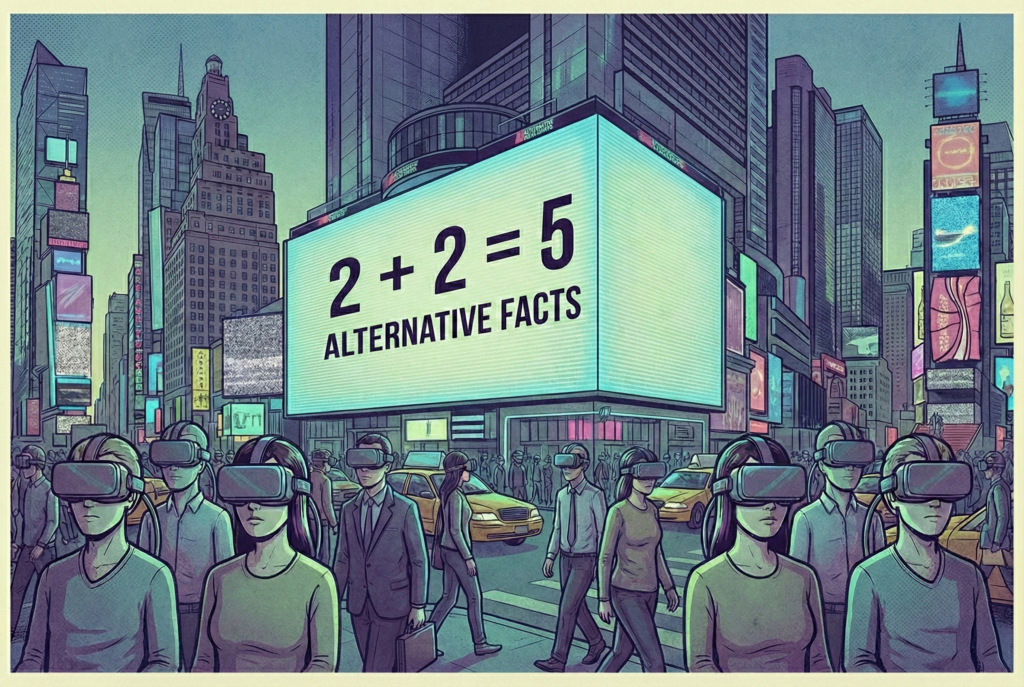
His relationship to the truth is strictly Orwellian. In 1984, George Orwell described a totalitarianism where the ultimate power was not the ability to kill, but the ability to dictate reality—to hold up four fingers and demand the observer see five. Trump’s “alternative facts” operate on this same principle. They are not merely lies in the conventional sense; they are tests of loyalty. When he claims a victory where the numbers show defeat, or a massive crowd where the aerial photos show asphalt, he is not trying to persuade you with evidence. He is asserting his dominance over the evidence itself.
He understood, perhaps better than any politician before him, that in a digital age, reality is malleable. If you can control the feed, you can control the world. He realized that for a significant portion of the electorate, “truth” is not an objective category but a tribal one. It is defined not by what is verifiable, but by what affirms their identity and wounds their enemies. In this epistemological break, the shared world dissolves. We no longer disagree on how to solve problems; we disagree on whether the sky is blue.
The Gilded Age as Farce
Karl Marx famously wrote in The Eighteenth Brumaire of Louis Napoleon that history repeats itself, “first as tragedy, then as farce.” Trump’s rise is the grim fulfillment of this maxim. He capitalized on a genuine, heart-rending tragedy: the decades-long erosion of the American working class.
The neoliberal consensus of the late 20th century—embraced by both parties—promised that free trade and deregulation would lift all boats. Instead, it hollowed out the industrial interior. Factories closed, unions were crushed, and entire communities were left to succumb to opioids and despair. This was the tragedy. The farce was that the man who arrived to channel their rage was a caricature of the very forces that destroyed them.
Trump is a figure out of a Charles Dickens novel: the bloated, gold-plated capitalist who treats bankruptcy as a strategic tool and stiffing contractors as a sport. He is the living embodiment of the extractive economy. Yet, with a showman’s genius that would have impressed P.T. Barnum, he performed a sleight of hand. He convinced the victims of this extraction that he was their retribution. He localized their abstract economic anxiety into concrete, tangible villains—the immigrant, the globalist, the “Deep State” bureaucrat.
He offered the “left-behind” a catharsis that the technocrats could not. The experts told them to retrain, to move, to accept that they were obsolete. Trump told them they were robbed. He gave them permission to stop apologizing for their failure and start blaming a rigged system. It was a lie, but it felt more like the truth than the bloodless statistics of the economists.
Amusing Ourselves to Death
If Orwell explains Trump’s method, Aldous Huxley explains the medium. In Brave New World, Huxley feared a society so obsessed with entertainment and distraction that it would become trivial, passive, and easily manipulated. Trump is the first President of the Huxleyan age. He erased the line between the Situation Room and the Green Room.
But this stage was not built by him alone. It was constructed over decades by a media ecosystem, most notably the empire of Rupert Murdoch. Fox News and its imitators created a sealed information loop—a distinct reality tunnel—where fear was the currency and outrage the product. For years, this machine trained its audience to mistrust mainstream institutions and to crave the adrenaline hit of conflict. Trump simply walked onto the set they had built and fired the director.
His career—from tabloid fixture to The Apprentice to the White House—tracks America’s shift from an economy that makes things to an economy that makes images. He understood that in this new world, “boring” is the only capital crime. Competence is invisible; chaos is viral. This dynamic has only intensified. By 2025, even his own biological decay became content.
When reports confirmed his chronic venous insufficiency—his legs swollen, valves failing, blood pooling in his extremities—it did not shatter the image of the superman. Instead, it became a plot twist. His supporters saw his refusal to concede to age as a heroic defiance; his detractors saw a portrait of Dorian Gray, where the painted image remains pristine while the man himself rots. The spectacle had cannibalized the biology. The actual health of the leader mattered less than the stamina of the performer.
The Algorithmic Architect
If Rupert Murdoch built the stage, Silicon Valley built the cage. To understand why Trump’s hold on the public consciousness is so sticky, we must look beyond traditional media to the economic logic that governs our screens: what the scholar Shoshana Zuboff calls “Surveillance Capitalism.”
In this new order, human experience is no longer just life; it is raw material. Every click, pause, and keystroke is mined, processed, and packaged into “prediction products” sold to the highest bidder. The goal of these platforms is not merely to service the user, but to modify their behavior—to keep them glued to the screen to extract more data. And the most effective way to modify behavior, the algorithms quickly learned, is not through satisfaction, but through high-arousal emotions: outrage, fear, and tribal fury.
Trump is the perfect fuel for this engine. He is a walking, talking high-arousal event. The algorithms that curate our reality do not care about truth or civic health; they care about engagement. A calm, nuanced policy debate creates a data trickle; a conspiracy theory about a stolen election creates a data flood.
Consequently, the digital infrastructure of the 21st century was incentivized to amplify Trump’s frequency. It isolated users in “filter bubbles,” feeding them a confirmation loop of their own anxieties. It radicalized the lonely by connecting them to communities of grievance. Trump did not need to organize a propaganda ministry; the business model of the internet did it for him, free of charge. We are not just politically divided; we are inhabiting separate, algorithmically curated realities designed to keep us at each other’s throats for profit.
The Leviathan and the Fortress
Beneath the rhetoric of the Wall lies a primal, Hobbesian fear. Thomas Hobbes, writing in the aftermath of civil war, argued that without a “Leviathan”—a powerful, unquestioned ruler—life would be “nasty, brutish, and short.” Trump appeals directly to this terror.
The Wall was never truly about border security or immigration statistics. It was a psychological defense mechanism. For a demographic experiencing the vertigo of rapid demographic change and the erosion of white Christian hegemony, the Wall offered a fantasy of stasis. It was a promise that the “State of Nature” could be kept at bay, that the complexities of a globalized world could be physically blocked out.
By 2026, the masonry had largely given way to machinery—drones, biometric dragnets, and executive orders attempting to end birthright citizenship—but the impulse remained the same. It is an attempt to immunize the nation against history. Yet, as any biologist knows, an organism that completely seals itself off from its environment does not survive; it suffocates. The Fortress America is not a sign of strength; it is a sign of a civilization that has lost the confidence to engage with the world and has chosen instead to hide from it.
The Fisher King and the Crisis of Masculinity
Trump performs a hyper-masculinity that resonates deeply with men who feel displaced by shifting gender norms and economic irrelevance. It is a Machiavellian performance: it is better to be feared than loved, and weakness is the ultimate sin. He acts out the fantasies of those who feel powerless—saying the unsayable, breaking the rules, taking what he wants without asking.
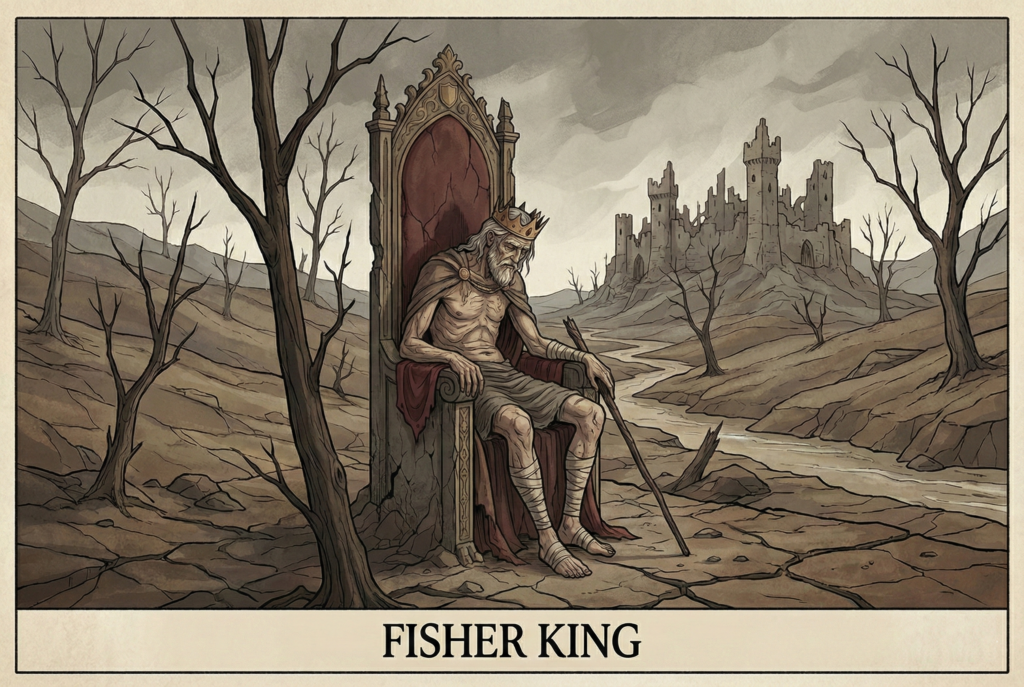
But this performance is haunted by a profound fragility. The contrast between the “Strongman” rhetoric and the reality of the aging body—the reliance on makeup, the hair spray, the physical difficulty in walking down a ramp—creates a poignant dissonance. It recalls the Arthurian archetype of the Fisher King: the wounded ruler whose infirmity reflects the sickness of the land itself.
The “masculinity” Trump offers is not the generative, protective strength of the father; it is the petulant, destructive demand of the adolescent who refuses to grow up. It offers no healing for the “masculine wound”—the loss of purpose and dignity in a post-industrial world. It offers only swagger as an anesthetic. It tells men that their worth lies in domination, a lie that leaves them lonelier and more brittle than before.
The True Believer
Why do the scandals not break the spell? Why does every indictment, every revelation of incompetence, and every exposed lie only seem to bind his followers closer to him? To answer this, we must look beyond politics to the psychology of the mass movement.
In 1951, the longshoreman-philosopher Eric Hoffer wrote The True Believer, a seminal study of fanaticism. Hoffer argued that the fanatic is not driven by the content of a cause, but by a desperate need to escape a “spoiled self.” For the atomized individual—lonely, economically irrelevant, and culturally invisible—the movement offers something more intoxicating than truth: it offers a cure for nothingness.
When reality conflicts with the leader’s vision, the follower does not abandon the leader; they abandon reality. This is the mechanism of cognitive dissonance at its most extreme. When a prophecy fails, the cult does not disband; it doubles down. To admit that the leader is a con man would be to admit that one has been conned, that one’s sacrifice was in vain, and that one is, once again, small and alone.
Trump understands this intuitively. He knows that his followers are not looking for a politician who admits mistakes; they are looking for a vehicle for their own resentment. As long as he remains the “Great Disrupter”—the stone thrown through the window of the establishment—they will forgive him anything. He is not judged by his virtues, but by his enemies. And as long as he is hated by the right people, he will be loved by the True Believer.
The Faustian Bargain
The alliance between Trump and the evangelical right is the modern era’s definitive Faustian bargain. In Goethe’s legend, Faust sells his soul to Mephistopheles not because he loves the devil, but because he desires power and worldly knowledge. American evangelicals made the same calculation.
They did not mistake Trump for a saint; they recognized him as a mercenary. In exchange for their loyalty, they received the structural power they craved: the Supreme Court seats, the overturning of Roe v. Wade, the dismantling of the Department of Education, and the validation of Christian Nationalism.
But as with Faust, the bill eventually comes due. By tying the cross to the flag of a man who mocks the Sermon on the Mount with his every action—who embodies pride, greed, lust, and wrath—they have hollowed out the moral authority of their faith. They secured their political fortress, but they lost the culture. A generation of young Americans now looks at the church and sees not a refuge for the weary, but a Super PAC for the cruel. The transaction was successful, but the soul was lost in the transfer.
The Crossing of the Rubicon
Republics do not always die with a bang; often, they die because the unwritten rules are ignored and the gatekeepers shrug. Julius Caesar ended the Roman Republic not by burning the Senate, but by crossing the Rubicon—by breaking a norm and daring anyone to stop him.
Trump demonstrated that the American Constitution relies heavily on the “honor system.” It assumes that leaders will have a sense of shame. When a leader simply refuses to be shamed—refuses to divest assets, refuses to accept electoral defeat, refuses to adhere to judicial norms—the machinery jams.
His second term, characterized by the blitz of executive orders in 2025, pushed this to the breaking point. By freezing federal grants, politicizing the civil service to purge “disloyal” experts, and weaponizing the Department of Justice against political enemies, he revealed that the “checks and balances” taught in civics class are not self-executing. They require people to enforce them. Trump proved that the guardrails of democracy are made of plastic, not steel, and they bend easily when hit by a heavy enough truck.
The Imperial Twilight
Finally, Trump represents the twilight of the “American Century.” For decades, the US played the role of the benevolent global hegemon. It was an empire, yes, but one that wrapped its iron fist in the velvet glove of “human rights” and “democracy.” Trump dropped the glove.
He treated alliances like The Godfather treats a protection racket: pay up, or you’re on your own. He viewed NATO not as a bond of shared values, but as a shakedown. To the rest of the world, this was a moment of terrifying clarity. The “City on a Hill” had become a landlord demanding rent. It marked the end of the illusion of American exceptionalism and the acceptance of a colder, more transactional reality—a multipolar world where power is naked and principles are for suckers.
The Global Echo
To regard Trump as a uniquely American aberration is to miss the forest for a single, albeit massive, tree. He is not an isolated weather event; he is part of a changing climate. If we zoom out from Washington, we see that the American Shadow is rhyming with a global darkness.
From Viktor Orbán’s “illiberal democracy” in Hungary to Jair Bolsonaro’s nostalgia for military dictatorship in Brazil, the same fracture is appearing across the West. These figures, though distinct in their local flavors, rise from the same tectonic shift: the collapse of the neoliberal promise. For forty years, the global consensus was that free markets and liberal democracy were inseparable partners that would inevitably lead to universal prosperity. That marriage has failed.
In its place, a new and darker pact is being forged. We are witnessing the rise of Authoritarian Neoliberalism—a system that keeps the predatory economics but discards the democratic rights. Like Trump, leaders across Europe and the Global South are discovering that you can channel the rage of the dispossessed not against the corporations that underpay them, but against the vulnerable who live among them. They have realized that in a world of complex, borderless threats—climate change, migration, pandemics—the most seductive political product is not a solution, but a fortress. Trump is simply the loudest voice in a global chorus singing the same song of retreat.
The Competent Successor
The true danger of the Trump era, however, is not Trump himself. He is, ultimately, a chaotic actor—driven by impulse, easily distracted by flattery, and lacking in ideological discipline. He is a demolition ball, not an architect.
The greater fear is what comes next. Trump has shown that the door to authoritarianism is unlocked. He has mapped the weaknesses of the system and normalized the language of political violence. He is the symptom, but the next leader may be the cure that kills the patient.
Imagine a successor who possesses Trump’s populism but lacks his erraticism. A “Caesar with a brain.” A leader who understands the mechanics of the bureaucracy, the nuances of geopolitics, and the discipline of true statecraft, but who is committed to the same illiberal ends. Such a figure would not tweet their crimes; they would legislate them. They would not merely break the institutions; they would capture and repurpose them with surgical precision. Trump is the storm; the next one could be the climate change.
Hope in the Margins
Yet, the story does not have to end in darkness. If Trump is the symptom of a dying order—the last, flailing gasp of industrial, extraction-based capitalism—then the cure is already growing in the margins.
The old system, which treated nature as a limitless resource and people as disposable labor, is collapsing under its own weight. But in the cracks of this crumbling concrete, green shoots are emerging. We see it in the resurgence of worker cooperatives, like the model of the Mondragon Corporation, where capital serves labor rather than the other way around. We see it in the mutual aid networks that sprang up during the pandemic and persisted, teaching communities that they can rely on each other when the state fails.
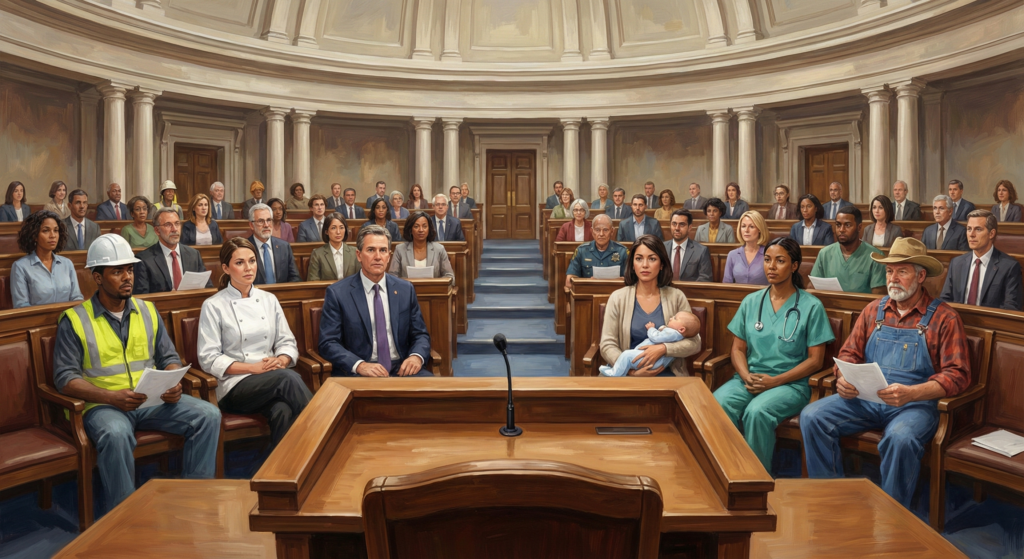
We see it in the movement for regenerative agriculture, which seeks not just to extract yield from the soil, but to heal the land—a powerful metaphor for the healing the country needs. We see it in experiments with citizens’ assemblies and participatory democracy, where ordinary people prove they are capable of complex deliberation that bypasses the polarization of the party system.
These are not yet dominant forces, but they are the seeds of the next America. They are the proof that human beings are capable of organizing themselves by logic other than predation.
The Reckoning
Donald Trump has held up a mirror to the American soul. The reflection is grotesque, cracked, and frightening. It shows us our racism, our greed, our addiction to spectacle, and our deep, repressed violence.
But we cannot blame the mirror for the face it reflects. To shatter the mirror—to banish the man—solves nothing if the face remains the same. The Shadow has been acknowledged. We can no longer pretend it isn’t there.
The question now is whether the nation has the maturity to integrate this dark knowledge. Can we build a society that meets the needs that Trump exploited—the hunger for dignity, community, and purpose—without resorting to his cruelty? Can we move from an era of extraction to an era of regeneration?
The American Shadow is out of the basement. It is walking the halls of power. We cannot repress it again. We must face it, understand it, and ultimately, transcend it. The fever is burning hot, but sometimes, a fever is the only way the body can clear the infection to make way for health.

