
Why I Can’t Join the Party
There is a principle that acts as the bedrock of almost every progressive movement in the Western world, one that I hold as sacred as any other: Bodily Autonomy.
It is the simple, irrefutable idea that the state has no business telling a free adult what they can do with their own flesh and blood. It is the logic that underpins the fight for reproductive rights, the struggle for LGBTQ+ identity, and the necessary backlash against the catastrophic failure known as the “War on Drugs.”
I believe in this principle. I do not believe that the desire to alter one’s consciousness is inherently immoral. Human beings have sought to explore the edges of their own minds for millennia, from the wine cults of Dionysus to the rave culture of the 90s. The idea that a government should cage a human being for possessing a chemical compound is, frankly, archaic.
I say all of this as someone who does not use drugs.
My abstinence isn’t born of a sense of moral superiority. I am not a puritan. I drink alcohol—a substance that we know, scientifically and socially, is toxic. It damages the liver, it burdens our public healthcare system, and it fuels addiction. I am under no illusions that the Pinot Noir on my dinner table is healthier than a tab of LSD or a line of MDMA. In fact, it’s quite the opposite – a 2010 study published in The Lancet by Professor David Nutt (the former chief drug advisor to the UK government) ranked 20 drugs based on harm to the user and harm to society. Alcohol was ranked #1 (most harmful overall, scoring 72/100). LSD was ranked #18 (one of the least harmful, scoring 7/100). Alcohol is physically addictive and withdrawal from alcohol can be fatal (delirium tremens). It is a direct toxin to almost every organ in the body. It is carcinogenic (causes cancer), neurotoxic (kills brain cells), and hepatotoxic (kills liver cells). LSD is considered physiologically non-addictive and physiologically remarkably non-toxic. You can have a terrifying psychological experience, but your liver and heart are generally not in danger from the substance alone.
But there is a critical, devastating distinction between the bottle on my table and the baggie in a pocket at a music festival. It isn’t a difference in the quality of the high. It isn’t a difference in the morality of the user. It isn’t a difference in the health for the user.
The difference is the supply chain.
When I buy a bottle of wine in Ontario, I am participating in a regulated, taxed, and monitored economy. The Liquor Control Board of Ontario (LCBO) has its flaws, certainly. But it does not use drive-by shootings to settle disputes with the Beer Store. It does not use its profits to traffic women across borders. Its truck drivers are often unionized, and its revenue builds hospitals rather than buying silence.
When one buys illegal party drugs, they are participating in the most ruthless, unregulated, hyper-capitalist market on earth.
In political theory, hyper-capitalism refers to a market that is completely unconstrained by social obligation, government regulation, or ethical boundaries. It is pure, raw supply and demand, where the only objective is profit and the only law is the ability to enforce a contract yourself.
For those of us who identify as left leaning—who march for social justice, who fight for wealth equity, who champion human rights, and who scrutinize the ethics of everything from our coffee beans to our clothing—this market presents a contradiction so large one can usually only deal with it by ignoring it.
But we can’t ignore it anymore. The “party drug” economy is not a counter-culture; it is the venture capital engine for the very oppression we claim to fight.
The Illusion of the Victimless Crime
We need to start by dismantling the psychological shield that protects the socially conscious drug user. It is the belief that their usage is victimless.
Most of my friends who use recreational drugs are deeply empathetic people. They are the first to recycle, the first to support a boycott of a company that uses sweatshop labor, and the first to stand up for the marginalized. When they take MDMA, Ketamine, GHB, or LSD, they view it as a private act. A moment of joy, connection, or release in a difficult world.
They believe that because they are not hurting anyone while they are high, no one is being hurt by their high.
This is a failure of systemic thinking.
As progressives, we are trained to look at systems. We know that buying a t-shirt for $5 comes at a cost to someone, somewhere, in the supply chain. We accept that “there is no ethical consumption under capitalism.” But the illegal drug trade is not just capitalism; it is hyper-capitalism. It is a market stripped of every single constraint that civilization has invented to protect people.
There are no labour laws. In the legal cannabis market, workers have safety gear, ventilation, and the right to refuse dangerous work. In the black market, the workforce is treated as disposable biological machinery.
The “cooks” who mix volatile precursors in clandestine labs often work in unventilated basements or sealed shipping containers to hide the smell. They are exposed to concentrated carcinogens and neurotoxins without industrial respirators, leading to chronic respiratory failure and chemical burns.
But the exploitation goes deeper than safety. In many transnational networks, the lower-tier labor—the people mixing the chemicals or harvesting the raw product—are not willing employees. They are often victims of debt bondage or undocumented migrants coerced into working off “smuggling fees” under threat of violence. If a worker passes out from fumes, is injured in a volatile explosion, or simply burns out, there is no Workers’ Compensation. They are dumped at a hospital entrance, or simply disappeared.
There are no environmental standards. In a legal market, industrial byproducts are neutralized. In the black market, the environment is a sewer. Producing just one kilogram of MDMA generates roughly 6 to 10 kilograms of toxic sludge—a caustic cocktail of acetone, hydrochloric acid, and heavy metals like mercury.
In Ontario and Quebec, this waste isn’t disposed of; it’s weaponized against the landscape. It is dumped into streams in protected greenbelts or poured onto rented farmland, where it seeps into the water table to poison local wells. When urban labs flush these chemicals, the solvents are corrosive enough to eat through municipal piping and kill the bacterial cultures water treatment plants rely on to clean our drinking water. When you buy the product, you are funding the poisoning of your own ecosystem.
There is no contract law or legal enforcement. This is the deadliest factor. In the legal world, business disputes are settled by lawyers, judges, and insurance adjusters. In the illicit economy, there is no recourse to the state. If a shipment is stolen, a debt goes unpaid, or a rival encroaches on a territory, a dealer cannot file a lawsuit or call the police.
In this vacuum, the only mechanism available to enforce a contract or secure an asset is physical force. Violence is not a “bug” of the drug trade; it is the operating system. It is the industry’s only form of litigation.
To function, a criminal organization must establish a credible threat of lethality. A shooting in a public square isn’t just an act of rage; it is a calculated business move designed to serve as a deterrent, much like a cease-and-desist order, but written in blood. When you purchase the product, you are paying a premium that funds this private justice system. You are buying the bullet used to settle the next invoice.
The Myth of the “Boutique” Dealer
The most common defense I hear from my friends is the boutique argument.
It goes like this: “I don’t buy from gangs. I buy from Dave. Dave is a nice guy. He’s an artist. He cares about the quality of his product. He’s not a criminal; he’s a distinct, ethical outlier.”
This is a comforting fantasy. It allows us to draw a mental line between the “good” drugs (MDMA, GHB, LSD, Ketamine) and the “bad” drugs (Heroin, Fentanyl, Crack). We imagine that the supply chain for our party drugs is separate from the misery of the opioid crisis.
But in the world of logistics, Dave is not an artisan. Dave is a franchisee.
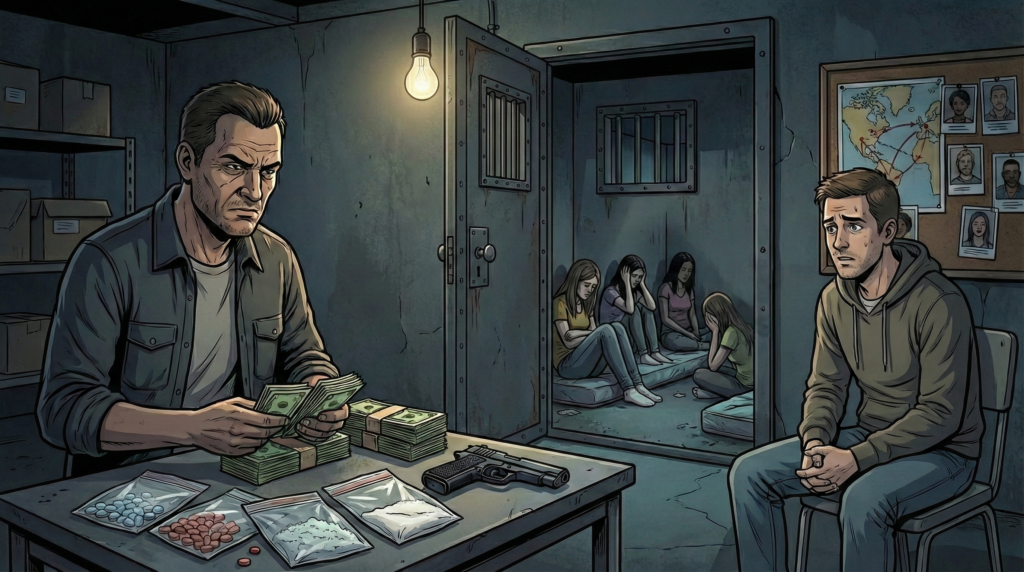
Let’s look at the chemistry. To create synthetic drugs like MDMA, GHB, LSD, or Ketamine, you need specific precursor chemicals. You cannot make MDMA out of thin air. You need safrole, piperonal, or PMK-glycidate. You can’t make GHB without GBL (Gamma-butyrolactone) or 1,4-BD. In Canada, GBL is a Class A Precursor under the Controlled Drugs and Substances Act. You cannot legally buy it, possess it, or import it without a very specific industrial license. Unlike MDMA, which requires a complex lab and a skilled chemist to synthesize which creates a barrier to entry, GHB is actually very easy to make. If you have the GBL, you can make GHB in a kitchen sink with drain cleaner (Sodium Hydroxide). It is “shake and bake” chemistry. The entire barrier to entry is the precursor. The only reason everyone isn’t making GHB in their bathtub is that they can’t get the GBL. Therefore, anyone selling GHB is, by definition, someone who has a connection to an illegal importer of controlled precursors.
These are not items you can pick up at Home Depot. They are heavily restricted, monitored, and controlled substances globally. To get them into Canada requires an international smuggling operation. It requires connections in source countries (often China or India), it requires the ability to bribe port officials, and it requires a transportation network that can move illicit goods across borders without detection.
“Dave” the artist does not have these connections.
The Hells Angels do. The Triads do. The transnational cartels do.
The reality of the drug trade in Ontario is that it is a wholesale-to-retail model. The organized crime groups control the import of the precursors and the production in super-labs. They then sell the finished product down the chain to mid-level wholesalers, who sell to street-level dealers like Dave.
By the time the baggie gets to you, it has passed through the hands of the most violent organizations in the country. Dave might be a pacifist, but he is paying his invoice to a wolf.
The Poly-Criminal Nightmare
If the only issue was that “bad guys” were making money, that would be one thing. But we have to look at what those bad guys do with the money.
Canadian intelligence agencies and the RCMP have repeatedly classified the major criminal organizations in this country as “Poly-Criminal.”
This is a crucial concept for the progressive mind to grasp. It means they do not specialize. A criminal organization is, at its core, a logistics company. They specialize in moving illegal things from Point A to Point B.
If they have a route to move drugs into Toronto, they do not send the truck back empty. They use that same infrastructure to move other commodities.
And what are those commodities?
Illegal Firearms In the GTA the raw number of shootings dropped in 2025, but the brazenness of the violence—shootings in broad daylight, near schools, killing innocent bystanders—has not. The terror is real, but we must be precise about the cause. The problem isn’t a lack of laws; it’s a lack of a border. The guns terrorizing our communities are not coming from our neighbors’ gun safes; they are coming from the trunks of smugglers’ cars.. Innocent bystanders, children, and community members are being caught in the crossfire. We rally against this violence. We demand stricter gun laws.
But we fail to ask: Who is paying for the guns?
The illegal gun trade is not a standalone business; it is almost entirely subsidized by the drug trade. The profits from drug sales provide the liquid cash needed to buy guns in the US and smuggle them north. Furthermore, the guns are brought in specifically to protect the drug territory.
When we buy drugs, we are creating the value that requires the gun. We are the reason the territory is worth shooting someone over.
Human Trafficking This is the most harrowing link, and the one that should make any person sick to their stomach, especially someone who supports women.
There is a documented, financial, and operational link between drug trafficking and sex trafficking in Ontario.
Trafficking human beings is a high overhead crime. Unlike a box of drugs, a human victim must be housed, fed, moved, and guarded 24/7. They must be psychologically broken and physically controlled. This requires a constant stream of liquid capital.
The drug trade is the ATM that funds this atrocity.
In operation after operation—from Project Sunder to Project Sizzle—police in Ontario have found that the same gangs running the “party drug” lines are running the sex trafficking rings. They are co-mingled.
Project Sunder was a 2020 operation that dismantled the Eglinton West Crips. Police explicitly stated that this gang was running a poly-criminal empire. They were not just moving cocaine and fentanyl; they were actively recruiting and trafficking women for sex. The charges laid included Trafficking in Persons alongside drug and firearm offenses. Project Sizzle was an operation that targeted the Heart of a King gang in downtown Toronto (who frequented the Entertainment District). Police raids confirmed that their lifestyle was funded by a specific mix of guns, drugs, and prostitution.
Even worse, the drugs themselves are used as tools of coercion. It is a standard tactic for traffickers to force victims into drug dependency to keep them compliant and indebted. The MDMA or Ketamine that is used to expand minds on a Saturday night is the same substance being used to shackle a teenage girl to a life of exploitation on a Tuesday morning.
This creates a dissonance that is becoming impossible to ignore.
We cannot wear attend a Women’s March, chanting for the liberation of women, and then spend our weekends injecting liquidity into the very networks that buy and sell them.
Snow Washing: How Your High Evicts Your Neighbors
For many left leaning people in Ontario, the defining crisis of our generation is housing. We watch as our cities become playgrounds for the rich, while working-class families, artists, and immigrants are pushed out by skyrocketing rents and unattainable property values.
We blame foreign investors. We blame greedy developers. We blame zoning laws.
But we rarely blame the weekend habits many participate in.
We need to talk about “Snow Washing.”
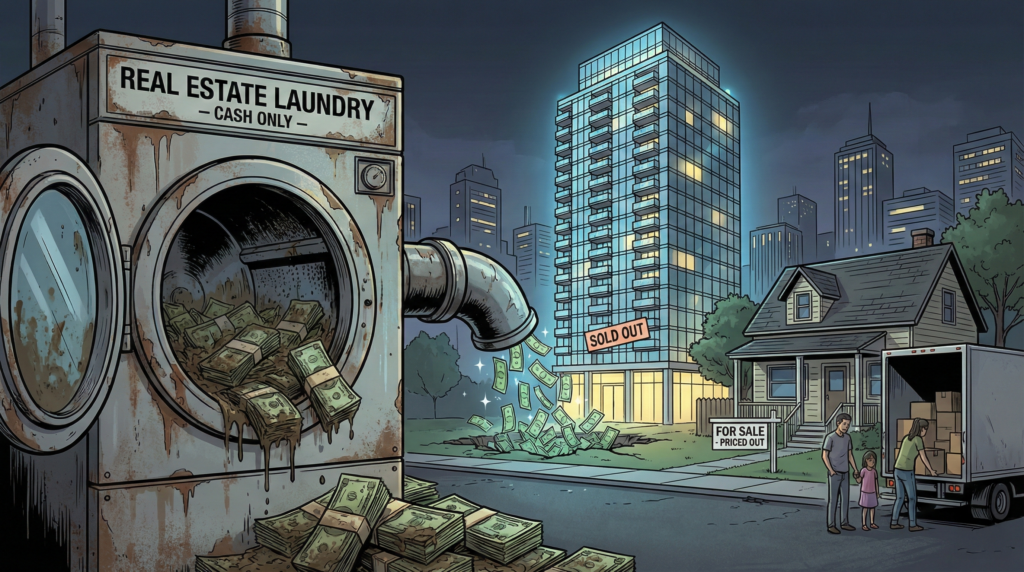
The illegal drug trade generates billions of dollars in cash. This cash is useless unless it can be “cleaned” or laundered to look like legitimate income. In Canada, the preferred washing machine is real estate.
I see the scale of this threat in my own professional life. I work for CMI, a private mortgage lender, where I oversaw the integration of LSEG’s World Check—a global risk intelligence database used to screen for financial crime.
In the legitimate lending space, we spend massive amounts of time and resources on Anti-Money Laundering (AML) compliance. We don’t build these digital walls because we enjoy red tape; we do it because the sector is a known target. I know firsthand that the pressure from illicit capital trying to enter the system is relentless.
But where legitimate lenders like us put up gates, the black market builds tunnels.
Investigative reporting and transparency organizations have shown time and again how organized crime uses numbered companies and shell corporations to buy residential real estate in the GTA and Vancouver. They pay in cash, or they use private lenders to bypass bank scrutiny. They often overpay, because their goal isn’t value—it’s speed. They need to turn dirty cash into a clean asset.
This artificial demand drives up the price of housing for everyone else.
When you hand $100 to your dealer, that money doesn’t stay in a shoebox. It eventually works its way up to a syndicate that needs to wash it. That syndicate buys a condo in Toronto or a house in Hamilton. They outbid a young family. They leave the unit empty, or they use it as a stash house.
If you are fighting for affordable housing, you must understand that the black market is one of the engines of gentrification. By feeding the black market, you are helping organized crime price your own neighbors out of their homes.
I can’t spend my day working to stop money laundering, and then spend my personal time funding it. Nor should you.
The Privilege of the “Safe” User
There is one final, uncomfortable truth we need to confront. It is the issue of Privilege.
The safe recreational drug use that takes place in leftist circles—at cottages, at festivals, in comfortable living rooms—is an act of profound economic privilege.
You get the product, but you outsource the process.
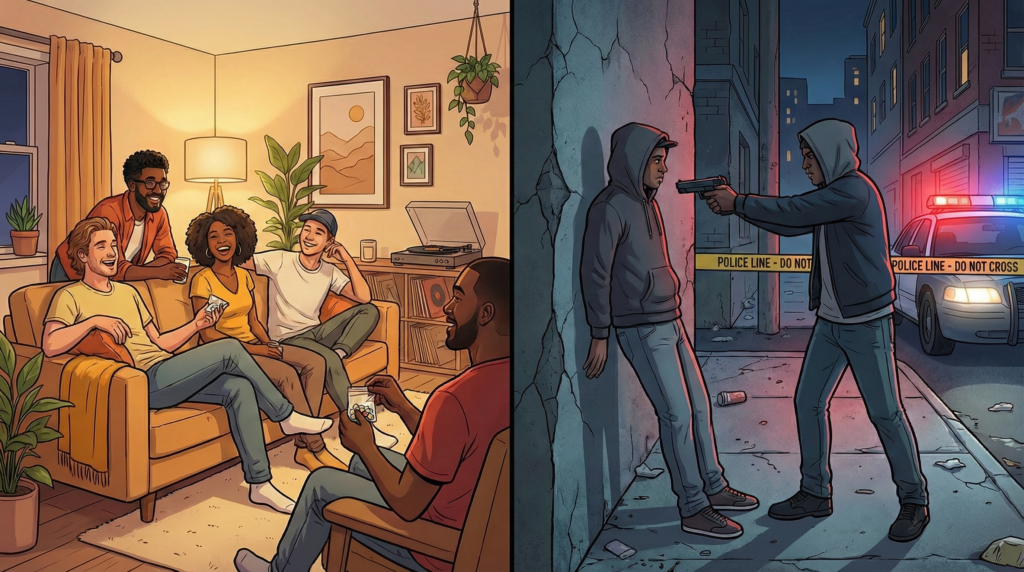
The violence of the drug trade rarely happens at the music festival. It happens in the neighborhoods where the stash houses are located. It happens in the marginalized communities where the gangs fight for turf. It happens in the transit corridors where the guns are moved.
When you buy illegal drugs, you are essentially saying: “I am willing to pay for a system that inflicts violence on poor people, so that I can have a fun night.”
I recently confronted a friend with this reality. To their credit, they didn’t deny it. They looked me in the eye and admitted that my description was accurate—they were aware that their only justification was that it was fun—and then they shrugged.
In any other context, my progressive friends would call for a Truth and Reconciliation process, leaning into Restorative Justice or Transformative Justice models. They know that you cannot have justice without first acknowledging the harm. Yet here, the acknowledgement was made, but the behavior continued. That isn’t solidarity; it’s complicity.
Alcoholics Anonymous’ famous 12 Step program starts with Step 1, which is “Admitting you have a problem”. But in this case, the problem isn’t just chemical dependency; it is an addiction to convenience at the expense of human rights.
We are outsourcing the risk. We are capitalizing on the suffering of others. It is the definition of exploitation.
The Call for Sober Solidarity
I understand the allure. I truly do.
I understand that the world is heavy, and the desire to escape, to feel euphoria, to connect with friends on a chemical level is a deeply human urge. I understand the frustration with a government that moves too slowly on legalization.
But we do not live in the world we want—yet. We live in the world we have.
And in the world we have, every dollar spent on illegal drugs is a vote. It is a vote for the Hells Angels. It is a vote for the traffickers. It is a vote for the gun runners. It is a vote for the money launderers.
As progressives, we know the power of the boycott. We know what a picket line is.
We know that when workers are being exploited, when a system is abusive, we do not cross the line. We sacrifice our convenience, our wants, and even our joys, in solidarity with those who are being hurt.
Today, the victims of this trade—the trafficked women, the communities living in fear of gunfire, the families displaced by laundered money—are on the picket line. They are asking us to stop funding their oppressors.
Abstaining from drugs until there is a safe, legal, ethical supply isn’t about being prudish. It isn’t about being a goodie-two-shoes.
It is an act of protest.
It is a declaration that our pleasure is not worth their pain. It is a refusal to be a shareholder in a corporation of violence.
I look forward to the day when we can explore our consciousness freely, safely, and ethically. I will be the first to toast that day (maybe even without alcohol). But until it arrives, the most radical, progressive thing we can do is to starve the beast.
We have to stop the party, to save the people. We need to bring our moral compass into alignment.

