
Prolog: The Teeth of the Storm
The hilt of the sword was a liar. To Garon’s hand, the worn leather felt like home, a familiar comfort that promised a victory his body knew was impossible. Above, the sun was a white-hot coin pressed against the sky of the Ashari desert. It didn’t just shine; it hammered. Every ring of his chainmail had become a point of searing contact, branding the salt-crusted tunic into his skin.
Garon blinked, but his eyelashes were matted with grit. Through the shifting ochre haze of the sandstorm, the world was a blur of violence. He didn’t need his eyes to know the Kheldari were close; he could smell the copper of spilled blood and the musk of the great sandworms.
A rhythmic thrumming vibrated through the soles of his boots—a deep, subsonic tectonic shift.
Thump. Thump.
In his youth, those tremors belonged to hatchlings no larger than a horse. Now, the earth groaned under the weight of titans. The worms weren’t just scavengers anymore; they were the desert’s judgment, drawn to the frantic heartbeat of a dying army.
A bitter sound—half-cough, half-laugh—rattled in Garon’s chest. He spat, but his mouth was too dry for phlegm, leaving only the metallic tang of thirst on his tongue. He looked at the fortress of Eldoria. Once, its white stone had been a defiant shout against the horizon. Now, the walls were jagged and broken, looking like a row of rotted teeth.
“General!”
A voice cracked nearby. Garon turned to see a boy—he couldn’t have been more than seventeen—stumbling through the dust. His tabard, once the proud blue of the Aethel Republic, was stained a dark, wet maroon. He wasn’t crying, but his eyes were wide, the pupils blown until they were nothing but black holes of shock.
“The western wall,” the boy gasped, his chest heaving. “It didn’t just break, sir. It… it dissolved. They’re coming through the gaps like water.”
Garon didn’t tell the boy it would be alright. He didn’t tell him they were winning. He simply reached out and gripped the boy’s shoulder, his gauntlet heavy and cold. He felt the kid’s frantic pulse through the leather.
“Breathe, soldier,” Garon said. His voice was a low rasp, a sound like stones grinding together. “If you’re still standing, the city hasn’t fallen. Find Captain Anya at the breach. Tell her the reserves are hers to command. She is to execute the ‘Cinder Protocol’—pull back to the inner gate and don’t look back.”
The boy’s throat worked as he swallowed hard. “But Captain Anya said… she said you were staying at the vanguard. She said—”
“Anya has her orders,” Garon interrupted, his grip tightening just enough to anchor the boy. “And now you have yours. Go. Run as if the worms are at your heels, because they are.”
He watched the boy vanish into the swirling dust. For a heartbeat, Garon allowed his shoulders to sag. A sharp ache flared in his lower back, a reminder of a spear-wound from a decade ago that never quite closed right. He envied the boy’s terror; at least terror meant there was still something left to lose.
He turned back to the screaming wind. The Kheldari raiders emerged from the dust like ghosts, their curved blades catching the dying light. Behind them, a massive shadow crested a dune—a sandworm the size of a cathedral spire, its mouth a forest of needle-teeth.
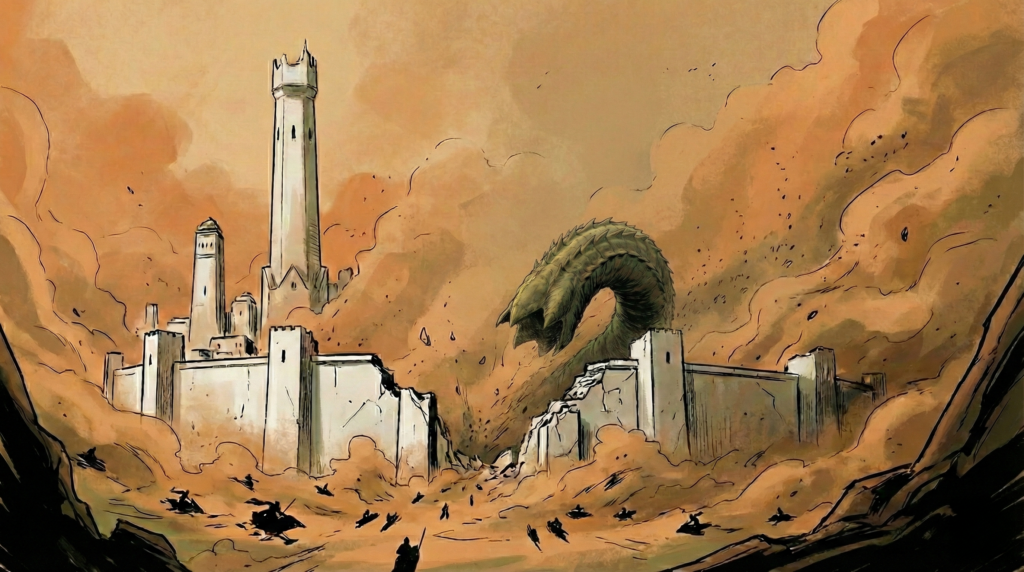
Garon Ironheart didn’t roar a hero’s challenge. He simply adjusted his grip on the liar’s hilt, planted his feet in the shifting sand, and waited for the tide to break against him.
Chapter 1: Ashes in the Wind
Five years is long enough for a man to forget the sound of his own name, but not long enough to forget the smell of burning hair and stone.
Garon sat perched on a weather-beaten tooth of granite, overlooking the undulating grave of the Aethel Republic. Where the spires of Eldoria once pierced the clouds, there was now only a flat, mocking expanse of ochre. The wind here didn’t just blow; it searched. It felt its way into the cracks of his boots and the deep lines of his face, leaving a film of fine, gray silt that tasted of ancient hearths and pulverized bone.
He reached for the sword resting across his knees. His fingers moved with a slow, arthritic caution. The leather grip, once stained dark by his own sweat and the blood of Kheldari princes, was now parched. It felt like snakeskin—dry, brittle, and alien. He didn’t draw the blade. He hadn’t drawn it in three hundred miles. To do so would be to admit there was still a reason to fight, and Garon’s body was tired of being lied to.
Below him, in the lee of a collapsed dune, a ribbon of acrid smoke rose from a sputtering fire.
“The wind is turning, Garon.”
He didn’t turn. He knew the cadence of Anya’s footsteps, even in the soft sand. They were heavy today—the gait of a woman who had spent the morning bartering for camel-piss water and finding none. She stepped into his peripheral vision, her face wrapped in a tattered indigo veil that left only her eyes exposed. They were the color of a bruised sky, hard and flickering with a restless, impatient energy.
“The sand will be at our backs by nightfall,” she continued, looking out at the wasteland. She didn’t call him General. That title had died with the walls. “Kael is coughing again. Wetly. If we don’t find a shadowed cistern or a trade-route scrap by tomorrow, he won’t make the next ridge.”
Garon finally looked at her. He saw the way she tucked her hands into her sleeves to hide the tremors of hunger. “Then we move at moonrise,” he said. His voice felt like a heavy weight being dragged over gravel. “The Kheldari scouts stick to the wadis when the sun drops. We’ll take the high crests.”
“The high crests are exposed,” Anya countered, her voice sharpening. “We have three able bodies, two wounded, and a bard who can barely carry his own water skin. If the Kheldari see us on the ridgeline, we aren’t a caravan. We’re target practice.”
“We’re ghosts, Anya. The desert doesn’t hunt what’s already dead.”
Anya stepped closer, the scent of dried sage and unwashed wool following her. “Don’t hide in your nihilism, Garon. It’s the only luxury you have left, and the rest of us can’t afford it.” She gestured toward the huddle of survivors below. “They look at you and see the Lion. I look at you and see a man waiting for a heart attack to finish what the Kheldari started. Pick a side. Either lead them or let them go.”
She didn’t wait for an answer. She turned and began the long, sliding descent back to the camp, her silhouette sharp against the shimmering heat.
Garon watched her go, a dull ache throbbing in his chest—not the sharp fire of the battlefield, but the slow, corrosive rot of shame. He looked back at the horizon.
Movement.
At first, he thought it was a dust devil, a dancing pillar of grit kicked up by the heat. But it moved with a jagged, desperate intentionality. A lone figure, cloaked in rags that fluttered like broken wings, was stumbling toward them from the direction of the Dead Sea.
Garon stood. His knees popped with a sound like dry kindling. He reached for his binoculars—the brass worn down to a dull, oily black—and adjusted the focus.
The figure fell. Rose. Fell again.
As the man drew closer, the wind shifted, carrying a frantic, rhythmic sobbing. It wasn’t the sound of a nomad lost in the wastes. It was the sound of a man running from a nightmare.
“Anya!” Garon called out. The old authority returned to his voice, a phantom limb twitching into life. “Get the water skin. And bring your kit. We have a guest.”
Garon didn’t wait for Anya’s protest. He descended the ridge, his boots kicking up plumes of dust that tasted like the end of the world.
Below, the camp was a study in slow-motion desperation. Kael, the former smith, lay curled in the shade of a lean-to, his chest rattling with every breath. Beside him sat Elara, the bard—though she hadn’t touched her lute in months. She was busy sharpening a piece of scavenged bone into a needle, her eyes focused on a tear in Kael’s tunic with a terrifying, hollow intensity.
“Anya, water!” Garon barked as he hit the flat of the basin.
Anya was already moving, but she stopped by Elara first, placing a firm hand on the woman’s wrist. “Elara, leave the sewing. Go to the ridge and watch the northern flank. If you see dust that isn’t made by the wind, you whistle. Twice.”
Elara looked up, her gaze vacant for a second before snapping back to the present. “The boy? Is it more of them?”
“It’s one man,” Anya said, her voice dropping to a tone of calm command that Garon recognized from the trenches of Eldoria. “And he’s half-dead. Go. Now.”
Elara scrambled up, clutching a rusted dagger she’d kept tucked in her boot. She didn’t look at Garon as she passed; she looked only at Anya, nodding once in a silent pact of survival.
Garon reached the collapsed figure just as the man’s strength gave out entirely. He was a heap of sun-bleached rags and blistered skin. Garon rolled him over, expecting the sight of a stranger, a raider, or perhaps a ghost.
Instead, he found a face he had tried very hard to bury.
The boy—Kai—was unrecognizable. His lips were split into black, vertical gasps. His eyes were crusted shut with salt, but as Garon lifted his head, the boy’s hand flew out, clawing at Garon’s forearm with a strength born of pure, primal terror.
“General…” the boy croaked. It wasn’t a greeting; it was a plea for a world that no longer existed.
“Steady, son,” Garon murmured. He took the water skin Anya handed him—it was pitifully light—and let a few drops trickle onto Kai’s tongue.
Kai coughed, a violent, hacking sound that sprayed flecks of blood onto Garon’s hand. He gripped Garon’s tunic, pulling him down until their foreheads almost touched. The boy smelled of ozone and the strange, metallic tang of the deep wastes.
“They found it,” Kai hissed, the words whistling through the gaps in his teeth. “The… the breath… of the Deep. The Legacy.”
Anya knelt on the other side, her hands already working to peel back the boy’s tattered sleeves to check for infection. She froze at the word. Her eyes met Garon’s over Kai’s shaking body. Five years of pragmatic silence shattered in that one look.
“He’s delusional, Garon,” she said, though her voice lacked its usual steel. “Heat-madness. The Legacy is a nursery rhyme we used to keep the conscripts from deserting.”
“No,” Kai gasped, his eyes fluttering open. They were bloodshot, the whites turned a sickly yellow. “The Kheldari… they have a Sun-Seer. They opened the first seal. I saw… I saw the light that doesn’t cast shadows.”
He began to shake—a rhythmic, violent tremor that Garon knew well. It was the “rattle,” the sign of a body that had reached its limit and was starting to shut down.
“Kael! Get the blanket!” Anya shouted toward the smith.
Kael struggled to his feet, leaning heavily on a crutch made from a spear-shaft. He hobbled over, his face etched with a grim curiosity. “If he’s from the Republic, he’s a miracle,” Kael wheezed, draping a moth-eaten wool blanket over Kai. “Or a curse.”
Garon didn’t answer. He watched Kai’s fingers—the nails were worn down to the quick, as if he had been digging through stone.
“He’s not just from the Republic,” Garon said quietly, looking at the way Kai’s hand still clutched the air as if trying to hold onto a fading dream. “He’s the one I sent away. The one who was supposed to live.”
Kai’s head lolled back, his breathing turning into a shallow, rapid whistle. “The Whispering Sands… they’re moving, General. The desert… it’s waking up.”
Anya stood, her face a mask of calculated coldness, but Garon saw the way her thumbs stepped rhythmically against her thighs—a nervous tic she’d had since the siege.
“If the Kheldari are moving on the deep wastes, they aren’t looking for water,” she said. She looked at the small, broken group—the smith who could barely walk, the bard who had forgotten how to sing, and Garon, the lion who had lost his teeth. “And if they find whatever is out there, they won’t need to hunt us anymore. They’ll just wait for the world to stop.”
Garon looked down at his hands. For the first time in five years, the leather of his sword-hilt didn’t feel like a lie. It felt like a debt.
“We aren’t waiting,” Garon said. He looked at Anya. “Check the supplies. Every scrap. Every drop.”
Anya tilted her head, her bruising eyes searching his. “For what? A funeral march?”
“For a hunt,” Garon replied. “If the boy says the desert is waking up, then we’d better be standing when it opens its eyes.”
The sun had long since surrendered, leaving the desert to a cold, predatory silence. The campfire was a pathetic thing—a huddle of glowing embers fed by dried scrub and the occasional bit of sun-bleached driftwood.
Garon sat by the fire, the “Legacy” of his command reduced to a bowl of greyish gruel and a whetting stone. He pulled the stone along the edge of his blade. Shirr. Shirr. The sound was a heartbeat.
Anya approached from the shadows. She didn’t sit. She stood just outside the circle of light, her hands resting on her belt, her posture as rigid as a spear shaft. She had removed her veil, revealing a jawline tightened by five years of grit.
“Kai is stable,” she said. “The ‘rattle’ has subsided, but his fever is a wildfire. If we move him tomorrow, we’re essentially burying him ourselves.”
“We don’t have the luxury of a recovery,” Garon said, not looking up from the steel. “The Kheldari don’t wait for fevers to break.”
Anya stepped into the light, her eyes reflecting the orange glow with a sudden, sharp intensity. “You’re doing it again, Garon.”
“Doing what?”
“Playing the General.” She gestured toward the sleeping forms of Elara and Kael. “Look at them. Truly look at them. We aren’t an army. We’re a scavenger’s pile. You talk about ‘hunts’ and ‘standing when the desert opens its eyes,’ but we don’t have enough water to reach the next cistern, let alone the Whispering Sands.”
Garon stopped the stone. He looked up, his weathered face catching the shadows. “I know exactly what we are, Anya. But I also know what happens if we stay here. We wither. We turn into the same dust we’re walking on.” He reached out, his hand hovering near the fire. “I see the way you look at me. You’re waiting for the old man to collapse so you can finally be right about the world being over.”
Anya flinched—a microscopic movement, but Garon saw it. “I’m not waiting for you to collapse,” she whispered, her voice cracking for the briefest of moments. “I’m waiting for you to realize that Eldoria is gone. You keep reaching for a sword that’s already broken.”
“It’s not broken as long as there’s someone to hold it,” Garon countered. He stood, his joints popping like dry timber. He stepped closer to her, his height still imposing despite the slight stoop in his shoulders. “I remember a girl who once argued with a High Priest about the tactical value of hope. She told him that hope was the only weapon that didn’t need sharpening. Where is she, Anya? What happened to the commander who had dreams bigger than the next scrap of shade?”
Anya’s laugh was a dry, hollow thing. “She died in the western breach, General. She was buried under the rubble while you were playing the martyr at the inner gate. I didn’t have the luxury of ‘hope’ when I was pulling Kael out of the fire. I had gravity and sweat. That’s all I have now.”
She looked at him then, and for a second, the pragmatism slipped. Garon saw the girl he remembered—the brilliant, fiery strategist who had been his finest student. But it was like looking at a reflection in a cracked mirror.
“I rely on you, Anya,” Garon said, his voice softening. “More than you know. You’re the reason any of us are breathing. But if you stop dreaming, you’re just a corpse that hasn’t realized it’s stopped moving.”
Anya’s eyes welled with a sudden, angry heat, but she blinked it back. She wouldn’t give him the satisfaction of a tear. She wouldn’t let herself believe in him again, only to watch him fail her in the end.
“I’ll check the water skins,” she said, her voice regaining its flat, professional edge. “If we’re marching toward a myth, I’d prefer to do it without a parched throat.”
She turned to leave, but paused at the edge of the light. “Don’t push them too hard tomorrow, Garon. They aren’t your ‘Lion’s Guard’ anymore. They’re just people. Try to remember the difference.”
She vanished into the darkness, leaving Garon alone with the dying embers. He looked down at his sword. The blade was clean now, the edge catching the moonlight like a silver needle. He felt the weight of his years, the ache in his back, and the terrifying, beautiful flicker of purpose in his gut.
He was an old man, and he was tired, but he wasn’t done being a liar. He would lie to them all until they believed in the Republic again. Or until the sand claimed them.
The transition from the campfire’s embers to the dawn’s harsh light felt less like a new day and more like a fresh indictment.
The first morning of the march was not marked by a trumpet blast, but by the dry, rhythmic clicking of Kael’s crutch and the heavy, wet rasp of Kai’s breathing. They moved while the desert was still a deep, bruised indigo—the only time of day when the air didn’t feel like it was trying to peel the moisture from their eyeballs.
Chapter 3: The Long Awakening
Garon led the way, his shadow stretching out before him like a dark, elongated ghost. Every step was a negotiation with his spine. He could feel the grit in the hinges of his knees, a localized sandstorm of bone on bone. Behind him, the small caravan shuffled in a silence that was less about discipline and more about the preservation of breath.
By mid-morning, the indigo had vanished, replaced by a sky of bleached bone.
“Halt,” Garon said. He didn’t shout it; he didn’t have the spit. He simply raised a hand.
The group collapsed where they stood. They didn’t look for shade—there was none. They simply sat in the dust, their heads bowed like penitents. Anya moved among them immediately. She didn’t check on Garon. She went straight to Kai, who was strapped to a makeshift litter between two emaciated pack-mules.
“He’s burning up again,” Anya said, her voice tight. She looked at Garon, her eyes sharp with the accusation they had traded the night before. “The water we gave him an hour ago… it’s already gone to sweat. We’re pouring our lives into a sieve, Garon.”
Garon walked over, his boots crunching on the sun-baked crust of the earth. He looked down at Kai. The boy’s skin was the color of old parchment, translucent and stretched tight over his cheekbones.
“Elara,” Garon called out.
The bard looked up from where she was picking at a callus on her palm. “General?”
“Give us a cadence. Something for the feet.”
Elara stared at him as if he had asked her to sprout wings. “I… I haven’t sung since the fires, sir. My throat is full of Ashari dust.”
“Then hum,” Garon said, his voice gaining that stubborn, irritating edge that drove Anya to distraction. “Find a rhythm. If we walk to a funeral march, we’ll be dead before the sun reaches its zenith. Find something with a bit of the Republic in it.”
Anya stood up, her face inches from his. “A song won’t fill their bellies, Garon. And it won’t hide us from the Kheldari. Look.”
She pointed to the shimmering horizon. Through the heat haze, the desert floor seemed to ripple like water. But these ripples were dark. Moving. A line of dust clouds, distant but deliberate.
“Scouts,” Kael wheezed, leaning heavily on his spear-crutch. “The Kheldari don’t move that fast unless they’ve caught a scent.”
Garon squinted. His eyes ached, the sunlight feeling like needles behind his retinas. He didn’t see scouts; he saw the inevitability of their past catching up to their future.
“They’re searching for the same thing we are,” Garon said. He turned to the group, his stature straightening, forcing the pain into a small, dark corner of his mind. “They have horses and water, but they don’t have the Map.”
“We don’t have a map either!” Anya snapped. “We have a feverish boy’s rambling about ‘light without shadows’!”
“The boy is the map,” Garon countered. He leaned down, gripping the edge of Kai’s litter. “Kai! Look at me.”
Kai’s eyes flickered open, rolling wildly before settling on Garon’s face. For a second, the delirium cleared, replaced by a terrifying, lucid clarity.
“The sands…” Kai whispered. “They aren’t just shifting, General. They’re… breathing in. Can’t you hear the intake?”
Garon went still. He didn’t hear a breath. But he felt a change in the air—a sudden, sharp drop in pressure that made his ears pop. The horizon, where the Kheldari scouts were moving, began to blur. Not from heat, but from a sudden, violent eruption of white sand that spiraled upward like a titan’s finger.
“The Whispering Sands,” Kael breathed, his voice trembling. “They say when the white sand rises, the ancestors are speaking.”
“They aren’t speaking,” Garon said, reaching for his sword hilt. “They’re screaming. Anya, get them up. Now! We don’t head for the cistern. We head for the eye of that storm.”
Anya looked at the towering wall of white grit and then at the Kheldari scouts closing the distance. She saw the death behind them and the madness in front of them. For a heartbeat, she looked at Garon not as a pragmatic survivor, but as a soldier looking for a command.
“If we die in there,” she said, her voice barely audible over the rising moan of the wind, “I’m going to spend eternity telling you how wrong you were.”
“I look forward to the conversation,” Garon replied, a grim, ghost of a smile touching his cracked lips. “Now move!”
Chapter 4: The Star of the Ancients
The transition into the Whispering Sands was not a wall of wind, but a slow, sickening tilt of the world’s axis.
Garon felt it first in his inner ear—a sudden, pressurized pop that made the horizon shimmer and liquify. The orange dust of the Ashari didn’t fade; it was swallowed. One step, he was treading on the scorched silt of a dead republic; the next, his boot sank into a drift of white, crystalline flour that hummed against the leather.
“Halt,” Garon commanded. His voice sounded thin, the acoustics of the desert suddenly dampened as if they had walked into a room lined with velvet.
Behind him, the line faltered. Marek, the silent man whose face was a map of puckered burn scars, stumbled into the back of Hadley. Hadley didn’t curse; he simply stood there, his breath hitching in a series of jagged, wet gasps.
“General,” Anya whispered. She had stopped ten paces ahead, the lead rope of the mules slack in her hand. She was looking up.
Garon followed her gaze, and the breath died in his throat.
The sun was still there, but it had turned into a pale, sickly disc, stripped of its heat and its crown of fire. And around it, the sky had bruised into a deep, impossible violet. It was mid-afternoon, yet the stars were out—not the comforting constellations of the Aethel sailors, but long, needle-sharp splinters of silver that seemed to vibrate.
At the zenith sat a singular point of light, flickering with a rhythmic, heartbeat cadence.
“The Star of the Ancients,” Elara breathed, her voice a fragile thread in the cold air. “My grandmother used to say that when the Great King died, he didn’t go to the earth. He became the North Nail, pinning the sky to the world so the dark wouldn’t leak in.”
“It’s a navigational myth, Elara,” Anya said, but her voice lacked its usual academic bite. She reached up, shielding her eyes. “But the light… it’s wrong. Garon, look at your shadow.”
Garon looked down. The white sand beneath him was luminous, but there was no dark shape stretching out from his boots. The light was sourceless, bathing them from every angle at once. It stripped the world of depth, making the dunes look like flat, painted theater wings.
“Marek, Hadley,” Garon called, his voice grounding them. “Tighten the cinches on the mules. They’re starting to shiver.”
The two men moved with a sluggish, dreamlike quality. Marek ran a hand over the flank of a pack mule, his brow furrowed. “It’s the sand, sir,” he said—the first words Garon had heard him speak in days. “It’s… drinking.”
Garon knelt and pressed his bare palm to the white grit. The sensation wasn’t just cold; it was an active, predatory leeching. It felt as if the sand were pulling the very kinetic energy from his marrow. Within seconds, his fingers felt stiff, the joints beginning to lock.
Marek reached for his waterskin, but his hands—numbed by the leaching chill—fumbled the leather toggle. A few heavy droplets splashed onto the white flour at his feet near where Garon was still crouched down.
At the same moment, Kael’s spear-crutch slipped, the iron-shod tip striking a buried piece of obsidian with a sharp, metallic tang.
As the ringing sound of the iron continued to ripple through the air, Garon noted the sand around the spilled water. It moved slowly at first, then with increasing motion as the sound wave repeatedly hit the wet sand. As the tone evened out to a steady singular tone, the reaction was violent. The water droplets didn’t just turn to ice; they shattered the crystalline sand around them, creating a miniature crater of jagged, razor-sharp silicone. The sand seemed to clench around the sound and the moisture, turning from a soft powder into a brittle, glass-like state in a heartbeat.
It’s a resonant lattice, Garon realized, his mind cataloging the data. The sand reacts to moisture, but it’s the vibration that triggers the phase-change.
“Careful with the water,” Garon warned, his voice low. “In this place, a spill isn’t a waste. It’s a landmine.”
“Marek’s also right,” Garon said, standing and rubbing his numbing hand. “The sand is a heat-sink. If we stop moving for more than a minute, we won’t have the strength to start again. We march in two-column. Kael, you take point with Anya. Elara, you and Marek stay on the litter. Hadley, you’re with me at the rear.”
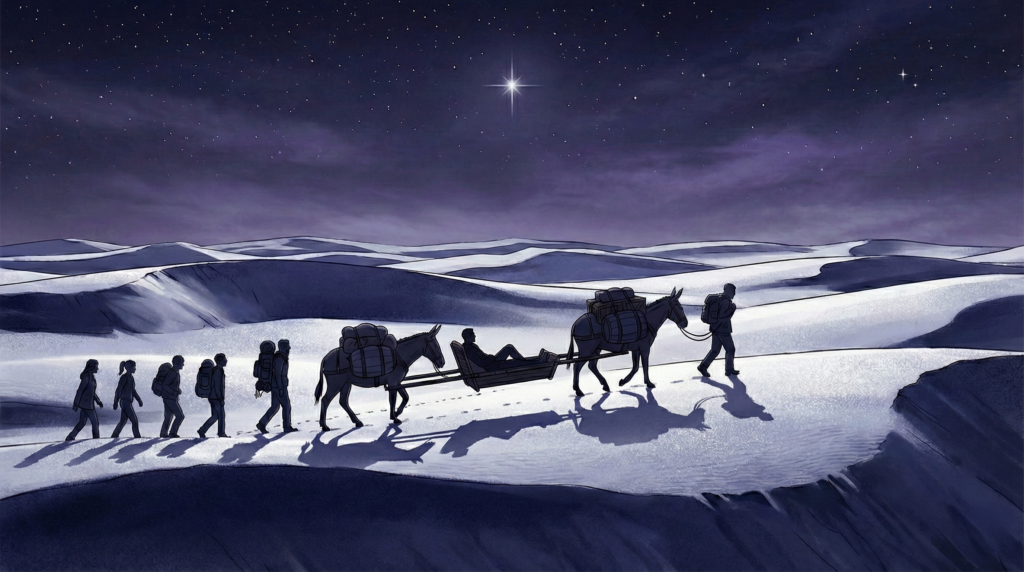
They moved, a small, fragile string of souls held together by the rhythmic shirr-shirr of their boots. The silence of the place began to manifest as a sound—a low-frequency thrum that resonated in the hollow of Garon’s chest.
…Lhe-an…
It wasn’t a voice. It was the friction of the crystalline sand rubbing against itself, but the human mind, desperate for patterns, shaped it into the Old Tongue. The Debt.
“Does everyone hear that?” Hadley asked, his hunched shoulder hitching nervously. “Is someone following us?”
“The wind, Hadley,” Garon lied, though he felt the word Lhe-an vibrating in his own teeth. “Just the wind.”
“It doesn’t feel like wind, General,” Kael wheezed from the front, his spear-crutch sinking deep into the floury drifts. “It feels like a conversation.”
They crested a high, translucent ridge, and the ruins finally revealed themselves. They weren’t built onto the desert; they were erupting from it. Massive ribs of black basalt, etched with glowing geometric lines, arched over a central plaza that seemed to swallow the violet starlight.
But between them and the safety of the stone lay a mile of open, shadowless white.
And on the far horizon, the “wrong” stars caught the glint of lead masks. The Kheldari hadn’t just followed them; they were pacing them, moving with a silent, frictionless grace that suggested they had been in this “other” place many times before.
“They aren’t hunting us,” Anya realized, her eyes wide as she watched the Kheldari wraiths glide over the sand. “They’re waiting for the sand to finish the job for them.”
Garon unsheathed his sword. The metal felt impossibly heavy in his cold-numbed hand. “Then we’ll have to disappoint them. Hadley, Marek—pick up the pace. If we reach the basalt, we regain the ground. Move!”
Chapter 5: The Toll of the Threshold
The Kheldari stayed exactly three hundred paces back.
In the shadowless, violet light, they looked like smears of ink against the white crystalline flour. There were four of them. They didn’t ride horses; they rode “sand-skimmers”—long, bone-framed sleds pulled by hairless, low-slung hounds that moved with a terrifying, silent efficiency.
“They’re playing with us,” Marek muttered, his voice cracking. He was sweating despite the biting cold, a sign of the deep, systemic exhaustion setting in. “They’re waiting for Kael to fall. Or the mules.”
“No,” Garon said, his eyes fixed on the lead skimmer. “They’re watching. They’ve been at the edge of these ruins for years, and they haven’t found a way in. They want to see if we’re the key or just more carrion.”
Anya shifted her grip on the lead rope. “If they see us activate the basalt arch, the secret is out. We can’t let them report back to the main host. Garon, if even one of those skimmers turns back toward the Ashari, we’re dead before we reach the inner sanctum.”
Garon looked at the ruins, then at the white, humming dunes. He felt the cold leaching through his boots, but he also felt the strange, rhythmic pulse of the ground.
“The sand,” Garon whispered. “It’s a heat-sink, but it’s the resonance that locks it. Anya, how long before the mules’ hearts give out if we push them to a gallop?”
Anya frowned, her mind spinning through the logistics. “In this cold? Ten minutes. Maybe less. Why?”
“We aren’t going to gallop,” Garon said. He turned to Hadley and Marek. “I need you to unstrap the secondary water barrels. Empty them. Now.”
“General?” Hadley gasped. “That’s our reserve. We’ll die of thirst before—”
“Do it,” Garon commanded, his voice brooking no argument. “Marek, take the salt-cured meat from the packs. Shred it. Scatter it in our tracks as we move. Elara, I need you to hum. Not a song—just a low, steady drone. Match the frequency of the ground.”
The group moved with a frantic energy. As the barrels were emptied, the water hit the sand with a hiss, creating a wide, unstable patch of wet crystalline slurry. Elara began to hum, a deep, vibrating tone that seemed to make the very air feel heavy.
The Kheldari took the bait. To them, it looked like the final, desperate act of a dying caravan. The lead skimmer accelerated, the hounds sensing the kill.
“Anya, lead them to the basalt,” Garon said. “When you reach the stone, don’t look back.”
Garon eyed the wet sand behind them. He could see the steady tone from Elara was starting to work as the sand was slowly shifting.
Anya didn’t move. She stepped toward him, her boots cracking the thin film of frost. “Don’t you dare,” she hissed. “Don’t you dare turn this into another ‘inner gate’ sacrifice. I’m not pulling you out of the rubble again!”
“You won’t have to,” Garon said, his voice grounded. “Because I’m not standing here to die. I’m standing here to win. Now get to that arch.”
She searched his face and found only the Lion. She pivoted, pointing toward the massive ribs of black stone. “Hadley, Marek—aim for the pillars! The lore says basalt holds the sun’s pulse. The sand can’t touch it!”
As the others scrambled toward the ruins, Garon lagged behind. He knelt in the white flour, waiting until the lead Kheldari was fifty paces away. He could see the featureless, lead-masked face of the raider, who raised a barbed harpoon in an arrogant salute.
Garon didn’t draw his sword. He waited until the skimmer’s hounds hit the wet, vibrating patch of sand.
Then, he slammed his gauntleted hand against the iron pommel of his sheathed sword—CLANG.
The sharp, metallic ring acted like a hammer-blow to the resonant lattice of the sand. Combined with Elara’s humming and the moisture, the reaction was instantaneous. The “tension” of the crystalline sand snapped. The exothermic reaction simmering beneath the surface turned into a localized implosion.
The ground didn’t just break; it vented. A plume of super-cooled vapor erupted, and the sand beneath the skimmer turned into a vortex of razor-sharp glass. The hounds’ paws fused to the surface in a heartbeat, their momentum carrying the sled forward until the bone frame shattered against the now-solidified ground.
Garon stood as the second and third skimmers tried to veer away, but the “conversation” of the sand had turned into a roar. The raiders were caught in a trap of their own physics. One raider managed to leap from his sled, landing on the surface with a heavy thud. He scrambled to his feet, his lead mask catching the violet starlight.
He looked at Garon—truly looked at him—and froze. The recognition was visible even through the lead slits. The Lion. But the sand didn’t care for reputations. The raider had been on the white flour too long. As he tried to draw breath to sound a horn, the cold reached his lungs. He fell silently, his body turning into a white, frosted statue before he hit the ground.
Garon didn’t linger. He turned and ran—a limping, heavy-footed dash toward the basalt arch where Anya was waiting. He hit the black stone and felt the warmth radiating through his boots. Behind him, the white sand smoothed over, the raiders buried under a fresh, humming drift.
“Did any get away?” Anya asked, her crossbow leveled at the horizon.
“No,” Garon said, his chest heaving. “The sand took the debt.”
Anya looked at him, her eyes searching. “They recognized you. That last one… he knew.”
Garon looked back at the violet horizon. “Then it’s a good thing he can’t talk. If the Kheldari find out the Lion is here, they won’t send scouts next time. They’ll send an army.”
He turned toward the ruins, where Marek and Hadley were already staring in awe at the glowing geometric lines of the plaza.
“Come on,” Garon said. “Let’s see what they were so afraid of.”
Chapter 6: The First Layer
The transition from the lethal, leaching cold of the sand to the basalt of the ruins was like stepping from a grave into a heated hall. The black stone beneath their boots didn’t just feel warm; it felt thick, as if the rock were saturated with a thousand years of captured sunlight.
Garon stood at the threshold, his breath coming in ragged plumes that slowly vanished in the ambient heat of the plaza. Behind them, the Whispering Sands remained a violet-hued nightmare, but here, within the ribs of the black basalt, the air was still and smelled of sun-baked earth and something sharper—the ozone scent of a storm that had never broken.
The plaza was an expanse of polished obsidian and basalt, laid out in a series of concentric circles that drew the eye toward a central, domed structure. The geometric lines Garon had seen from the ridge weren’t just carvings; they were narrow channels in the stone, filled with a substance that flowed like liquid mercury and pulsed with a soft, rhythmic amber light.
“Stay on the black stone,” Garon commanded, his voice echoing with a clarity that startled him. “Hadley, Marek—bring the mules into the lee of that pillar. Kael, get the boy down. Gently.”
Marek and Hadley moved with a sudden, renewed vigor. The warmth of the basalt seemed to act as a tonic, loosening their frost-stiffened limbs. They led the mules toward a massive, square pillar etched with the history of a people who had been dead for millennia.
Anya didn’t look for a place to rest. She walked straight to one of the glowing channels, kneeling to inspect the liquid within.
“It’s not mercury,” she whispered, her fingers hovering just inches above the amber pulse. “It’s… resonant. The stone is vibrating at a frequency that keeps the liquid in a state of constant flux. Garon, this isn’t just a ruin. It’s an engine.”
“An engine for what?” Garon asked. He walked toward the central dome, his hand resting on the pommel of his sword.
“For memory,” a voice rasped.
Garon turned. Kai was awake. The boy’s fever hadn’t broken, but the milky luminescence in his eyes had intensified. He was sitting up on the litter, his gaze fixed on the dome.
“The First Layer isn’t a weapon, General,” Kai said, his voice layered with that strange, metallic resonance. “It’s a mirror. The Aethel didn’t just build walls; they built a way to remember why the walls were there.”
As Garon approached the central dome, the amber light in the channels surged, flowing toward him like a tide. The liquid mercury-stuff didn’t stay in its tracks; it began to rise, forming thin, shimmering needles that pointed directly at the “Lion of Eldoria.”
“Garon, get back!” Anya shouted, reaching for her kit.
But Garon didn’t move. He felt a strange pull in his chest—not a physical tug, but a recognition. The “spear-wound that never closed right” began to thrum. It wasn’t painful; it was a rhythmic, pulsing heat that matched the glow in the stone.
The central dome shuddered. A seam appeared in the flawless basalt, and the heavy stone doors ground open, revealing a chamber filled with a swirling, golden mist.
“It recognizes the Lion,” Kael whispered, leaning on his spear-crutch, his face illuminated by the amber glow. “The stories said the Legacy would only answer to one who carried the weight of a fallen crown.”
Garon looked at his group—the silent stonemason, the broken smith, the traumatized bard, and the brilliant, pragmatic commander who still didn’t want to believe. They were the last fragments of a world that had been erased.
“Stay here,” Garon said, his voice low and resolute. “Keep the mules tethered. If the doors start to close, Anya—you know what to do.”
“I’m not leaving you in there alone,” Anya said, stepping up beside him. Her jaw was set, her eyes reflecting the golden mist of the chamber.
Garon looked at her and felt a flicker of the girl she used to be—the one who would have argued the tactical necessity of a second observer. “Fine. But stay behind me. If this is a mirror, I’d rather be the one who breaks it.”
They stepped into the golden mist.
The interior of the dome wasn’t a room. It was a projection. The mist swirled into shapes—towering walls, white spires, and a sea of blue tabards. Garon froze. He was standing in the middle of Eldoria. Not the rotted, broken Eldoria of five years ago, but the city in its prime. He could hear the calls of the street vendors and the rhythmic clank of the city guard on patrol.
“It’s a ghost,” Anya whispered, her hand reaching out to touch a shimmering image of a fountain that wasn’t there. Her fingers passed through the golden light, leaving ripples. “A record in the stone.”
…Why do you seek the end, Lion?…
The voice didn’t come from the mist. It came from the stone beneath their feet.
In the center of the illusory city stood a figure. It wasn’t a holographic warrior or a monster. It was a woman in the robes of an Aethel Scholar, her face etched with a weary, ageless wisdom. She looked at Garon, and for the first time in his life, the General felt as if he were being inspected by someone who saw exactly how tired he truly was.
“I seek the Legacy,” Garon said, his voice echoing through the phantom streets. “I seek the power to protect what’s left.”
The Scholar tilted her head. “Power is the lie we tell to justify the cost. You do not seek power, Garon Ironheart. You seek a way to stop the sand from swallowing your shame.”
Anya stiffened beside him. “We’re here for the Republic. We’re here to stop the Kheldari.”
The Scholar turned her gaze to Anya. “The Republic is a ghost. The Kheldari are a fever. You are standing in the First Layer—the Layer of Truth. Before you can claim the Legacy, you must admit what you lost at the inner gate. Not the city. Not the army.”
The mist shifted. The golden image of Eldoria began to burn. Garon saw himself, five years younger, standing at the inner gate. He saw the moment he sent the boy away. He saw the look in his own eyes—not courage, but a desperate, hollow desire to die so he wouldn’t have to see the end.
“You didn’t stay to fight,” the Scholar whispered. “You stayed to hide.”
Garon felt the weight of the words. They were heavier than any chainmail, more cutting than any Kheldari blade. He looked at the image of his younger self, and then he looked at the weathered, scarred hands he held now.
“I stayed because I didn’t know how to live in a world without Eldoria,” Garon admitted, his voice barely a rasp.
The golden mist flared. The image of the burning city vanished, replaced by a single, glowing key of solid amber resting on a basalt pedestal.
“The first step to rebuilding,” the Scholar said, her form beginning to dissolve into the mist, “is admitting that the ruins are yours. Take the Key of Truth, Lion. But know this: the deeper you go, the more the stone will ask of you. And the stone always collects its debt.”
Chapter 7: The Resonance of Others
The golden mist inside the dome didn’t just fade; it collapsed, pulling back into the amber key Garon held with a sound like a long-held breath finally being released.
Outside, in the plaza, the silence was absolute—until the stone began to weep.
Marek stood with his back pressed against a soot-black pillar, his eyes squeezed shut. He wasn’t hearing the General’s confession, but he was feeling the frequency of it. The basalt beneath his palms was vibrating with a heavy, rhythmic thrum—the exact same sub-sonic shudder he’d felt in the deep quarries of the North right before a structural collapse. It was the sound of something solid admitting it was broken.
“Marek?” Hadley whispered, his voice trembling. The hunched man was staring at his own hands. The amber light flowing in the floor-channels had turned a violent, flickering crimson. “The stone… it feels hot. Like it’s angry.”
“It’s not angry,” Marek grumbled, though his own breath was coming in short, panicked bursts. “It’s just… yielding.”
Beside them, Elara hadn’t moved. She was sitting in the center of a geometric circle, her head tilted. She didn’t hear words, but she heard the shape of a grief she recognized. It was a discordance, a note held too long and too high until it shattered. She found herself humming along to the break, her voice a fragile, thin thread that harmonized with the grinding stone.
A sharp, metallic crack echoed through the plaza.
Garon and Anya emerged from the dome, Garon’s face a mask of pale exhaustion. He held the amber key like a live coal. Before he could speak, the very center of the plaza—the obsidian floor between the concentric circles—began to groan.
Massive, interlocking slabs of basalt didn’t just slide; they retracted into the earth with a tectonic force that made the mules bray in terror. Dust, thousands of years old, billowed up in a gray shroud, smelling of cold iron and stagnant oil.
As the dust settled, a staircase was revealed—not carved, but seemingly grown out of the dark stone, spiraling down into a heat-haze that shimmered with a dull, orange glow.
“It’s not the wind anymore,” Kai whispered from his litter. His eyes were fixed on the dark maw in the floor. “It’s the heartbeat. The Forge is hungry.”
Garon walked to the edge of the descent. The heat rising from the abyss was different from the desert sun; it was humid, heavy, and smelled of the deep places of the world. He looked at Marek and Hadley, seeing the fear in their eyes—and the way they looked at him, searching for the “Lion” who would tell them it was safe.
Garon didn’t offer a speech. He looked at his scarred hands, then at the key.
“Marek, Hadley—into the traces,” Garon said, his voice regaining its gravelly command. “We leave the mules here in the plaza; the stone is warm enough to keep them through the night. We carry only what we need. Anya, Elara… we’re going down.”
Anya stepped to the edge beside him. She didn’t look at the stairs. She looked at Garon’s profile, her eyes lingering on the new tension in his jaw. She had been in the mist. She had heard the Scholar.
“The Forge doesn’t just need a spark, Garon,” she said quietly, so only he could hear. “It needs a blueprint. And the only one who knows the shape of the Republic is you.”
Garon didn’t answer. He simply stepped onto the first stone slab and began the long descent into the orange dark.
Chapter 8: The Engine of the Deep
The descent led them into a cavern that smelled of wet iron and cold, stagnant air. This wasn’t a cathedral; it was a utility hub.
Massive, verdigris-coated pipes—some wide enough to drive a wagon through—snaked along the walls, disappearing into the dark. The “Forge” in the center wasn’t a furnace for swords, but a massive, tiered thermal-exchange.
“It’s a pump,” Kael whispered. He didn’t wait for Garon’s command. He hobbled toward a massive junction where four pipes met a central turbine. He pressed his ear to the cold metal, his face tightening. “It’s not just cold. It’s vacuum-sealed by age. If we just shove that flywheel, we’ll snap the drive-shaft.”
Garon watched Kael. The smith looked different here. In the Ashari, he was a broken man leaning on a stick. Here, surrounded by the geometry of industry, his posture straightened. He was a Master of the Forge again.
“Anya, Marek,” Garon said. “Check the seals on the lower intake. Hadley, help Kael with the secondary lever.”
“Elara,” Kael called out, his voice sharp and professional. “I don’t need a song. I need a pitch. Tap the third housing—the one with the silver inlay. Tell me if it rings flat or sharp.”
Elara stepped forward. She took a small, rusted iron spike from her belt and struck the housing. Ting.
She closed her eyes, tilting her head. “It’s flat, Kael. Like a cracked bell. There’s a blockage—sediment, maybe. Or ice.”
“Hadley! Marek!” Kael barked. “Get the pry-bars. We need to create a thermal shock. If we can get a bit of heat into the primary line, the expansion will crack the mineral build-up.”
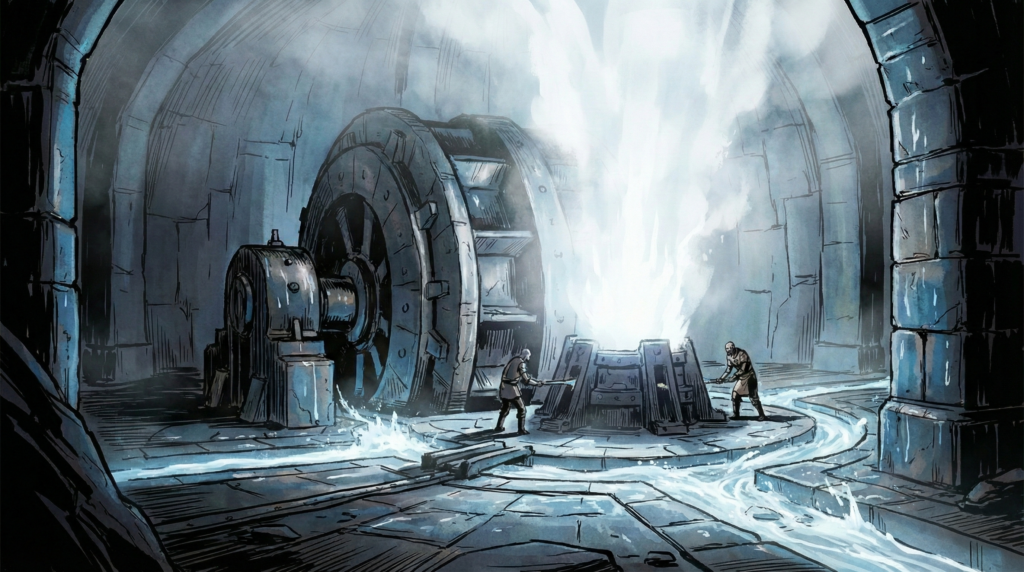
The “resonance” wasn’t a magic spell; it was a coordinated mechanical strike. Marek and Hadley provided the brute leverage, their muscles straining against iron that hadn’t moved in a millennium. Elara kept her hand on the pipe, signaling when the vibration changed from a dull thud to a clear, resonant hum.
Garon didn’t join the physical labor. He stood by the central console, the amber key in his hand. He felt the responsibility of it—the leader of a dead world, trying to reboot a system that didn’t just provide power, but life.
“Now, Garon!” Kael shouted, his face slick with sweat and ancient grease. “The seals are loose! Give it the spark!”
Garon plunged the amber key into the slot. He didn’t pray; he gave a command. Iterate. Start.
The key flared. The amber light surged through the floor-channels, not as a glow, but as a high-voltage current. The turbine groaned—a sound like a mountain being ground into flour. Then, a rhythmic thud-thud-thud began to echo through the pipes.
It wasn’t the sound of a weapon charging. It was the sound of a heartbeat.
“The Deep Waters,” Kai whispered from his litter. His fever had cooled, replaced by a quiet, wide-eyed awe. “They’re rising.”
A valve at the base of the Forge hissed, venting a cloud of pure, white steam. Then came the sound—a distant, roaring thunder that grew louder with every second.
“Get back!” Anya shouted, pulling Marek away from the main intake.
A seam in the basalt floor opened, and a torrent of water—clear, cold, and impossibly fresh—erupted into a collection basin. It wasn’t just a trickle; it was a flood. The smell of the chamber transformed instantly. The acrid scent of oil and sulfur was washed away by the scent of rain, minerals, and life.
“It’s not a weapon,” Marek said, staring at the water as if he were seeing a miracle. He fell to his knees, plunging his scarred hands into the basin. “It’s a well. A well for the whole desert.”
Garon looked at the water. It was flowing through the channels now, disappearing into the walls, headed toward the surface. He realized then what the Aethel had protected so fiercely. In a world of sand and war, the ultimate power wasn’t a sword that could kill ten thousand Kheldari. It was the ability to turn the sand back into soil.
“The Legacy,” Anya said, standing beside him. She looked at the amber key, then at the roaring water. The pragmatist in her was silent. “It’s a Second Chance.”
“But it’s not finished,” Garon said, looking at the stone stairs. The water was rising, following the internal plumbing of the ruins back to the plaza. “This is just the pump. We still have to plant the seed.”
Chapter 9: The Garden of the Long Night
The ascent from the Forge was no longer a climb through a dark throat. As the turbine below reached its optimal frequency, the basalt walls themselves began to bleed light—not the sickly violet of the desert, but a deep, resonant gold that pulsed in the veins of the stone.
When Garon reached the top of the central stairs, he didn’t find the small plaza he had left. The “engine” had done more than pump water; it had triggered a sequence of mechanical shutters and stone plates across the entire horizon. The grey dust that had clouded the air was being sucked away by a massive ventilation system, revealing a city of black glass and basalt that spiraled out for miles.
It was a necropolis of geometry, silent and sprawling, protected by the rising wall of the vortex that now shimmered at the far edges of the city’s perimeter.
The additional sand that had been cleared off of the city was now bound up in the swirling maelstrom surrounding the city.
“Look at the horizon,” Anya said. She wasn’t looking at the water. She was looking back toward the desert they had crossed.
The violet sky was fracturing. The “wrong” stars—the needle-sharp splinters of silver—were vibrating so fast they had become a blur. At the perimeter of the ruins, where the black stone met the white flour-like sand, the air was beginning to warp. It looked like the shimmer of heat, but it was cold. A wall of pressurized air and refracted light was rising, fueled by the same energy that pumped the water.
“A veil,” Kael wheezed, leaning against a pillar. He looked at the white sandstorm beginning to swirl at the boundary. “The pump doesn’t just draw water from the deep. It draws the atmosphere. It’s creating a localized vortex.”
“A storm that never ends,” Garon said. He walked to the center of the plaza looking around with awe.
“The Kheldari can’t see through that,” Anya said to Kael, gesturing toward the shimmering wall of the vortex. “To them, the Whispering Sands just became ten times more lethal. They won’t even find the outer ribs of the ruins. The resonance will scramble their hounds and shatter their skimmers before they get within a mile.”
“And us?” Kael asked. “We’re trapped in a cage of our own making.”
“Not a cage,” Anya countered. “A nursery. We have the water. We can stay put for more than a few days without looking over our shoulders. We can…”
“We can grow a foundation,” Garon finished as he walked back to their conversation, his eyes alive.
“General,” Marek called out, his voice echoing across the vast expanse. He wasn’t by the stairs. He and Hadley had wandered toward a massive, curved structure that flanked the central plaza—a hall of translucent stone that caught the golden light.
Garon walked toward them, his boots ringing on the basalt. He watched the way Marek moved; the man’s hunched, defensive posture had vanished, replaced by the steady, measuring stride of a mason who recognized the work of masters. Beside him, Hadley was no longer just the muscle; he was tracing the geometric lines on the walls with a reverent touch, his eyes wide with the realization that they were standing in a place built to last forever.
They entered the flanking hall, and the air changed. It was humid, thick with the scent of damp earth—not the scorched smell of the Ashari, but the rich, heavy perfume of a world that had been buried in its prime.
This was the Conservatory.
Massive troughs of dark, mineral-rich soil lined the walls, kept in perfect stasis for five years. At the far end of the hall stood a series of silver canisters, each etched with the sigils of the Aethel grain-lords.
“They didn’t just hide the water,” Anya whispered, stepping past Garon to examine a control panel made of polished obsidian. She looked smaller in the vastness of the hall, but her voice held a new, quiet intensity. “They hid the biology. They knew the Ashari would turn, Garon. They knew the Republic would fall. This wasn’t a panic room; it was a library for the future.”
She tapped a sigil, and the silver canisters hissed, sliding open to reveal thousands of seeds, preserved in a shimmering, amber gel.
Garon stood in the center of the hall, the weight of the moment pressing down on him. He looked at Kael, who was leaning against a massive irrigation pipe, his hands covered in the grease of the pump but his face cleaner than it had been since the war. Kael wasn’t looking at the seeds; he was looking at the way the water moved through the pipes he had just fixed, a Master of the Forge witnessing his own work bring a city back to life.
Near the seed-vault, Elara had sat down, her hands flat against the warm soil of the troughs. She wasn’t humming. She was simply closing her eyes, listening to the vast, subterranean heartbeat of the city as it breathed through the vents. For the first time, the hollow look in her eyes had been replaced by a focus that looked like a plan.
“We aren’t going to have to scrounge for shade anymore,” Hadley said, looking up at the high, translucent ceiling.
“No,” Garon said. He walked to the seed-vault and reached in, his fingers closing around a single, gel-coated grain. It felt heavy—a tiny, dormant life waiting for a command. “But we aren’t going to be ‘General’ or ‘Captain’ or ‘Smith’ anymore, either. This city is too big for a handful of survivors to hide in. It’s a city that needs to be lived in.”
He looked at Anya. “The Kheldari are out there, blinded by the storm we just woke up. They’ll spend the next decade trying to find a way through the white sand. That gives us a decade to turn this black stone green.”
Anya met his gaze. The pragmatism was still there, but it was being redirected. She wasn’t calculating their deaths anymore; she was calculating the yield of the soil. “We’ll need to map the lower levels,” she said, her voice already slipping into the cadence of a leader. “We need to know how many of these halls are functional, and if the stasis-soil extends to the outer wards.”
Garon nodded. He turned back to the others. “Marek, Hadley—you’re our scouts now. Explore the perimeter of this ward. Kael, I want a full diagnostic of the irrigation lines. Elara… keep listening. If the city starts to groan, I want to know why.”
He stepped toward the first trough of dark earth. He didn’t look back at the stairs or the desert beyond. He looked at the soil.
“We were the last embers,” Garon said, his voice carrying through the silent, golden hall. “But embers are meant to start fires. Let’s plant.”
The first seed hit the damp earth with a soft, final thud. Outside, the Whispering Sands roared against the invisible shield of the vortex, a distant, powerless ghost. Inside, the city of the Aethel began to grow.
Epilogue: The Gathering Echo
Decades had passed, but the basalt still held the heat of the sun.
Garon sat in the shade of a heavy-limbed fruit tree—one of the first to take root in the Conservatory’s mineral-rich soil. His hair was the color of bleached bone, and his hands, once stained with the copper of Kheldari blood, were now stained with the deep, dark loam of the gardens. He moved his legs with a slow, deliberate caution; the old spear-wound from Eldoria still thrummed whenever the atmospheric pressure of the vortex shifted.
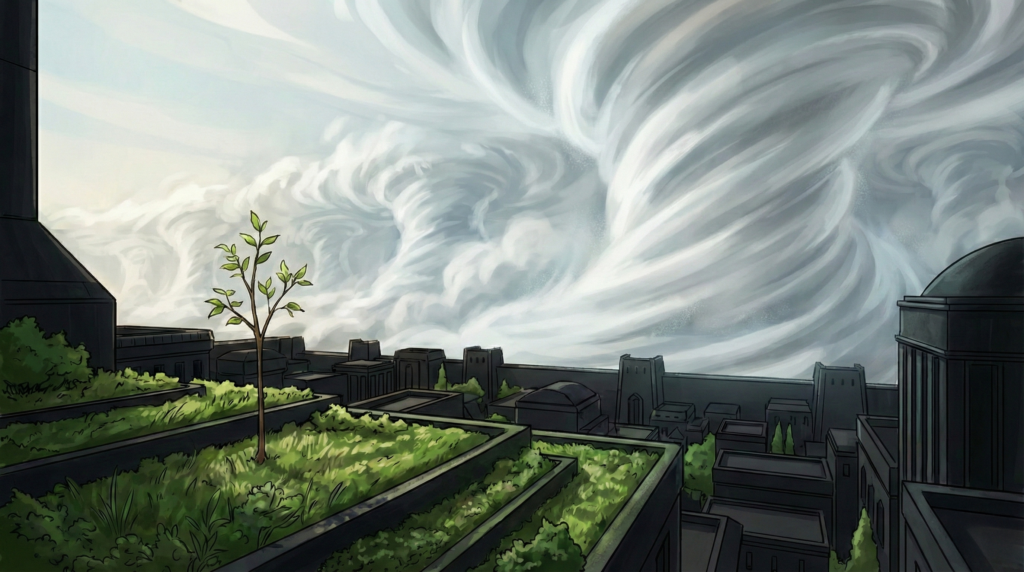
Across the plaza, the city of the Aethel breathed. Water flowed through the black stone channels with a steady, rhythmic pulse, feeding the tiered gardens that now climbed the ribs of the ancient ruins. It was a forest of basalt and leaf, a sanctuary of green held in the center of a white, howling storm. He saw the silhouettes of people moving through the wards—children who had never known the taste of Ashari dust, and elders like Marek and Kael who spent their final years teaching the young how to listen to the stone.
“Grandfather?”
A young girl, barely ten years old, ran across the obsidian tiles. She had the restless energy of a scout and eyes the color of a bruised twilight sky. Her name was Anya, and Garon never spoke the name without a sharp, sweet pang of memory. The original Anya—the commander who had traded her crossbow for a plow—had seen the first ten harvests before the desert finally claimed her, and her last act had been to map the outer wards of the vortex. She had died a scholar-general of a world that didn’t need soldiers anymore.
“The wind is louder today,” the girl said, leaning against his knee. She pointed toward the horizon, where the white wall of the vortex shimmered like a ghost. “The Whispering Sands are trying to get in.”
Garon chuckled, a dry, rasping sound. “They aren’t trying to get in, little one. They’re just keeping the world away. They remind us that nothing grows without a shield.”
“General.”
A voice, low and melodic, drifted from the shade of a nearby pillar. Elara stepped forward. She was older, her face etched with the same wisdom as the stone she had spent decades listening to. No matter how many times he corrected her, she still called him General. She didn’t carry a lute, but she wore a Resonant Shard around her neck—a sliver of basalt tuned to the heartbeat of the Forge below.
“The Array is humming,” Elara said, her eyes fixed on the distant vortex. “I felt the skip in the frequency an hour ago. There’s a group at the Quiet Gate. Travelers from the Northern Reach.”
Garon looked toward the perimeter. “How many?”
“Twelve. Mostly families,” Elara replied. “They carried the Shards we sent out with the last trade-caravan. Hadley is leading them through the calm channels now. They look tired, Garon. They look like we did.”
Garon looked at the newcomers as they emerged from the white haze, blinking in the shadowless, golden light of the city. To the Kheldari, who still periodically tested the perimeter of the sands, the area remained a “God-Cursed Void”—a lethal trap of razor-glass and wind. They would never find the black city or the green halls because they didn’t have the frequency. They didn’t know how to listen.
“We have the room,” Garon said, his gaze returning to his granddaughter. “And the cisterns are full. Tell Hadley to bring them to the Second Ward. There’s soil ready for planting.”
Elara nodded, her hand resting briefly on the girl’s head before she turned back toward the Array. “The city is growing, General. It’s no longer just a memory.”
Garon picked up his journal, his fingers tracing the leather cover. He looked at the white storm in the distance. The Kheldari were still out there, a shadow on the horizon of history. They would eventually learn that the “void” was a lie; they would eventually bring a force large enough to test the very limits of the basalt ribs.
But for now, the city breathed.
“Tell me about the Lion,” Little Anya asked, settling into the dirt at his feet. “Tell me about the day the water came.”
Garon looked at the green leaves dancing against the black glass. He saw a gardener’s hands, a commander’s legacy, and a child’s future.
“The water didn’t just come,” Garon said, opening the journal to the first page. “We had to wake it up. We had to admit that the world we knew was gone before we could build the one we needed.”
He began to read, his voice steady and low, harmonizing with the distant, eternal hum of the Forge. The Lion of Eldoria was gone, buried under a decade of soil. In his place sat a gardener, and for the first time in a long, violent life, he didn’t need a sword to feel safe.

