
There is a specific kind of silence that settles in when you realize you are no longer standing at the beginning of the story. For a long time, the horizon feels infinitely elastic, a blurry line of “someday” and “perhaps” that stretches out to accommodate every ambition. But then, almost without warning, you find yourself at fifty. The light shifts from the bright, flat glare of noon to the long, amber shadows of late afternoon—a vista that is both more limited and infinitely more clear.
In this season, loss begins to take on a more intimate character. It is no longer a theoretical concept; it becomes a frequent visitor that thins the ranks of the generation above and occasionally taps a contemporary on the shoulder. But the loss isn’t just about people. You start to notice a subtle erosion of your own agility, a realization that your body doesn’t bounce back quite as fast or that your mind doesn’t grab hold of new systems with the same instantaneous friction it once did. Even the culture around you begins to feel like a conversation you’ve walked into halfway through. The modern media landscape, once designed to mirror your own face and desires, has largely moved on to the next generation. There is a strange, quiet grief in realizing you are no longer the target audience of the world.
The Clearing of the Decks
However, if the loss of optionality is a kind of grief, it is also a necessary clearing of the decks. When you’re younger, the world is a dizzying static of potential paths, a constant pressure of “what-ifs.” Now, the static has quieted. The work is no longer about starting from scratch; it is about the deliberate, careful masonry of building on the foundation already laid. The opportunities available to me now aren’t about grand, new beginnings or chasing breadth. They are about the profound, often more difficult, pursuit of depth.
I’ve spent a lifetime building networks and friendships, but I haven’t always prioritized the deepest levels of connection. The opportunity in this second half is to take those long-standing relationships and make them more meaningful. It means learning to be vulnerable, to ask for help, and to truly let people in instead of always playing the role of the self-contained “rock.” My therapist recently suggested that the goal is to move from being merely “respected” to being “liked or loved.” This transition requires a different kind of courage—the courage to be known by my partner and my oldest friends not for what I can do, but for who I am.
The Legacy of the Quiet Leader
This shift also changes how I view my own history. The problem-solving abilities and professional experience I’ve built over decades are more than just tools for my own advancement; they are a resource for others. I have always been a quiet leader, a style that feels perfectly suited for mentorship. It isn’t about being a charismatic guru or a loud voice in the room. It’s about sharing wisdom and helping someone else navigate their own path, ensuring that the legacy I leave is not just a list of accomplishments, but a collection of people who are better for having known me.

Even as I confront the physical reality of aging, there is a different kind of optionality in learning for the sake of learning. I may not be able to become an elite athlete, but I can still take up a new sport or hobby that challenges me. Writing has always been my way of processing the world, and there is a quiet thrill in the idea of being a beginner again—perhaps in a writing class or through a new language. The purpose is no longer to get a degree or change careers, but simply to keep the mind sharp and experience the joy of discovery without the pressure of a specific outcome.
Stewardship and the Canvas
Perhaps the most significant shift is in my relationship with my own health. Having managed ongoing issues since adolescence, I’ve often felt a sense of guardedness, as if my body were a territory I had to defend. At fifty, the choice is clear: I can let these issues define my limits, or I can take an active role in my own well-being. This isn’t about some dramatic, late-life transformation. It’s about the daily, quiet opportunities to be mindful. It’s choosing steadiness over the exhausting cycle of highs and lows, appreciating the body I have, and taking care of it for the long haul.
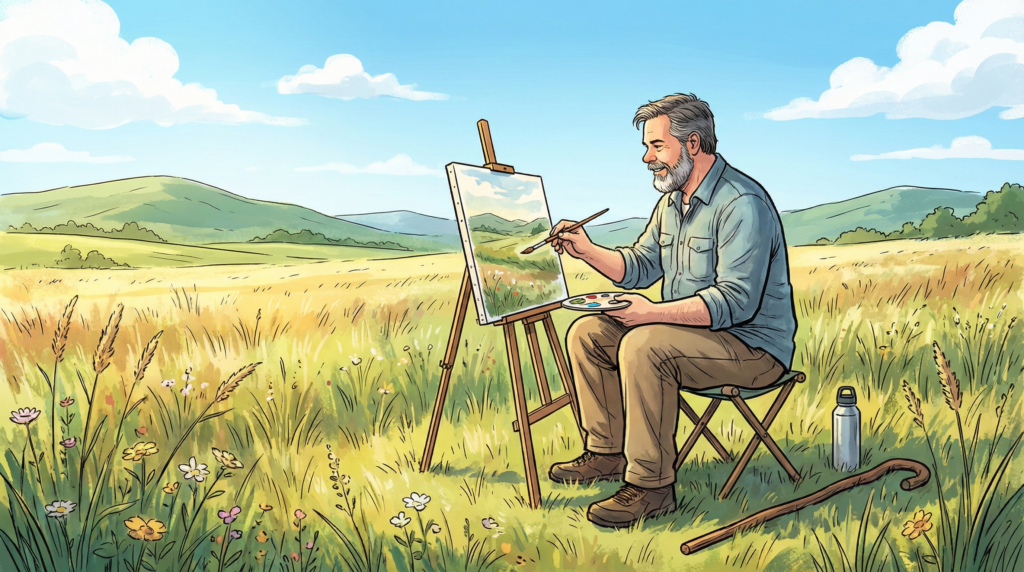
Ultimately, this period of life is a move from accumulation to distillation. It’s about taking the best of what I have—my intelligence, my skills, my community—and using them to build a richer life, not just for myself, but for the people around me. The future is no longer a blank slate, and that is a relief. It is a canvas with a beautiful, complex background already painted on it. My job now is not to start over, but to add the color.

