
There is a particular kind of quiet horror that accompanies the realization that progress is not a one-way street. For a generation raised on the techno-optimistic myth of the late twentieth century, the internet was supposed to be the ultimate library of Alexandria—an indestructible, infinite repository where humanity’s collective knowledge would be preserved, democratized, and permanently elevated. But knowledge, it turns out, is highly vulnerable to the shifting political and economic climates of the day. It can be dismantled and systematically erased just as easily by an administrative directive as it can by a physical match.
In the early 2010s, during the administration of Canadian Prime Minister Stephen Harper, a quiet purge took place across the nation’s federal scientific libraries. Decades of peer-reviewed climate data, fisheries research, and environmental history were abruptly decommissioned. To the public, it was framed as a modernization effort, an administrative consolidation designed to save taxpayer dollars by digitizing the records. But the digitization was a ghost protocol. In reality, irreplaceable data logs, some detailing baseline ecosystem metrics dating back to the nineteenth century, were tossed into dumpsters. In some instances, specialized research collections were literally burned in bonfires behind government facilities.1
The chilling nature of that moment did not just stem from the physical destruction of pages; it lay in the calculated refusal to let the information exist anywhere else. When private research institutions and university libraries stepped forward, offering to house, fund, and catalog the discarded data at their own expense, the state declined. The objective was not fiscal efficiency; it was the deliberate creation of an informational vacuum. It was a real-time manifestation of the warnings found in classic dystopian literature, a blurring of the lines between the enforced ignorance of Fahrenheit 451 and the engineered distraction of Brave New World. If you control the baseline of reality, you control what can be questioned. If the historical data no longer exists, the unfolding crisis cannot be proven.
This administrative arson occurred at the exact historical moment the digital world was committing itself to a different, more systemic kind of informational erasure: the birth of the hyper-optimized attention economy.2 While physical archives were being emptied into furnaces, the digital landscape was being paved into a frictionless, multi-lane highway designed for maximum velocity and zero depth. The symbol of this era became the 140-character tweet. Silicon Valley spent two decades engineering a smooth, un-graveled superhighway of content, optimizing for a state of perpetual acceleration where users could glide effortlessly from one distraction to the next. But when a road is perfectly smooth, the driver falls asleep. To keep the brain awake and processing ads, the platforms needed a continuous series of artificial jolts.
From its inception, short-form microblogging presented a fundamental design flaw that the market mistook for a virtue. It treated brevity not as an artistic constraint, but as an intellectual standard. To compress a thought into fewer than three sentences requires the immediate amputation of context, nuance, and historical baseline. You cannot explain a systemic economic failure or the multi-generational cause of a geopolitical conflict in a soundbite; you can only express identity, allegiance, or rage.
The attention economy discovered that human psychology responds predictably to friction. When an individual encounters a complex, challenging idea that contradicts their baseline assumptions, the brain experiences cognitive friction—a state of discomfort that requires time, reflection, and deliberate intellectual labor to resolve. For an algorithmic marketplace that monetizes the sheer volume of immediate clicks, cognitive friction is an economic disaster. If a user pauses to think, they stop scrolling. If they stop scrolling, they stop consuming advertisements.
The algorithms were therefore engineered to eliminate intellectual friction entirely, replacing it with the frictionless dopamine hit of the “hot take.” The hot take is information stripped of its mass. It is a highly volatile, instantly consumable particle designed to provoke an immediate emotional reflex. Because the digital ecosystem rewarded speed above accuracy, the cultural premium shifted away from the slow cultivation of expertise toward the rapid deployment of provocation. The person who could comment fastest, loudest, and with the most polarizing clarity became the apex predator of the digital feed.
This environment engineered a profound shift in public discourse. Nuanced policy debate was replaced by a permanent cycle of rage-baiting. Political leaders realized that they no longer needed to build consensus or articulate sophisticated solutions to complex socio-economic problems; they merely needed to dominate the daily feed. The micro-targeted meme became the primary unit of political currency. While the populace was kept in a state of fractured exhaustion by synthetic outrage, the actual machinery of governance withdrew into the shadows. Complex, far-reaching, and often deeply regressive legislative changes were quietly packed into thousands of pages of omnibus bills—colossal documents designed with the explicit understanding that a public raised on microblogs would never have the attention span or the time to read them.
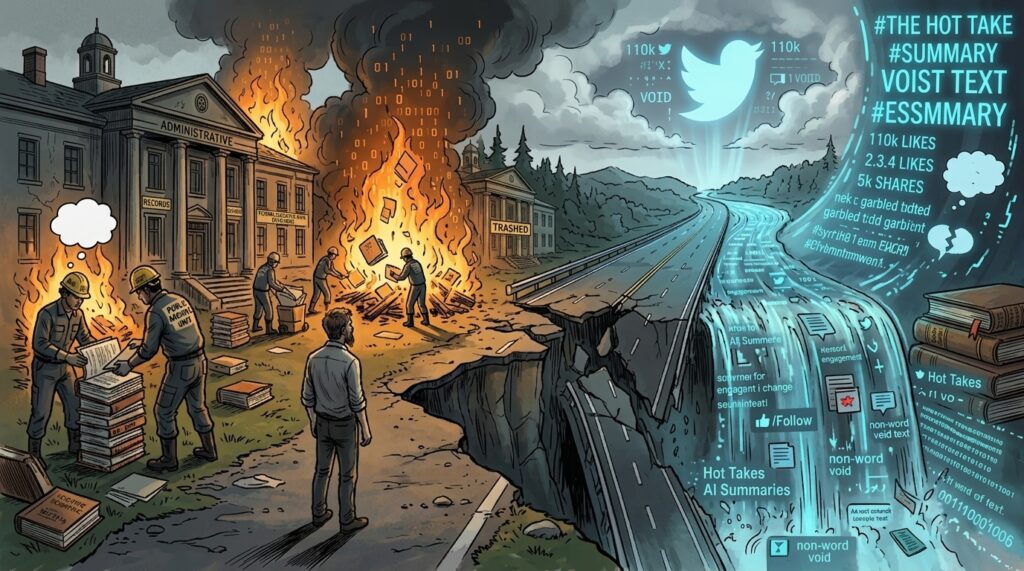
The transition of the platform into X did not mark a radical departure from this trajectory, but rather its cynical, terminal acceleration. The digital town square has degenerated into a colosseum where the loudest, most unverified assertions are amplified by financial design, while deep, evidence-based reporting is buried beneath the algorithmic fold. For those who always viewed the medium with a fundamental distaste, the descent was entirely predictable. The frictionless feed was never designed to inform; it was designed to exhaust.
Now, we have reached the saturation point. The ultimate irony of the attention economy is that its hyper-efficiency has finally broken the market. With the advent of generative artificial intelligence, the marginal cost of producing a superficial hot take has plummeted to absolute zero. The digital ecosystem is being entirely inundated by a tidal wave of clean, sterile, automated summaries and synthetic insights. These outputs are mathematically optimized to sound plausible, authoritative, and perfectly smooth, yet they are completely devoid of human perspective, original research, or experiential weight. They look like insight, but they taste like water.
When the market is flooded with an infinite supply of cheap, frictionless commodities, the value of those commodities collapses. In a world where anyone can generate a highly articulate, completely hollow summary of a complex issue in three seconds, superficial speed loses its status. The hot take is dead, suffocated by its own automation.
It is within this vacuum of exhaustion that a profound counter-movement is beginning to emerge. The rise of “Wisdom Flexing.”
The cultural currency is resetting, moving away from the fast-paced soundbite curators toward an intentional celebration of intellectual depth. Thinkers and readers alike are realizing that the only way to preserve human distinctiveness in an automated world is to rebuild the very things the algorithms tried to destroy: complexity, slow reflection, and intellectual friction. We are standing on the precipice of a shift from the Attention Economy to the Depth Economy, but as this new landscape forms, it brings with it an entirely new set of socio-economic fractures.
Intellectual sophistication and “nerding out” have replaced casual content consumption as the ultimate status symbols. In elite circles, books have shifted from mere reading material to high-end lifestyle signifiers; as marketing agencies have dryly observed, books are the new luxury handbag.3 The visible effort of carrying, reading, and citing an un-summarized text is the new mechanism for signaling
cultural distinction.
There is a quiet migration underway, visible only to those who look beneath the surface of the mainstream digital landscape. For years, the dominant cultural narrative insisted that younger generations were permanently broken by the attention economy—that their brains had been rewired into fifteen-second intervals of hyper-stimulation, rendering them incapable of sitting with a complex narrative or a prolonged argument. But if you observe where they are actually gathering, a different reality emerges.
In community spaces like The Ultimate Experience, a distinct generational decoupling is taking place. The youth are quietly abandoning the legacy colosseums of the attention economy. Platforms like Facebook have become digital ghost towns, avoided not merely because they are unfashionable, but because their architectural intent has become too transparent, too suffocating. Instead, there is a marked drift toward digital spaces that afford agency, anonymity, and depth: the conversational rabbit holes of Reddit, the un-algorithmic text of Substack4, and, perhaps most tellingly, the physical page.
Analog journaling has seen a massive, quiet resurgence. In an era where every keystroke is tracked, monetized, and predicted by a corporate large language model, the act of putting ink to paper becomes a small, radical insurrection. It is a deliberate choice to think in an un-indexed environment, to allow thoughts to be messy, uncurated, and completely private. This isn’t a random aesthetic trend; it is a profound psychological defense mechanism. The human soul can only survive in a state of hyper-reactive surveillance for so long before it begins to crave a sanctuary of silence.
This generational shift mirrors a broader, collective awakening on the global stage. After a decade marked by a reverent, almost fanatical celebration of populist ignorance—where institutional expertise was villainized as an elite conspiracy and international political networks like the Harper-led International Democrat Union quietly coordinated the systematic dismantling of progressive infrastructure—the pendulum is beginning to feel the strain of its own momentum. The world is waking up, slowly, to the structural hangover of Trumpism and institutional erosion. There is a growing, visceral pushback against the deliberate simplification of the human experience. People are realizing that running a globalized society on memes and conspiracy theories is like trying to fly a commercial jet using a comic book manual; eventually, gravity asserts itself.
Yet, it would be dangerous to mistake this current awakening for a permanent victory. The hunger for depth, though real and expanding, is currently colliding with the cold, unyielding mechanics of modern capitalism. We are not entering a seamless intellectual renaissance; we are entering a highly stratified information class system.
As the major corporate architects of the internet realize that the ad-supported, frictionless model is hitting a ceiling of collective burnout, they are rapidly shifting their business models. Meta’s pivot toward paid, ad-free subscription tiers is the opening salvo in a new form of cultural segregation. Information is no longer just being monetized; attention protection is being premiumized.
This economic reality splits society along a dangerous fault line. Intellectual depth, nuanced writing, and rigorous systemic analysis are increasingly retreating behind premium paywalls. To read a deeply researched, multi-thousand-word dossier on economic policy or environmental degradation now requires a network of monthly Substack and journalism subscriptions. The wealthy and the highly educated are creating a modern equivalent of the Enlightenment-era salon—a quiet, gated digital aristocracy where ideas can be weighed, debated, and contextualized away from the screaming masses.
Meanwhile, those who cannot afford to pay for multiple independent publications are left stranded in the ad-supported, free digital colosseum, where the algorithms continue to deploy automated loops of rage-bait and synthetic AI content to keep eyes glued to the screen.
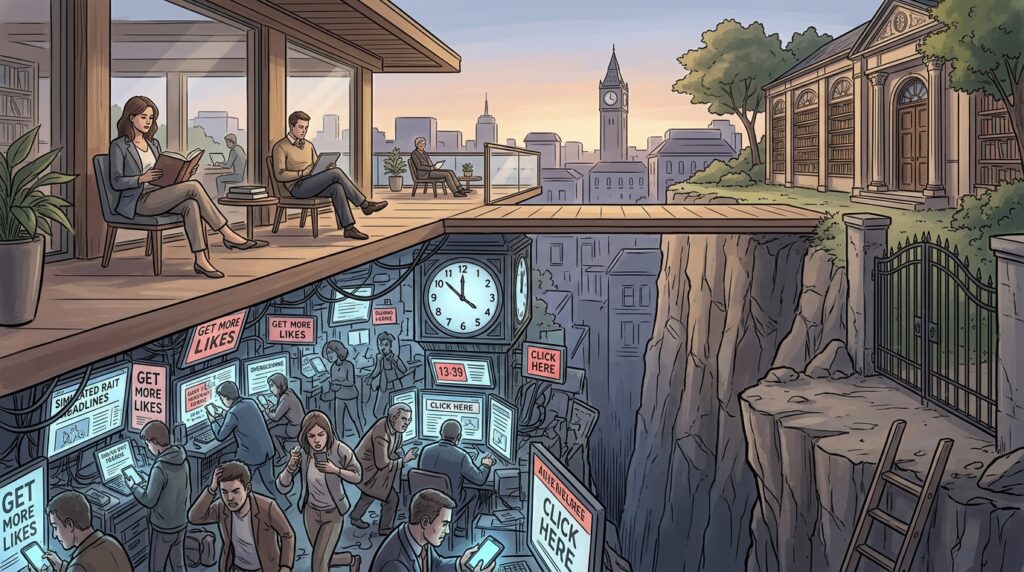
This brings us to the profound structural failure of modern Western democracy: a paradox that mirrors the limitations of the great nineteenth-century philanthropist Andrew Carnegie. When Carnegie funded the creation of thousands of public libraries, he did so under the noble, meritocratic belief that access to books would allow any working-class person to elevate their mind. It was a beautiful, intellectual dream, but it possessed a massive socio-economic blind spot.
A library card is entirely useless to a human being who has just spent fourteen hours performing backbreaking labor in a steel mill. When a body is physically broken and a mind is cognitively depleted by the grueling demands of survival, the capacity for deep, analytical reading is completely extinguished. Access to information was never the true bottleneck; the true bottleneck was, and remains, the luxury of time.
In the Depth Economy of 2026, time has become the ultimate luxury asset. The ability to sit undisturbed for two hours to read a systemic essay, to cross-reference citations, and to think deeply about structural causality is an economic privilege. The independently wealthy and the comfortable creative class have the luxury of focus because their survival does not require the continuous, exhausting fragmentation of their attention across multiple low-wage shifts.
The typical middle-class or working-class individual does not suffer from a lack of desire for depth; they suffer from an absolute deficit of cognitive bandwidth. When you are balancing a fluctuating gig-economy schedule, rising housing costs, and the relentless background anxiety of economic insecurity, your brain enters a state of chronic scarcity.
If Western democracy continues on this trajectory, the consequences will be terminal. We will have a society where the control of political outcomes is driven entirely by an attention-starved populace whose worldviews are engineered by free, algorithmic media, while the intellectual class sits in their expensive, paid ivory towers, wondering why the world outside their window keeps burning. The current generation’s craving for long-form text and analog journals is a beautiful, necessary pause, but without structural intervention, it will remain nothing more than a defensive bunker for the elite in a much larger, systemic war for the human soul.
There is a distinct, quiet isolation that comes with being labeled the “gifted kid” in a world built for the average of the curve. On the school playground, that designation rarely translates into popularity. Instead, it operates as a social marker of difference, an invisible wall that separates the intellectually curious from the social life of the peer group. To grow up with that identity is to become intimately familiar with a specific kind of social asymmetry: you are mocked for your eccentricities, sidelined during the easy, sunlit days of social play, and left off the guest list for the weekend party.
But a fascinating shift occurs the moment the environment destabilizes. When the playground dynamic fractures—when a complex dispute over rules threatens to derail a game, or when a crisis requires immediate, strategic problem-solving—the collective gaze of the group shifts instantly. The very peers who kept you at a distance look across the yard, searching for the quiet kid in the corner. In moments of genuine uncertainty, human beings possess a deep, evolutionary reflex that overrides prejudice: they look for competence. They turn to the person who has the baseline knowledge to fix what is broken.
The tragic pattern of this dynamic, however, is its transactional brevity. The moment the crisis is resolved, the machinery of the game repaired, and safety restored, the intellectual is gently but firmly ushered back to the margins. The gratitude is brief, the respect is silent, and the invitation to join the ongoing celebration never arrives.
This playground dynamic is not a localized quirk of childhood; it is the exact macro-political cycle that governs Western democracy on the global stage. For decades, modern societies have treated institutional expertise and deep intellectual rigor like emergency glass—something to be broken only in the event of a structural fire. When the economy is artificially buoyant and when wealth seems to generate itself without effort, the populace grows bored with complexity. They retreat into the entertaining, frictionless theatre of populism. They vote for the charismatic showman who deals in memes, easy scapegoats, and the comforting illusion that complicated global problems can be solved with a simple slogan. They celebrate a superficial, reverent ignorance because, in good times, ignorance feels entirely consequence-free.
Yet, just as on the playground, reality eventually breaks through the illusion. When inflation threatens to hollow out the middle class, when supply chains snap, or when the systemic institutions of democracy begin to buckle under the weight of their own corruption, the public mood shifts with remarkable speed. The crowd stops laughing at the performance. In moments of systemic terror, the collective instinct demands a return to gravity.
This is the point in the historical cycle where societies look past the populist entertainers and reach for the technocratic crisis-fixers. It is the moment a nation turns to a figure like Mark Carney—a thinker whose authority rests entirely on decades of calculated, un-flashy financial mastery—to steady a listing financial ship5. It is the moment the public craves the sweeping, articulate, and systemically grounded rhetoric of a leader like Barack Obama, whose prose reminds a fractured people that governance is an act of architecture, not a series of social media posts.
The true tragedy of modern history is that we have allowed this cycle to remain purely reactive. We have treated our brightest minds as societal mechanics rather than cultural architects. But as the collective exhaustion with the frictionless attention economy deepens, a brilliant, hopeful ray of light is beginning to pierce through the clouds. We are discovering that a transition back to an enlightened, information-backed society is not only possible, but that the seeds of that world have already been planted. They are growing in the spaces we least expected.
The hope lies in the realization that the public’s hunger for depth does not need to be engineered from scratch; it simply needs to be met with authentic, compelling infrastructure. The smart parts of the world are no longer waiting for traditional political systems to reform themselves; they are actively seeking out and building new spaces of intellectual celebration. We are seeing the rise of a new class of cultural leaders who refuse to compromise on complexity, and who are proving that long-form, deeply researched information can be a source of profound human joy.
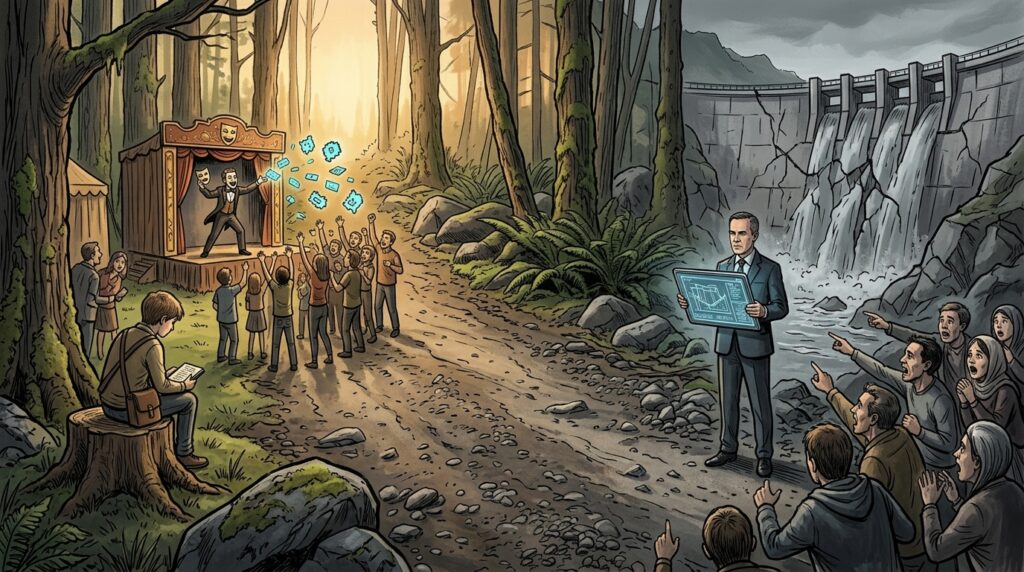
Consider the massive, unprecedented success of creators like Derek Muller of Veritasium or Cleo Abram of Huge If True. These are digital-era essayists who have completely upended the cynical myth that the modern audience has an incurable fifteen-second attention span. They take complex scientific dilemmas, multi-layered historical histories, and deep engineering concepts, and they present them to millions of viewers through long-form video narratives that refuse to skip steps. They do not summarize; they explain. They do not lower the cognitive bar; they invite the audience to stretch their minds to reach it.
Similarly, figures like Neil deGrasse Tyson have shown that science communication can be a form of mass cultural celebration. They demonstrate that “nerding out”—diving headfirst into the hyper-specific, elegant mechanics of the cosmos—can be transformed from a marker of social isolation into the ultimate status symbol of a mature culture. These creators are achieving something beautiful: they are dragging the intellectual class out of the back of the classroom and onto the main stage, making depth feel not like a cold, exclusionary chore, but like a thrilling human adventure.
The path forward toward a sustainable, enlightened society requires us to transform this emergent trend into a permanent cultural architecture. We cannot afford to remain a society that only values its deep thinkers when the house is on fire. If we wish to break the destructive cycle of populist decay and structural crisis, we must learn to celebrate, support, and actively promote the intellectual class during the quiet, prosperous times as well.
We must find these systemic voices, elevate them within our communities, and actively vote them into our institutions. But more than that, we must change the social terms of engagement. We need to drag the intellectuals to the party when things are good. We must create a culture where intellectual depth is integrated into the fabric of our daily celebrations, where competence is treated as a continuous public good, and where the preservation of baseline truth is recognized as the ultimate form of societal stewardship. The hunger for a return to gravity is real, and the leaders capable of guiding us there already exist; our collective task now is to ensure they are given the permanent custody of the room.
Authenticity has become the most embattled territory on the digital landscape. In an ecosystem where generative large language models can mimic the cadence of human vulnerability with terrifying precision, the genuine human voice is increasingly hard to isolate. This technological acceleration has created an strange, inverted psychological landscape. Those of us who have spent our lives thinking in highly structured, precise, and systemically analytical patterns now find ourselves facing a bizarre accusation: we are told we sound like the machines.
For a lifetime, a meticulous, deeply considered approach to language—one that prioritizes exactness, structural symmetry, and dense baseline data—was simply the marker of a rigorous mind. It was the way a certain class of thinkers, often isolated in their youth as “gifted,” naturally processed the world. But now that the statistical probability engines of modern technology have been trained to output text that is similarly clean, the world has a confusing time telling the difference. It is an ironic twist of cultural history: the world hasn’t necessarily lost its taste for structure; it has simply automated it so completely that when a human mind naturally operates with high-level precision, it is suspected of plagiarism. It feels, in some quiet ways, as though the broader culture is finally catching up to a way of thinking that used to be a source of personal isolation.
Yet, true authenticity possesses a distinct, un-copyable weight that eventually cuts through the synthetic fog. It does not survive through a stubborn refusal to touch modern technology, but rather through a fundamental clarity about where the thinking happens. When an essayist uses artificial intelligence not as a replacement for critical thought, but as a cognitive chisel—a digital editor that helps refine, tighten, and polished the prose while leaving the core architecture of the argument entirely human—the voice remains unmistakably alive. It is the modern equivalent of the traditional publishing house relationship, where a masterful human editor pushes an author to find the sharpest version of their own perspective without ever erasing the unique, flawed, soul of the creator. The authenticity comes through in the structural asymmetry of the argument, the unexpected leaps of logic, and the deliberate weaving of deeply subjective, personal histories through the grander macro-narrative. The machine can simulate the smooth surface of intelligence, but it cannot fake the blood and grit of a lived life.
Just as the environmental crisis gave rise to corporate green-washing, we are also witnessing the inevitable corporate co-opting of this aesthetic; a synthetic, automated version of human vulnerability. We see it in the meticulously engineered corporate memos where executives prompt an LLM to make them sound flawed but resilient, or in the calculated LinkedIn posts that use informal phrasing to simulate a soul. This is the performance of friction without any of the actual structural risk. True authenticity, however, looks entirely different. It is anchored in community-first stewardship and raw, un-curated transparency—the kind of leadership found in grassroots, mission-driven organizations where infrastructure is built out of a genuine sense of accountability rather than personal branding. True leaders do not use automated tools to outsource the struggle of thought; they use them like a publishing editor’s chisel, refining the delivery while keeping the core logic, the human errors, and the deeply subjective personal narratives entirely intact.
If we are to ensure that this human-led depth economy becomes a permanent renaissance rather than a fleeting luxury for the elite, we must pivot from cultural observation to systemic action. Creators and thinkers must intentionally throw gravel back onto the frictionless superhighway of modern content. We must build intellectual speed bumps—long-form essays, multi-layered narratives, and dense, challenging formats—that force the human mind to wake up and engage. But more fundamentally, we must pull the political and societal levers required to democratize the luxury of time, ensuring that the middle and working classes are not permanently locked out of this intellectual awakening.
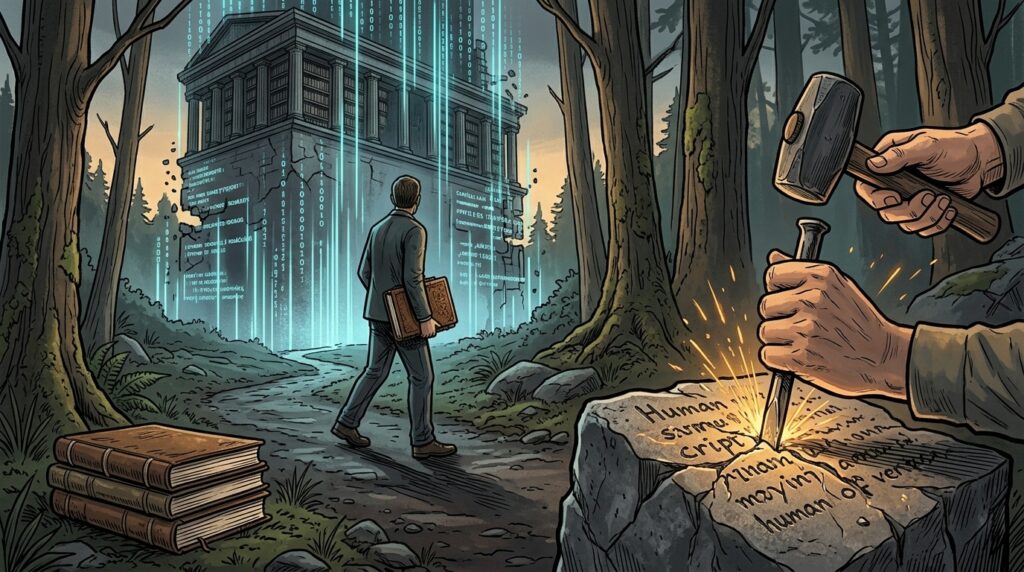
The first and most critical lever is the democratization of the work cycle itself. The widespread, global trials of the four-day workweek—most notably the monumental multi-country studies published in Nature Human Behaviour6—have fundamentally shattered the twentieth-century assumption that more hours spent at a desk equates to greater human value. The data reveals that reducing the workweek to thirty-two hours without a reduction in pay doesn’t just preserve economic productivity; it dramatically lowers chronic burnout and restores cognitive bandwidth. Giving an entire day of existence back to the individual is the construction of a modern public intellectual commons. It provides the literal hours required for a human being to rest their nervous system, step away from the hyper-reactive demands of survival, and engage with complex, systemic ideas.
Complementing this structural shift is the necessary rise of “Right to Disconnect” frameworks7, such as the evolving federal labor policies currently taking hold across Canada and the earlier foundational mandates within Ontario’s Employment Standards Act. These regulations represent a vital legal acknowledgement that human attention is a finite resource that must be protected from continuous corporate extraction. By establishing clear, legally protected boundaries around after-hours communication, society actively pushes back against the insidious bleeding of work into cognitive recovery time. They ensure that when a worker leaves their shift, their attention belongs to themselves, their families, and their minds—not to an incoming tide of automated algorithmic notifications.
Furthermore, we must reimagine public broadcasting and educational funding to support the creation of free, accessible, and deeply rigorous systemic media infrastructure. Just as the public libraries of the industrial era required state protection to remain free from commercial exploitation, the digital salons of the Depth Economy must be decoupled from the immediate pressures of the marketplace. We need to fund spaces where independent, long-form reporting and complex historical analysis are treated as public utilities, accessible to all regardless of income.
We stand at a critical crossroads in the history of human consciousness. The attention economy has run its course, leaving behind an exhausted, hyper-polarized world drowning in an infinite supply of cheap, automated soundbites. A revolution toward depth is actively forming, driven by a universal human craving to slow down, to think deeply, and to reconnect with baseline truth. But a revolution cannot survive if its participants are locked inside an ivory tower, separated from an attention-starved public by a wall of economic privilege.
Building an enlightened, information-backed society is an act of collective stewardship. It requires us to actively support the creators who refuse to simplify the world, to vote for leaders who treat governance as architecture, and to fiercely advocate for the structural labor reforms that protect human focus.
I have made my choice. I want to be an active part of this structural solution, leveraging whatever knowledge and skill I possess to help build the infrastructure of a deeper world.
Which leaves an open, quiet question for the screen before you: What side of the long-form revolution are you on?
- Reference: The 2013/2014 investigative coverage by The Fifth Estate (“Silence of the Labs”) or the public tracking by the Professional Institute of the Public Service of Canada (PIPSC) regarding the closure of the Department of Fisheries and Oceans libraries. ↩︎
- Reference: Herbert A. Simon’s foundational economic essay on information scarcity, or contemporary work by tech ethicist Tristan Harris (Center for Humane Technology) regarding algorithmic design and dopamine loops. ↩︎
- Reference: The Weber Shandwick cultural trend forecasting data (“Predicting the Unpredictable” framework), which formally identified the premiumization of depth as a counter-movement to generative AI content saturation. ↩︎
- Reference: Substack’s published milestones regarding reader subscription numbers, or industry overviews detailing the unexpected post-pandemic boom in independent, boutique print media. ↩︎
- Reference: Reference Mark Carney’s economic manifestos or his BBC Reith Lectures (Values: Building a Better World for All), which extensively critique how market values have crowded out human values. ↩︎
- Reference: The landmark peer-reviewed research papers documenting the widespread trials coordinated by 4 Day Week Global, Boston College, and Oxford University, which explicitly measure the massive drop in workplace burnout and the restoration of mental “work ability.” ↩︎
- Reference: Ontario’s Bill 27, the Working for Workers Act, which legally mandated that businesses with 25 or more employees establish clear, written policies regarding disconnecting from work outside of business hours to protect cognitive recovery time. ↩︎

