
A Road Trip Through Prairie Populism and Quiet Hospitality
If you only read Canadian political headlines, you would be forgiven for picturing Alberta as a perpetual frontier showdown. An austere expanse populated exclusively by disaffected partisans plotting an exit from Confederation, waiting for the signal to pull up the stakes and let the rest of Canada fend for itself.
Then you land in Calgary, rent a car, and get a haircut.
The man holding the scissors above my ears had arrived in Alberta five months prior from Sweden, drawn by cheaper rents and proximity to the Rockies. The young guy inspecting our rental car had recently moved out west from Boston. His supervisor, directing traffic across the Enterprise lot with practiced cheer, grew up in Kitchener-Waterloo. And later that afternoon, stopping for a late lunch in Canmore as the jagged silhouette of the Three Sisters loomed outside the restaurant window, our server brought our drinks and casually noted that his family was back home in Burlington, Ontario. Our Ukrainian speaking taxi driver who took us to the airport.
It became a running game on our trip for me to try to find someone working a frontline service job who was actually born in Alberta.
The province’s modern political narrative is constantly framed through the lens of deep-rooted regional grievance and separatist rumblings, portraying an insular struggle between “us” and Ottawa. Yet the people actually keeping the province running day to day that I met were an eclectic mix of recent arrivals from southern Ontario, New England, and Europe.
Alberta has always run on migration, from the original homesteaders who broke the prairie sod to the modern “Alberta is Calling” billboards enticing young professionals west. The irony, of course, is that the loudest populist and separatist voices rarely complain about newcomers who look like Swedish barbers or Ontario college grads. The grievance is selectively applied echoing a distasteful-yet-familiar brand of dog-whistle politics where otherness is invoked only when newcomers do not match a very specific cultural and racial blueprint of what an Albertan is supposed to look like.
Lawn Signs and Living Rooms
The disconnect between political theater and daily life became even sharper the moment we left the tourist corridors and drove through the towns and residential neighborhoods.
Along the roadside and hammered into lawns, the political temperature was visibly high. Slogans like “No to the 9” and vocal declarations of support for Canada stood planted in front yards, signaling fierce resistance to the separatist push and the provincial government’s institutional maneuvers. You could sense the weariness of residents who felt their province’s reputation was being hijacked by an ideological minority.
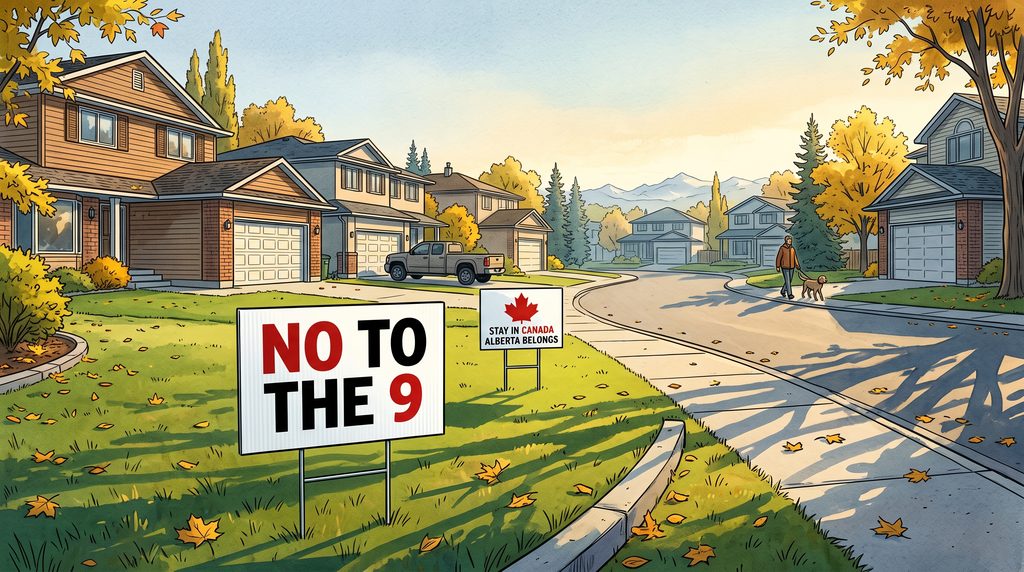
Yet whenever we struck up a conversation with locals who had lived in the province for decades, the posture was remarkably consistent. They were proud of their province, frustrated with Ottawa in that time-honored Western Canadian tradition, but almost universally dismissive of actual separation. They were not agitators spoiling for a divorce. They were pragmatic, neighborly, and distinctly, stubbornly, politely Canadian. In restaurant waiting lines, coffee shops, and trailheads, interactions were defined by an easygoing politeness that bore zero resemblance to the combative fury broadcast on the evening news.
Which raises the inevitable question, if the people living and working here are either mobile newcomers building a life or grounded locals shaking their heads at separation, how did the conversation become so radicalized?
The Faustian Bargain of Modern Populism
The disconnect between the kitchen tables of Canmore and the rhetoric of the legislature is not an accident. It is the natural consequence of a calculated political gambit that has infected modern democratic parties worldwide. It is the belief that to win, you must broaden your coalition by quietly courting the extremes.
In political backrooms, the math always sounds seductive. Why leave five or ten percent of the vote on the table when you can fold them into a “big tent”? In conservative politics in Canada we see this from the old Reform Party debates to the creation of the United Conservative Party. The playbook has been to wink at the fringe, indulge their anxieties, and promise them a voice in exchange for reliable turnout and ferocious volunteer muscle.
Historically, however, this strategy is an illusion. You do not absorb an ideological fringe; it absorbs you.
When mainstream parties welcome extreme factions into the fold, they do not moderate them. Instead, they grant them institutional leverage and credibility. The fringe does not quietly sit in the back rows grateful for the ride; it starts grabbing for the steering wheel. This isn’t new. The demise of the old ‘Progressive Conservative’ party of Brian Mulroney as it was consumed to form the modern ‘Conservatives’ is the same story. Yet, we never seem to learn. Premier Danielle Smith’s political balancing act is a live case study in this dilemma. By flirting with sovereignty bills, independence grievances, and referendum questions to secure the militant base, she walked directly into a classic pincer movement. Moderate conservatives and pro-unity Albertans view the dance with separation as reckless folly, while the committed separatists – now energized and demanding the real thing – view any eventual pivot to Canadian unity as a betrayal. In the end, the leader belongs to neither side: too radical for the center, and insufficiently revolutionary for the extremists they emboldened.
The Fortress of Party Discipline and the Mirage of Local Power
How did our system allow this dynamic to hijack legislative common sense? In civics textbooks, we are taught that we elect a local representative to be a member of parliament or legislative assembly and whose sacred duty is to carry the collective voice of their constituents to the capital. Yet somewhere along the way, that constitutional promise quietly dissolved. Today, Canadian party discipline is among the most suffocating in the democratic world, turning elected members into predictable, rubber-stamp voting machines choreographed entirely from the center.
That centralized stranglehold traces back directly to a deceptively dry bureaucratic tweak in 1970 under Pierre Trudeau, when changes to the Canada Elections Act granted national party leaders the exclusive legal authority to sign candidate nomination papers. Before that stroke of the pen, local riding associations decided who ran under their banner. Once the party leader held the veto, the internal calculus changed forever. After that change, any representative who dared to vote against the party line faced not just a quiet reprimand, but the immediate threat of being barred from the ballot at the next election.
At the very same time, politics mutated into a perpetual campaign orchestrated by hyper-vigilant central war rooms in the Prime Minister’s and Premier’s offices. The days when local representatives enjoyed broad regional independence were swallowed whole by 24-hour news cycles and digital messaging discipline. A backbencher speaking their mind or voting with their conscience ceased to be seen as a thoughtful community advocate; central strategists now treat any sign of independent thought as a public relations crisis that weakens the daily narrative.
Our voting mechanics only feed this fire. Under the unforgiving logic of first-past-the-post, a party doesn’t need to persuade a broad consensus of citizens; 38 percent of the popular vote is routinely enough to capture 100 percent of executive power. This creates a relentless incentive for central campaign machines to double down on polarizing wedge politics, stoking high-turnout base grievances rather than building wide, compromise-driven coalitions. To keep that narrow 38 percent coalition intact across competitive ridings, central enforcers demand absolute, unbending solidarity.
Even the way parties choose their leaders has ironically cemented this top-down tyranny. In traditional Westminster systems (used by at least a dozen countries including the UK, Australia, Canada, etc), party caucuses, who are the actual elected representatives, chose and replaced their own leaders, keeping them accountable to the room. When Canadian parties shifted to direct membership votes, the balance of power decisively broke. Leaders could suddenly claim a personal mandate from tens of thousands of grassroots members across the country, effectively elevating themselves above their own caucus. Rather than serving at the pleasure of their fellow parliamentarians, the leader became an untouchable executive, reducing local representatives to subordinates who must toe the line or face the wrath of the party apparatus.
It is this institutional wall that makes the recent outrage over floor-crossing so revealing. When party discipline is absolute, crossing the aisle becomes the only remaining pressure valve for an elected official who refuses to surrender their principles. Decades ago, representatives could openly push back and vote against their party on specific issues without having to tear up their membership card. Today, because internal dissent is treated as treason, an MP who genuinely objects to the party’s direction is left with an impossible binary choice to capitulate in silence, or walk across the carpet.
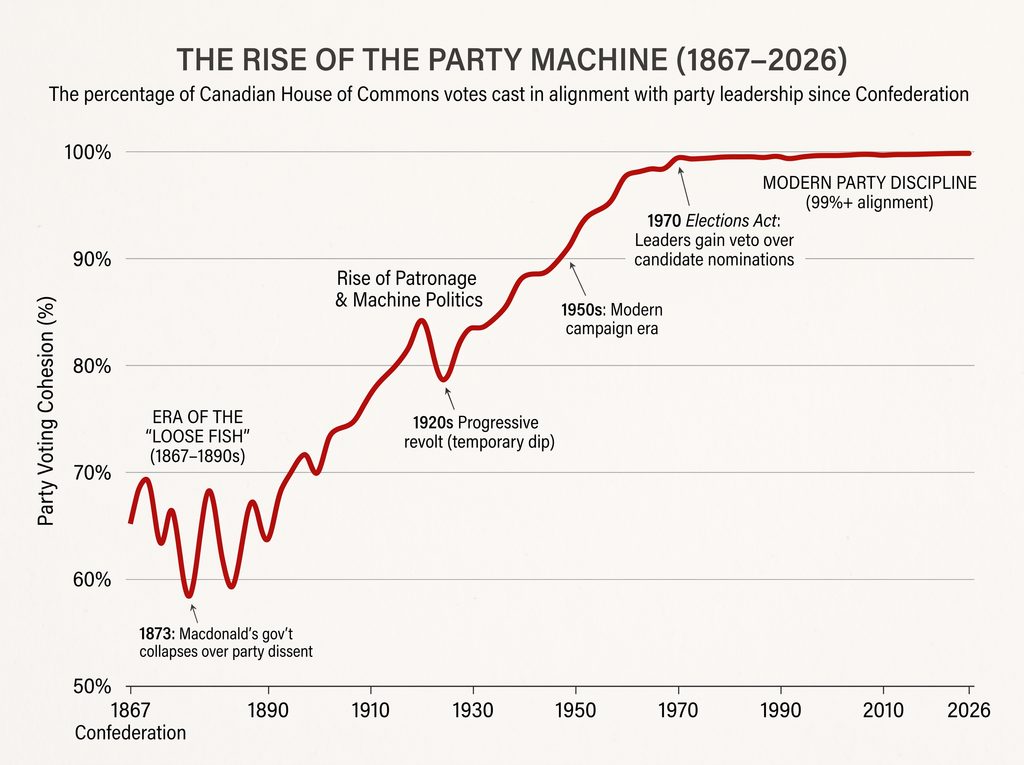
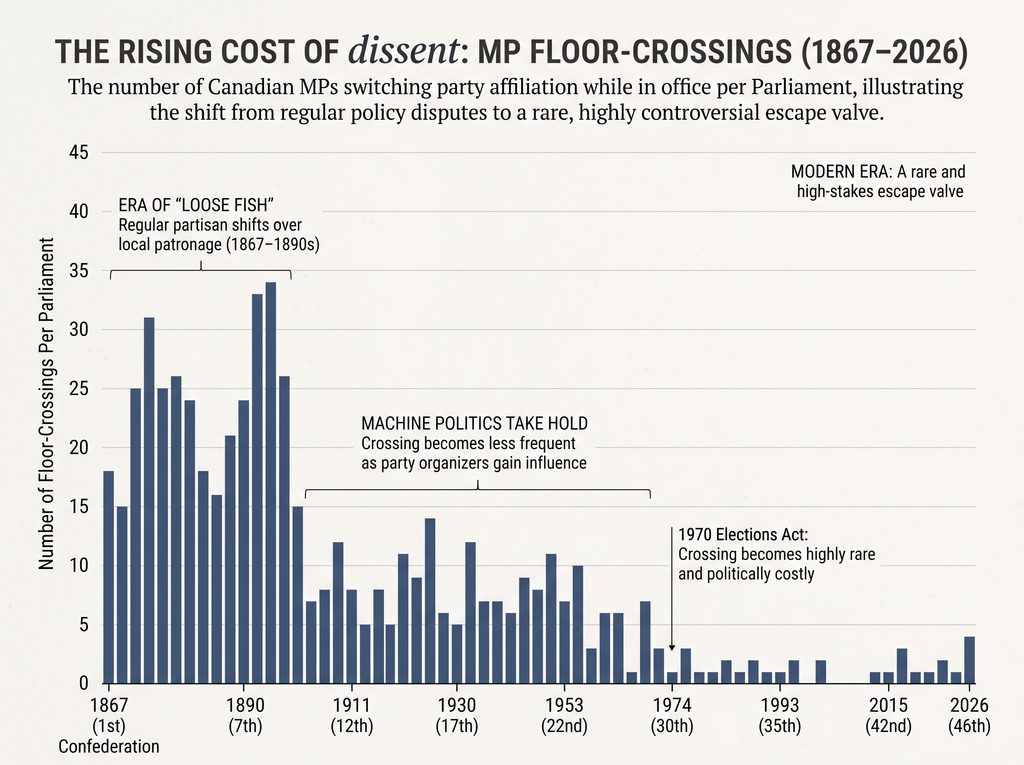
The entire machine has evolved to suppress nuance and enforce ideological purity from above leaving the everyday decency, quiet pragmatism, and welcoming spirit of the real Alberta stranded outside the legislature doors.
Reclaiming the Ground Beneath Our Feet
Leaving the foothills behind on the drive back to the airport, it was hard to shake the feeling that we are living through an enormous political mirage.
If you consume only the daily dispatches of party war rooms and social media skirmishes, it feels as though the country is perpetually coming apart at the seams. Yet the ground tells an entirely different story. Out in the real world – in the barbershops, the rental lots, the bustling lunch sports beneath mountain ridges – the fabric of daily life remains woven from quiet generosity, hard work, and open doors. The people keeping Alberta moving forward are not plotting an ideological secession. They are simply busy building lives, raising families, and treating their neighbors with the unpretentious warmth that has defined this country for generations.
The crisis we face is not a deficit of neighborliness among ordinary Canadians as much as it is a structural failure of our democratic architecture. When a political machine rewards parties for courting fringe grievances to manufacture a 38-percent majority, and when party leaders hold an ironclad veto over the conscience of their elected members, representation ceases to be a dialogue. It becomes an extractive industry, turning genuine local concerns into fuel for endless wedge politics.
If we want to close the chasm between how we govern and how we actually live, the repairs must begin with the machinery itself. We need to dismantle the imperial control of the central party offices, returning the power of candidate nomination to local riding associations so representatives answer to their neighbors rather than their leaders. We need voting systems that force politicians to build broad, consensus-driven coalitions rather than pandering to vocal, radicalized margins.
Most of all, we need the collective humility to stop mistaking the noise of the partisan arena for the pulse of the country. The future of Alberta, and indeed Canada, does not belong to the ideological combatants shouting into microphones in Edmonton or Ottawa. It belongs to the Swedish barbers, the Ontario transplants, and the lifelong locals waving from front porches beside lawn signs that quietly insist on staying together. They have already figured out how to live side by side in decency and good faith. It is long past time our politics learned to do the same.

